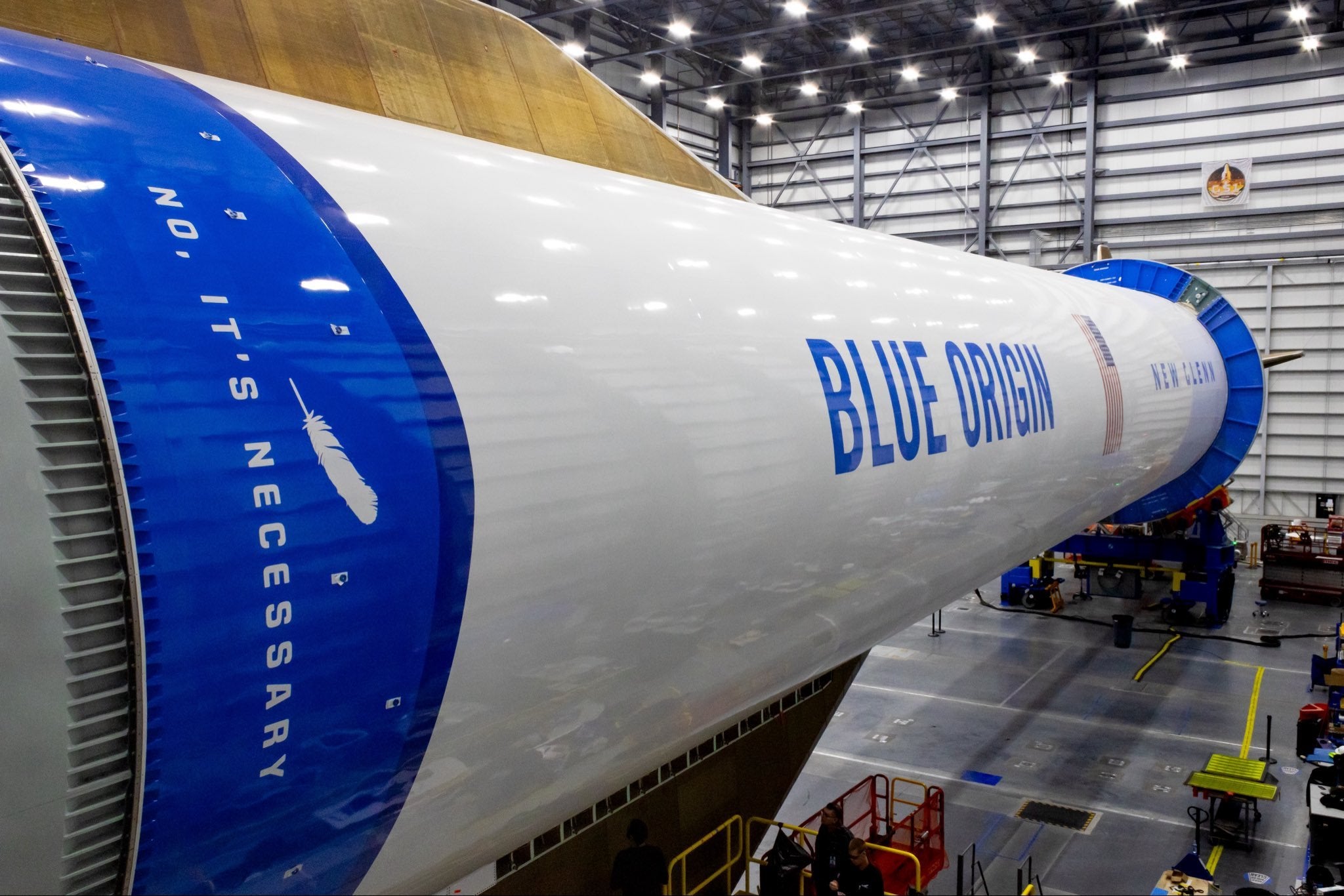
Blue Origin’s New Glenn rocket faces a major setback after an explosion on the launch pad at Cape Canaveral on Thursday evening.
This explosion will likely impact timelines for the rocket’s customers Amazon Leo, AST SpaceMobile, NASA, and its national security certification for the U.S. Space Force.
The New Glenn rocket was going through a hotfire test ahead of its first mission for Amazon Leo, when a massive explosion took place. It was captured on video by Spaceflight Now. Blue Origin confirmed in a statement there was an anomaly during the hotfire test, and confirmed personnel are safe.
“All personnel are accounted for and safe. It’s too early to know the root cause but we’re already working to find it. Very rough day, but we’ll rebuild whatever needs rebuilding and get back to flying. It’s worth it,” Jeff Bezos, founder and owner of Blue Origin, said in a statement.
Images from Launch Heaven Media taken on Friday during the daylight show extensive damage to the launch pad and tower.
Blue Origin CEO Dave Limp said Saturday that Bue Origin regained some access to Launch Complex 36 and the investigation is underway. “We will start clearing the pad soon and have a good rebuild plan in place. The booster and GS2s in the integration facility appear healthy from quick looks,” Limp said.
At this point, Blue Origin has not shared more about the cause of the incident and the road ahead to restore the launch pad and return New Glenn to flight.
The Amazon Leo satellites were not on board during the test and had not been integrated with the rocket. The satellites are currently at Amazon’s processing facility at Kennedy Space Center, Amazon confirmed to Via Satellite
This issue comes just after New Glenn was cleared to return to flight after its last mission didn’t go as planned. Just over a month ago, a New Glenn launch placed an AST SpaceMobile satellite into the wrong orbit, losing the satellite as a result.
The FAA had just closed its mishap investigation into the April mission on May 22, identifying a cryogenic leak that froze a hydraulic line, causing a thrust anomaly. Blue Origin identified nine corrective actions in the investigation.
In the case of Thursday’s issue, the explosion will not trigger an FAA investigation because it was a test activity, not a launch. The FAA said in a statement that the test was not within the scope of FAA-licensed activities, and there was no impact to air traffic.
New Glenn made a successful debut launch in January 2025 and had a much-celebrated booster landing on its second mission last year. The rocket was expected to alleviate some of the scarcity in the launch market.
Its customers include Amazon’s own constellation Amazon Leo, which is racing to get its satellites into orbit in order to start service this year. Amazon Leo is working with multiple launch providers and launched a new batch of satellites on Friday evening with a United Launch Alliance (ULA) Atlas V mission.
After the recent failure, AST SpaceMobile leaders were optimistic about New Glenn returning to the launch pad and continuing to work with Blue Origin.
Both Amazon and AST SpaceMobile have emphasized using multi-launch provider strategy. New Glenn makes up less than 25% of Amazon Leo’s planned launches.
New Glenn was also in the process of being certified to fly National Security Space Launch (NSSL) missions for the U.S. Space Force. Last year, Space Systems Command awarded Blue Origin nearly $2.4 billion for an expected seven missions in Phase 3, Lane 2 of the NSSL program.
SSC happened to award Blue Origin a launch task order just ahead of the anomaly. SSC awarded Blue Origin a Phase 3 Lane 1 task order for a mission for the National Reconnaissance Office (NRO), set for the fourth quarter 2027 and first quarter 2028. NSSL certification is not required for Lane 1 missions, SSC said.
“This anomaly is a solemn reminder that the critical capability this community provides is rocket science and inherently challenging. The National Security Space Launch program will continue working closely with our Blue Origin partners to help identify the root cause and implement corrective actions,” U.S. Space Force Col. Eric Zarybnisky said in a statement.
For NASA’s Artemis program, New Glenn is the planned launch vehicle for Blue Origin’s Blue Moon lander, which is one of two options for NASA’s human landing system. And just this week, as part of its Moon Base plans, NASA announced a Blue Moon mission to land on the Moon no earlier than fall 2026 to deliver NASA payloads.
NASA Administrator Jared Isaacman said in a statement that NASA will provide information on impacts to Artemis and Moon Base programs as it is available. Isaacman traveled to Launch Complex 36 over the weekend with senior NASA engineers to survey the damage at the site, saying NASA is committed to helping Blue Origin recover.
“Spaceflight is unforgiving, and developing new heavy-lift launch capability is extraordinarily difficult. We will work with our partners to support a thorough investigation of this anomaly, assess near-term mission impacts, and get back to launching rockets,” Isaacman said.
This story was updated on May 31