The field of companies eligible for National Security Space Launch (NSSL) Phase 3, Lane 1 awards is now at seven after U.S. Space Force‘s Space Systems Command (SSC) awarded two entrants, Impulse Space and Relativity Space‘s Relativity Federal subsidiary, $5 million firm fixed price task orders for risk and capability assessments.
Space Force Col. Eric Zarybnisky, the service’s acting portfolio acquisition executive for space access, said in a statement that the addition of launch providers “is critical at a time when our launch cadence is rapidly increasing and our customers are relying on us to deliver everything they need to provide for the security of our nation and allies.”
“We have numerous upcoming missions that the Lane 1 launch providers will be able to compete for as soon as they’ve successfully launched at least once,” he said.
Redondo Beach, Calif.-based Impulse Space has developed orbital transfer vehicles, but not primary launch rockets. Aerospace engineer Tom Mueller founded the company in 2021. Mueller was the first employee at SpaceX in 2002 and helped develop the Merlin engine that powers SpaceX’s Falcon 9 rocket.
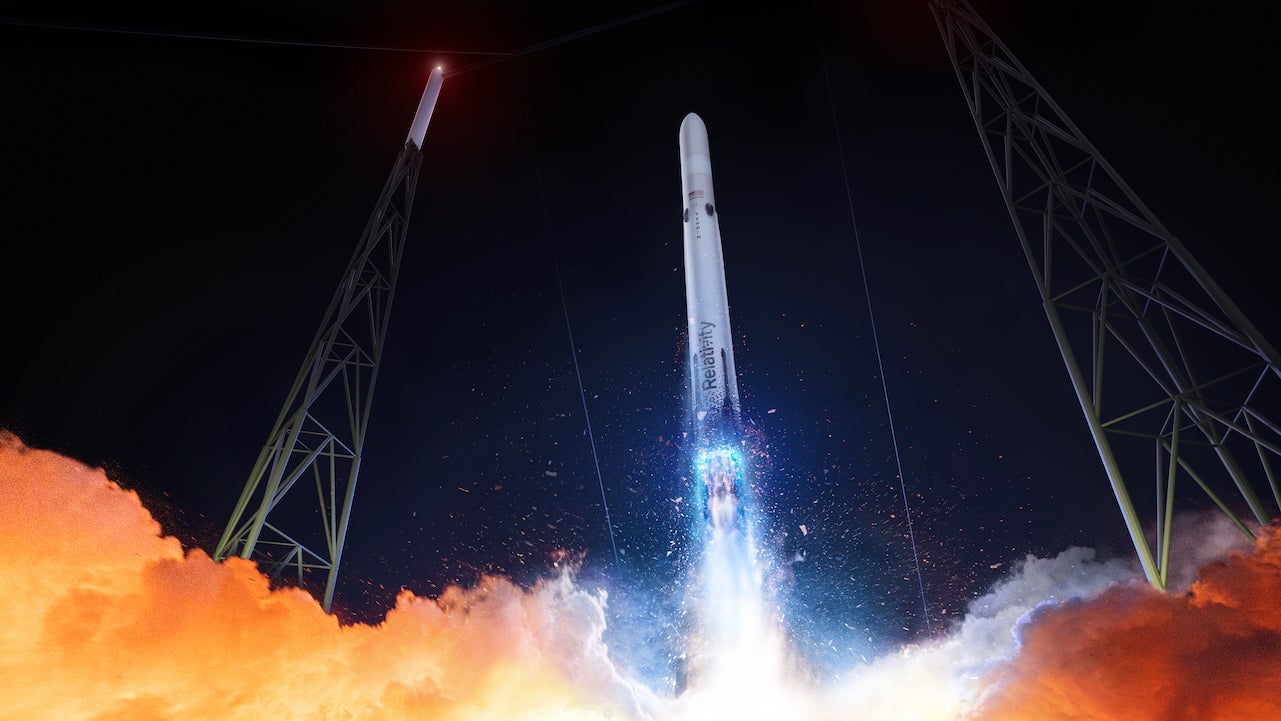
Founded in 2016, Long Beach, Calif.-based Relativity Space has developed the Terran R, what the company has billed as a reusable medium-to-heavy-lift rocket. Eric Schmidt, former head of Google, became Relativity Space’s CEO last year.
NSSL Phase 3, Lane 1 is for launches involving non-critical payloads, such as Space Development Agency satellites, while NSSL Phase 3, Lane 2 is for launches related to “assured access and the highest reliability for our most demanding, least risk-tolerant payloads,” according to SSC.
In 2024, SSC awarded SpaceX, Blue Origin, and United Launch Alliance (ULA) an umbrella contract worth up to $5.6 billion for Phase 3, Lane 1 of NSSL.
In January, SpaceX received $739 million in nine task orders for Phase 3, Lane 1. Curiously, as it does not appear that they fully relate to “non-critical payloads,” those task orders were for Space Development Agency and National Reconnaissance Office satellites.
The nine launches of SDA and NRO satellites are to start late this year and end in fiscal 2028.
In March last year, Stoke Space Technologies and Rocket Lab USA became eligible to receive Phase 3, Lane 1 task orders under the $5.6 billion umbrella contract.
Stoke Space is developing its Nova rocket for national security certification in order to compete in NSSL, while Rocket Lab plans to offer its 13-ton Neutron reusable rocket for payloads up to 13,000 kilograms. Stoke Space has said Nova will boost 3,000 kilograms to low-Earth orbit in reusable mode and up to 7,000 kilograms otherwise.