In this new era of space defence, Germany has been making a lot of headlines as it looks to ramp up its capabilities. Germany’s security also came into a sharp focus with the recent drone attack on Leipzig airport that has been linked to Russia. Recently, at a GovMilSpace digital event, Via Satellite spoke to a number of key stakeholders about Germany’s intentions when it comes to space defense, both to protect its Eastern flank, and work in a pan-European context.
Commander of German Space Command, Maj. Gen. Michael Traut told Via Satellite that the Russian threat is real, based on recent analysis, as well as the public statements of Germany’s political and military leadership. “Our chief of defense says on a regular basis that all intelligence points towards a date somewhere in 2029 that Russia would have built up enough capabilities to launch a serious attack towards NATO,” Traut said. “It may not look to over-run NATO, but perhaps to test NATO’s coherence. This is something which needs to be deterred from the outset. Germany has now really realized the strategic necessity of a strong defense.”
The importance of space in this new age of warfare cannot be under-estimated. The last five years have shown that space is now front and center in many different ways. Traut says some people argue that the war in Ukraine started with Russia’s cyber attack on Viasat. He also pointed to the phenomenon of Maxar imagery of the long Russian convoys advancing into Ukraine, saying it shows the “huge impact” of space technologies.
“Our focus lies on defending and protecting every square inch of NATO territory at our Eastern flank, so we need to emphasize our reconnaissance capabilities and our communications capabilities. We need to make sure that our forces are protected from the effects of our potential adversary space capabilities. Space is really, really important in defending NATO’s eastern flank, and we have already started to invest a fair amount of resources into strengthening capabilities which are immediately linked to that,” Traut said.
Space as the Fifth Domain
It can be argued that there are now five military domains where modern conflict takes place. The first three — land, air, and sea — are the traditional ones. The fourth one is the new cyber domain. There is now a fifth domain – space, which is the latest domain where conflict will take place. “You need to be able to deter and defend in space as well, and that makes it so important for our Eastern flank,” said Traut.
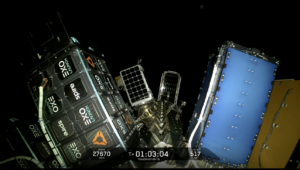
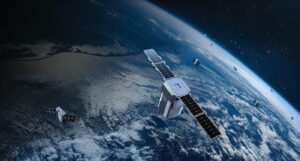
In late 2025, in recognition of this, Rheinmetall and Iceye were tasked to supply the German Armed Forces with space-based reconnaissance data via exclusive access to a synthetic aperture radar (SAR) satellite constellation. “This will provide very close to real time satellite imagery for the deployment of our Armed Forces in the Baltics, predominantly around Lithuania, for example. We need to have a good idea on the situation there,” said Traut. “We realized due to the events happening in the Baltics and on the Eastern flank right now, such as interference, jamming, the attempt to mitigate the effects of our space capabilities, this means we need to protect and defend these capabilities as well.”
Juliana Süß, associate for Stiftung Wissenschaft und Politik (German Institute for International and Security Affairs) who spoke on a panel about space investment in defense echoed Traut’s points here. Süß said that space capabilities are underpinning the defense capabilities that Germany now needs.
“ISR capabilities are becoming an increasing part of modern warfare. ISR, but also communications, the ability to communicate with ships, with planes, with further deployed troops. It is also a really critical capability.”
Süß said there is now a new threat environment, and to counter this Germany now needs a massive build-up of personnel as well as more modern capabilities. Süß pointed to the fact that German Defence Minister Boris Pistorius committed 35 billion euros ($40.6 billion) over the next five years to space defense. This is a major step change to what we have seen before.
“It is a very ambitious timeline with a lot of money entering the system now. That is the overall context that we have to view all of this in. There is a renewed focus on space that I don’t think we have really seen anything quite like this in the past,” she said.
There has been a kind of lightbulb moment in Germany where Traut said the nation has realized not only the necessity of a of a strong and robust defense, but also the need of having significant space capabilities. That realization extends far beyond the military capabilities. “It is the necessity of having a prosperous and economically self-sustaining space industry as well, a broad and capable economical basis for space, and of course resilience in space capabilities as well,” he added.
Süß said that space services can no longer be taken for granted, marking another shift. “I think there was always a sort of space was taken for granted attitude, maybe at times because it typically worked. We have used space services as building the base to defense capabilities since the early 1990s. However, it was never under threat to the same extent as it is now. This is part of our learnings from the war in Ukraine. It can’t go unnoticed now.
Risk and Innovation Cycles
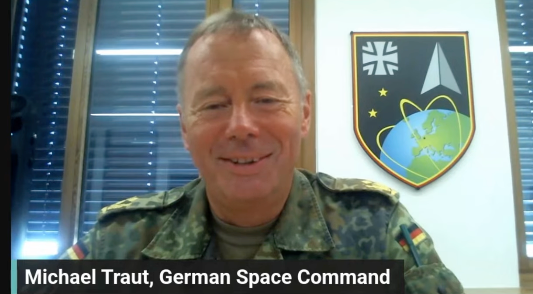 One of the interesting things about the conflict in Ukraine is how it has upended previous overarching defense strategies when it comes to building up capabilities. Traut talks about how paradigms have significantly changed here. Traut says Germany now has the money, resources for defense, a significant and growing space budget. The one thing it does not have is time, and now must take a different approach towards risk. “We need to change, and that is already a lesson learned. We need to change our culture from risk adversity into risk management. This goes into not only for governmental units like a procurement office or like a military unit, but this risk has to be shared between governments and industry as well.”
Ukraine has shown the example of rapid innovation cycles. Traut says Germany has come from a culture where defense, especially in space in Germany, was not taken as seriously as it is today.
“What are the consequences from that? If you do not have a lot of resources, i.e. money, and you have a lot of time because of the absence of a threat perception. What do you do? You try to spend every euro very, very carefully. You set up some cross-check and double-check mechanisms, and you try really to avoid mistakes by all means, and this led to a culture of risk aversity, not only in the military but in procurement in many structures,” he said.
When looking to improve innovation cycles in Germany, Ukraine has set the standard.
“If you look at the Ukraine scenario right now, you have innovation cycles — not necessarily in space, but in other means — run by weeks or months instead of years,” said Traut. “We need to be able to keep that pace, and I see that with a diverse and competitive industry landscape. It is more probable that we would be able to keep that pace, rather than having only just one to two big primes doing their business over here. You need economic power. This is absolutely right. You need large scaling and production know-how. That is also right. But I would like to include the innovative power of young and risk taking companies, and hence we to want to distribute our investments to foster that.”
The clear emphasis is that Ukraine has taught the world to invest quicker, build faster, take more risks, as the war domain simply won’t wait. Germany is already making changes which means it should be able to procure leading edge space technologies faster. Normally, the German Armed Forces (Bundeswehr) procure military equipment through its Armed Forces procurement office, which Traut says has a very complex, if effective procurement process with a huge number of potential specifications.
“Now, we tend to give some projects to our German Space Agency, which has better opportunities to take some risks and to set up some prototypes and experimental solutions at a quicker speed than we would be able to materialize this with our normal procurement process. We are already trying to make all opportunities available to us in order to acquire capabilities more quickly than before,” he added.
Making a Statement
Germany’s increased investment in defense and space is setting the tone in Europe. It is a huge statement of intent. Giulia Pavesi, lead for Security and Defence at the European Space Policy Institute (ESPI) said on the space investment panel this massive investment by Germany can be seen as a “positive signal” and shows that Germany is ready to take up a bigger role also in reacting to these geopolitical shifts and to these evolving trade landscapes.
Working with European partners here is a key as Germany shapes a new landscape and new supply chains here. Pavesi highlights how Germany could structure new partnerships with other European countries. “We have seen it already with leading German industrial players in defense venturing into the space domain with industrial partners from Finland or Poland. One question here is how Germany can structure at the industrial level this engagement with other European partners?”
Anjali Ramachandra, vice president of Strategy & Business Development for German spacecraft manufacturer Reflex Aerospace, said that previously there had been a high dependency on the U.S. especially in intelligence, surveillance, and reconnaissance (ISR) capabilities.
“The biggest area that Germany is focusing on now is on space-based capabilities and making that as sovereign as possible,” she said. “A lot of the procurements are focused on how do we ensure that the components, the key systems, the key capabilities are coming from Germany first, and then expanding within Europe, and really looking at creating that ISR infrastructure.”
Ramachandra said it is no longer just about the satellites, but the entire infrastructure going from space to ground to the integration and the fusion of the data, and making sure there is actionable intelligence. However, while this is important, strong partnerships are still key.
“It is important that we do not forget that there are exceptional technologies elsewhere, including the United States. If God forbid, war does actually break out across within Europe because of Russia, I think it is important that we do not lose sight of the capabilities that are out there, while in parallel building that capability in-house. When you are faced with a near-term threat, it is important to not get only focused on building in-house, but also making sure that you have what you need when you need it to be able to go solve problems,” Ramachandra added.
A Lot of Room for Improvement
Süß, Ramachandra, and Pavesi assessed the relationship between the German government and commercial space industry on a score of one to 10 — with one being not very good and 10 being excellent. Süß and Ramachandra gave a score of 5 out of 10, with Pavesi giving it a 6. All implied by these scores there was a lot of room for improvement. “There is a level of trust that still needs to be built with the government and with the military and other organizations. I do not believe that we have actually got there yet. We are working towards it,” Ramachandra said.
Süß said both sides share a frustration with the current processes in place. “There is a lack of trust at points, that is underlying some of these processes. So, my score of five out of 10 indicates that there is motivation to change. Things are being put into place to improve processes. However, there is a lot of room for improvement. I think some shift has already taken place, whereby I think commercial space is seen as more as part of the solution to defense space capabilities as well. The sort of space as a service shift as well. Ultimately it is going to take time, and I do not think money alone will solve the situation.”
In the fireside chat, Traut spoke of how the landscape of the space industry in Germany and in Europe, has predominantly been state-driven or governmentally driven, and that is now changing. He added, “The industry, more or less in broad terms, lived from governmental products and projects, and what we need to do now is something which might have been taking place in the United States for already 15 years, a kind of industrialization and commercialization of space.”
The changing geopolitical environment and the threat from Russia means it is now necessary to spark some industrial activity and commercial products by giving some investment by the state’s budget and the military budget into an emerging and diverse space industry, encouraging innovative processes and encouraging the build-up of more capability, according to Traut.
Building a strong over-arching space industry remains the fundamental goal here. “The big challenge and the big issue is actually to acquire enough growth capital and growth potential in order to have a self-sustaining space industry. This is where the anchor customer, the governments, which we would be one of those, can just buy something from off the shelf because the market is large enough, being able to serve commercial needs and commercial products as well,” Traut added.
In mid-July this year, German Space Command celebrated its fifth anniversary. It has been a time of change over the last year. The German government published its space safety and security strategy in the last 12 months and there is a feeling that Germany is at an inflection point for space and defense. “Our growth has been very moderate until last year, and now we feel that the intensity of our growth is really stepping up,” Traut said. “That is something that makes us who have been working in and for space for quite a long time already, satisfied and excited. We are looking forward to shape the next couple of years in space.” VS
[Germany’s push to get space capabilities into service faster speaks to a challenge shared across allied nations, one that will bring government, military, and industry leaders together at GovMilSpace 2027, March 8–11 in Washington, D.C.]