Update: SpaceX launched the SDA mission on Thursday afternoon from Vandenberg at 4:33 p.m. ET.
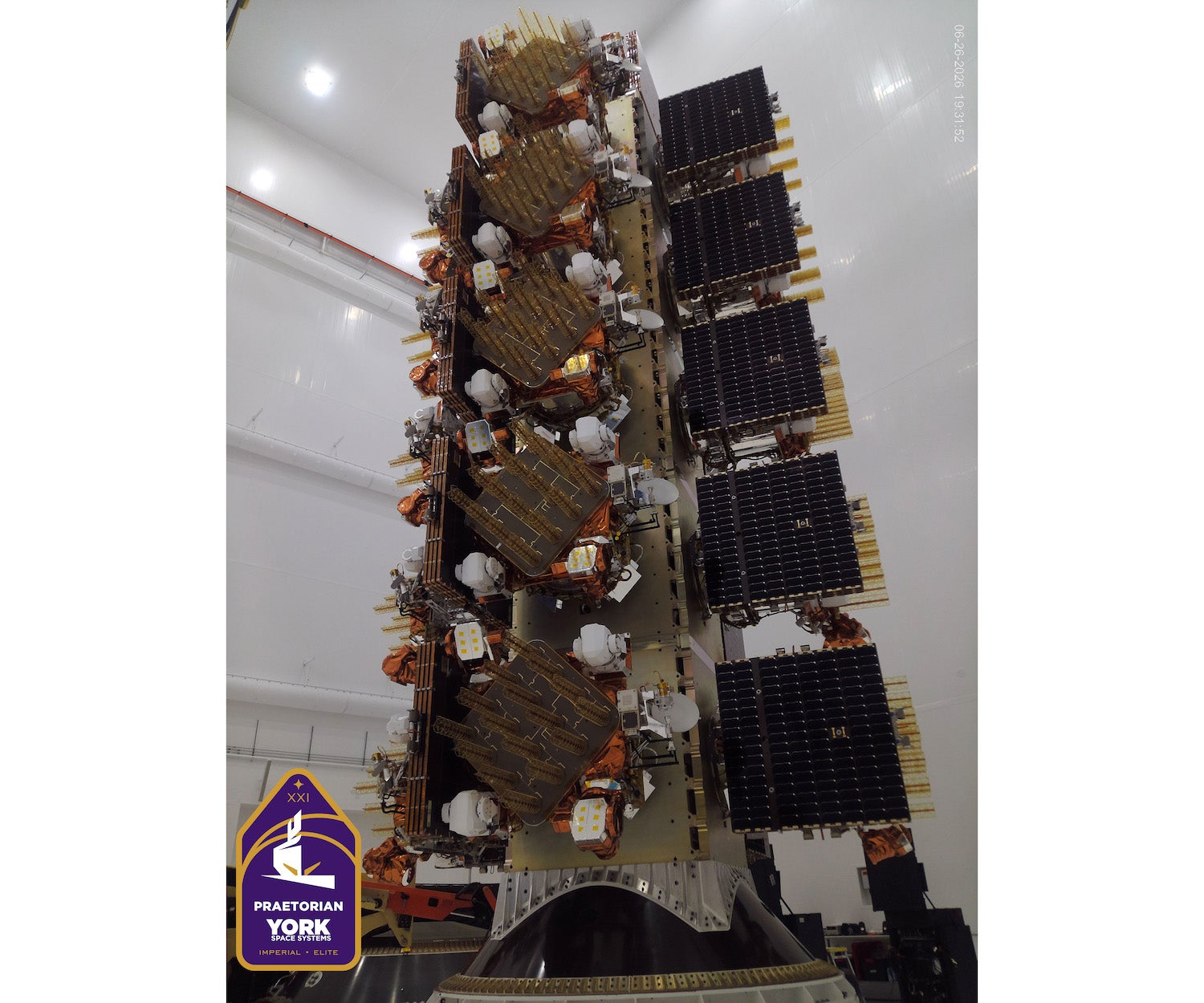
After a nine month pause in launches, the Space Development Agency (SDA) on Thursday plans to launch the next plane of 21 York Space Systems data transport satellites into orbit as it attempts to rebuild momentum to build out the Proliferated Warfighter Space Architecture (PWSA).
The launch aboard a SpaceX Falcon 9 rocket is slated for 4:32 p.m. EDT from Space Launch Complex 4 East at Vandenberg Space Force Base, Calif. SpaceX plans to land the first stage booster on its recovery ship in the Pacific Ocean.
The launch of York’s Tranche 1 (T1) Transport Layer spacecraft will mean half of the planned constellation of data transport space vehicles in the initial tranche will be on orbit, giving warfighters’ “real capability,” SDA Director Gurpartap “GP” Sandhoo told reporters on Tuesday evening.
The Transport Layer satellites are equipped with Link 16 tactical data link capability and optical communications terminals. They are designed to function within the PWSA by transmitting data collected by the soon-to-be launched Tracking on advanced and hypersonic threats to warfighter as quickly as possible, Sandhoo explained.
If Thursday’s launch is scrubbed, the next launch window is on Friday.
Last September, SDA launched York’s first 21 T1 data layer satellites followed in October by 21 Lockheed Martin T1 transport spacecraft.
SDA originally planned to maintain a monthly launch cadence for the entire T1 constellation, which will consist of 126 Transport Layer spacecraft, 28 Tracking Layer satellites for missile warning and tracking, and four missile defense demonstration spacecraft. However, the agency halted further launches in a “strategic pause” to correct issues that arose during in-space checkout of the satellites.
Once on orbit, SDA and York discovered “thermal models were off” for the first satellites and required “thermal mitigation,” Sandhoo said.
A second issue was the need for additional ground entry points–Earth-based connections that enable software updates to be pushed to the satellites–during the contractor’s early checkout phase, he said. Because the satellites are in low Earth orbit and moving fast, more ground connection points are necessary to ensure access to the spacecraft for the updates.
There have also been hardware changes to the satellites, which were planned, Sandhoo said.
Checkouts are still ongoing with the first two planes of satellites but Sandhoo expects satellite checkouts to go “smoother” and faster this time.
As for York’s T1 satellites on orbit, Sandhoo said they are not all in “ideal” orbital planes, citing “issues with the propulsion systems.” Still, SDA will be linking York’s satellites into the agency’s operations centers in the coming weeks to months, he said.
One of Lockheed Martin’s satellites on orbit “has been out of contact for some time now, but we have 20 good ones, which is fine,” he said, highlighting later that the PWSA is built for resilience.
“I do expect some failures, but we have enough resilience in the architecture that we don’t need all of them. Right?” he said. Sandhoo added, “Remember, the whole reason we’ve gone to this design, this architecture, a proliferated architecture, is that we expect to take hits and be able to continue the mission. One satellite does not kill the whole architecture.”
One of the impacts of the issues with the on-orbit satellites is that the SDA has not been able to establish the optical mesh network, Sandhoo previously said in March. As the satellites have still not reached their orbital position, the SDA has still not established a mesh network with either plane already launched.
“We have not established a mesh yet, but we are working our way towards it,” Sandhoo said Tuesday.
The goal is to establish a mesh network within each plane of satellites launched before attempting a cross-plane mesh network, he explained.
“These 21 will establish [a mesh network] amongst themselves first. The same thing, we’re working the other two to establish their in-plane mesh first. Once that is done, that’s when we start doing cross-plane, because that gets very complicated very quickly.”
Prior to the initial T1 launches, SDA launched Tranche 0, a small constellation of demonstration satellites. SDA has lost contact with some of these for three to five months yet they “have come back,” he said.
After this week’s launch, there are seven more launches planned for T1, including three Transport and four Tracking. Northrop Grumman is also building 42 T1 Transport Layer space vehicles. SDA will launch either Lockheed’s or Northrop’s transport satellites next, and this might be followed by the first T1 tracking layer launch, Sandhoo said.
L3Harris Technologies and Northrop are manufacturing the T1 Tracking Layer birds.
Sandhoo said the supply chain for optical communication terminals (OCTs) continues to be a cause for delays in getting satellites to the launch pad.
Having “confidence” in the post-launch checkouts for the satellites to become operational is more important than sticking to a monthly launch cadence, Sandhoo said.
“I’d rather take the three-week launch delay versus a four-month checkout delay. That’s the kind of math we are doing,” Sandhoo said. “The goal is to get operational as quickly as possible once you get on orbit.”
Rachel Jewett contributed to this story