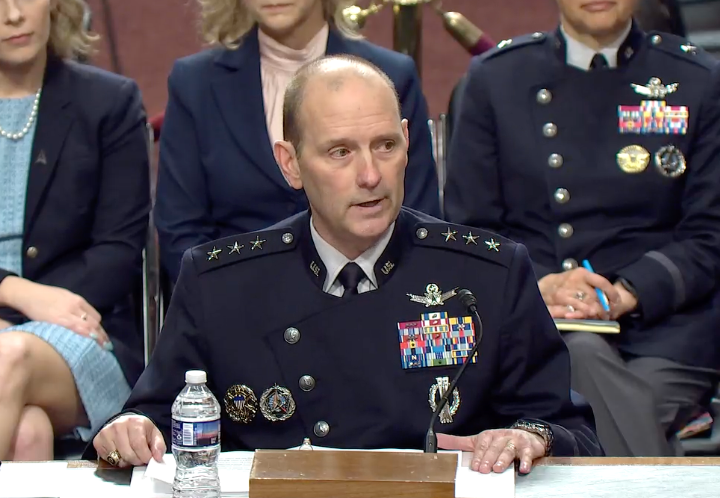
Building U.S. space-based moving target indication systems and the capability to disrupt Chinese military space systems is a top deterrence priority for U.S. Space Force Lt. Gen. Douglas Schiess, he told the Senate Armed Services Committee (SASC) during his nomination to become the third chief of space operations since the service’s founding in December 2019.
Schiess now serves as the deputy chief of space operations for operations and has held a number of positions, including as a missileer and Global Positioning System crew commander early in his career.
Sen. Jack Reed, D-R.I., SASC’s ranking member, said at the opening of Thursday’s hearing that China’s military space systems, including its expanding tactical space-based intelligence, surveillance, and reconnaissance, were a “serious threat” and that “China has built a space-based kill chain capable of tracking carrier strike groups from the moment they leave port and cueing missile systems in near real time.”
In response to a committee question before the hearing on U.S. warfare spectrum requirements against China and Russia, Schiess wrote, in part, “Denial of Adversary Kill Webs: the Joint Force must aggressively disrupt the adversary’s space-based sensor-to-shooter links. Robust electronic attack capabilities provide reversible denial of China and Russian targeting networks, blinding their long-range fires, and protecting the Joint Force.”
During the hearing, Schiess said that China’s ongoing development of electro-magnetic jamming capabilities is “very worrisome.”
“In the Pacific, they are using their intelligence, surveillance, and reconnaissance efforts to target our forces much farther than they have in the past,” he said. “They have built a kill chain to be able to see our carrier strike groups and bombers at speed and distances and have developed weapons systems to go after them.”
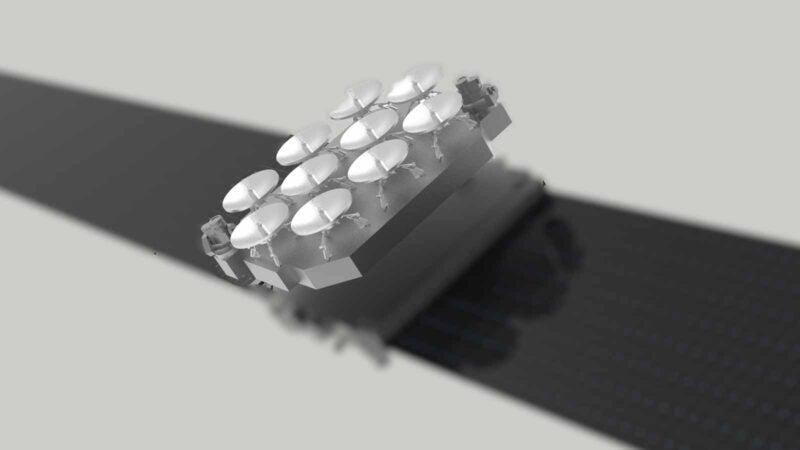
In response a question from Sen. Deb Fischer, R-Neb., on the importance of space-based air moving target indication (SB-AMTI) and what risk pausing SB-AMTI fielding would pose, Schiess replied that SB-AMTI “is something we need to do for multiple reasons, but I think one of the first reasons is to save American lives.”
Potential adversaries’ space systems and long-range missiles “sometimes pushes our forces out farther, and we need to be able to get our forces in,” Schiess testified.
SB-AMTI and ground moving target indication “for that matter, allows us to have our forces farther out and still provide that capability,” he said. “We will have airborne and other forces to do that mission as well, but we will be complementary with them. In the end, it saves American lives, but it also can provide us with much greater fidelity of information, and, as we continue to use other capabilities with automation and networks behind that to bring that capability right to the warfighter, it will help us be more effective in our missions.”
Before going public last month, SpaceX received a nearly $4.2 billion contract for the initial fielding of SB-AMTI. In April, the Space Force had awarded nine firms, including SpaceX, small contracts for SB-AMTI development.
The $87.6 billion supplemental funding request from the White House contains $4 billion for SB-AMTI and the Space Data Network Backbone.