
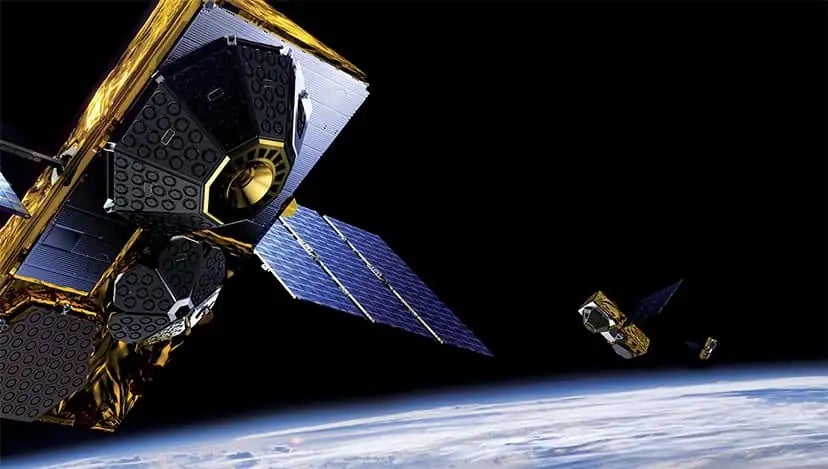
After months of rumors in the market that Globalstar was for sale, Amazon moved last month to acquire the company in a deal worth roughly $10.8 billion. Amazon will acquire Globalstar’s satellite infrastructure, including its mobile satellite services (MSS) spectrum licenses. The deal also included a tie-in with Apple to continue providing satellite services for Apple products. With this move, Amazon enters directly into the direct-to-device (D2D) arena, with plans to deploy a next-generation D2D constellation of its own in the future.
Via Satellite spoke with industry analysts about the implications for the D2D market and the value of mobile satellite services (MSS) spectrum, as well as the outlook for Amazon’s return on investment. Taking part in the roundtable are Rachel Kong, industry analyst for ABI Research; Jean-Baptiste Thépaut, principal for Novaspace; Armand Musey, founder and president of Summit Ridge Group; Lluc Palerm-Serra, research director of Analysys Mason; and Tim Hatt, head of Research and Consulting for GSMA Intelligence.
VIA SATELLITE: Given what Amazon is already doing in broadband with Amazon Leo, why do you think it felt it needed to acquire Globalstar and venture into D2D at the same time?
Palerm-Serra: D2D is moving from proof of concept to early commercial scale. The number of active services to consumers has grown from 17 to 24 in the last 6 months. The whole ecosystem is maturing with 96 smartphones offering D2D capabilities today compared with just 75 devices in September 2025. D2D is on the verge of becoming a multi-billion market. But in parallel, there are some formidable barriers to entry developing. This acquisition gives Amazon immediate control over globally harmonised MSS spectrum and a live network, while also de-risking device and ecosystem integration. The timing reflects a clear view that D2D is approaching a tipping point and that late followers will struggle to compete once spectrum, MNO partnerships and devices are locked up.
Also, there are synergies from the convergence of broadband and D2D. Starlink was the first to offer a “single-stop-shop” for backhaul, broadband and D2D with some deals already pushing for this unified approach. SES (with Lynk/Omnispace) and Amazon Leo could follow a similar path combining D2D, backhaul, and broadband services under the same roof.
Hatt: Amazon Leo was initially positioned around broadband and enterprise connectivity, particularly in rural and suburban markets and in support of Amazon’s broader cloud and logistics footprint. However, our data shows that the center of gravity in the satellite market is shifting rapidly toward D2D, driven by demand from mobile operators to extend coverage and resilience without new terrestrial infrastructure.
In light of this, the acquisition should be seen as an acceleration of its strategy. However, it’s important to note that D2D requires more than just capacity. The right spectrum assets, regulatory positioning and integration with the mobile ecosystem are all crucial too. Moving decisively into D2D allows Amazon to remain relevant as satellite connectivity becomes embedded as a standard network feature rather than a standalone product. In that sense, broadband alone is no longer sufficient as a long-term satellite growth strategy.
Kong: Amazon is expanding beyond satellite broadband to enter the D2D market, where potentially anyone with a smartphone can be their customer. By acquiring Globalstar, Amazon gains immediate access to globally harmonized MSS spectrum, which is essential for D2D services. Amazon has bought a ‘ready-to-use’ network that already supports millions of iPhone users. This drastically reduces their time-to-market and provides a massive, built-in user base from day one.
By integrating D2D into its LEO portfolio, Amazon generates higher-value, ‘stickier’ relationships with MNOs by transforming satellite features into a seamless extension of terrestrial mobile services. This strategy adds immense value to both consumer and enterprise segments including global logistics, industrial IoT, and emergency response by providing critical, always-on’ connectivity to billions of standard devices.
Thepaut: While the D2D market is still emerging and its pace of development remains uncertain, momentum is clearly building, with new agreements announced almost weekly between MNOs and satellite operators. D2D presents high barriers to entry, particularly for traditional fixed satellite services (FSS) players, which are already fully committed, both financially and operationally, to the deployment of broadband constellations. Amazon is among the very few actors with sufficient financial capacity to simultaneously support both a broadband and a D2D constellation, and it is evidently seeking to leverage this scale to position itself as a leading player in this nascent segment.
That said, D2D is not a market that tolerates incremental or partial commitment. Early approaches based on leveraging MNO spectrum, as initially pursued by SpaceX and AST SpaceMobile, have shown clear limitations, most notably interference issues with terrestrial networks (especially in border areas) and the relatively constrained bandwidth available. In contrast, MSS spectrum is increasingly emerging as the preferred option among MNOs globally. It would have made little strategic sense for Amazon to embark on a D2D initiative without first securing access to MSS spectrum.
VIA SATELLITE: What does this deal indicate about the value of MSS spectrum, and how might that impact other MSS spectrum holders Viasat and Iridium?
Hatt: The deal reinforces that spectrum is now one of the scarcest and most strategic assets in the satellite market. MSS spectrum, in particular, has become critical for D2D services, where compatibility with mobile devices and regulatory clearance are essential. As more operators pursue D2D at scale, MSS spectrum will move from a supporting asset to a defining competitive differentiator. For other holders such as Viasat and Iridium, this raises both opportunity and pressure. Their spectrum assets are valuable, but realising that value increasingly depends on scale, partnerships, and the ability to integrate into operator networks. This dynamic is a major driver behind the consolidation we are observing across the sector, as without consolidation many companies may struggle to monetize these assets.
Thepaut: MSS spectrum is emerging as the critical bottleneck for D2D, and the Amazon–Globalstar deal confirms a structural re-rating of its value. Crucially, not all MSS spectrum is equal. The holdings of Globalstar, Iridium, and Viasat are particularly valuable, as they benefit from quasi-global coordination built over decades of operational use. This significantly streamlines national go-to-market strategies, in contrast to other spectrum assets that must fight to secure authorizations on a country-by-country basis, often in a more fragmented and competitive regulatory environment.
Kong: MSS spectrum is no longer a niche technical asset but high-value orbital real estate. Late last year, SpaceX bought EchoStar’s AWS-4 and H-block spectrum band consisting of both L- and S-Band for $17 billion. Simultaneously, AST SpaceMobile also has a deal to acquire 45 MHz of Ligado Networks’ MSS spectrum which includes long-term usage rights for over 80 years. Now, Amazon is acquiring Globalstar, following the trend of consolidation in the market, demonstrating the value of MSS spectrum. The increased market value of MSS spectrum incentivizes players like Iridium and Viasat/ Equatys to leverage their spectrum and deploy open, 3GPP-standardized architectures that maximize commercial scalability.
VIA SATELLITE: Was the Apple link-up the real key to this deal? Given the developments in D2D, how do you think the relationship with Apple may change over the next few years?
Palerm-Serra: Apple is a strategic investor in Globalstar and has a right of first refusal. Additionally, it has 85% of the Globalstar constellation booked for its own use. However, for Apple it was increasingly difficult to ensure a differentiated service as Starlink’s D2D capabilities advanced. Also, Apple probably didn’t have the appetite to continue investing in a next generation constellation that matches future Starlink Mobile’s capabilities. This is a mutually beneficial deal: Amazon inherits a large pool of compatible devices, while Apple gets a partner willing to continue investing in next-generation capabilities. It remains to be seen what happens with other smartphone OEMs apart from Apple in terms of compatibility with Amazon’s D2D constellation.
Musey: Amazon would likely have been interested in Globalstar’s spectrum regardless of Apple’s involvement. Apple’s D2D business plan was interesting — don’t worry so much about subscriber revenue, use it to increase iPhone sales. Given that the size of the D2D market is not clear, this was an amazing way to reduce risk and justify investment. Having millions of iPhone users certainly could not have hurt Amazon’s interest. I don’t know what Apple’s future relationship with Globalstar will look like. However, I can’t see them abandoning D2D altogether and imagine Amazon would encourage their continued participation.
Kong: While the Apple partnership was a strategic anchor and a key factor of the deal, Amazon was going after Globalstar’s spectrum rights as the key digital asset to accelerate its upcoming D2D service. With the Apple partnership, it provided immediate scale as Amazon essentially serves millions of active iPhone customers by taking over the existing pipeline. The relationship with Apple is probably going to deepen further whereby Amazon will provide more satellite services to Apple customers beyond Emergency SOS services. This could include satellite messaging, voice and data and to be powered by Amazon’s high-capacity LEO constellation.
Apple might also plan to diversify with other partners like Skylo or Iridium for their lower to mid-tier devices to avoid giving Amazon total control over its satellite roadmap.
Hatt: Apple has played a catalytic role in legitimizing D2D as a consumer-facing proposition. By integrating satellite messaging at the device level, Apple demonstrated that D2D is not a niche emergency service but a scalable extension of mobile connectivity. As D2D ecosystems mature, relationships with device manufacturers like Apple are likely to evolve from point solutions towards broader, multi-provider frameworks as it’s unlikely that a single device partnership will be sufficient on its own.
VIA SATELLITE: Are we essentially seeing an Arms Race between SpaceX and Amazon now in both the traditional satellite arena and now D2D? What does this mean for other players in the market?
Musey: Yes, it seems like an arms race between SpaceX and Amazon, but SpaceX is far ahead. Both have spectrum (Amazon’s position globally may be stronger for now). Additionally, SpaceX has deep vertical integration, and Amazon may have strong distribution synergies. Other players will be challenged to compete without spectrum or a real competitive advantage.
Kong: Yes, both SpaceX and Amazon have built competing services in the space sector, first with satellite broadband, and now with the D2D market. SpaceX Starlink has over 10,000 satellites in orbit and more than 150 ground stations worldwide, serving over 10 million subscribers. By acquiring Globalstar, Amazon is hoping to take a shortcut by accessing 3GPP NTN spectrum and a significant partnership with Apple which can threaten SpaceX’s dominance.
For the rest of the industry, it ultimately means that they must innovate and build service differentiation to compete in the same market. The space industry is moving towards an oligopoly of commoditized service pricing led by SpaceX and Amazon. To survive in this emerging race, new entrants must find a way to escape this “race to the bottom” and build unique and profitable service offerings or risk being acquired.
Palerm-Serra: Yes, this increasingly looks like an arms race with SpaceX, Amazon Leo and Chinese projects flooding the market with supply and creating a highly competitive market. If Starlink proceeds with its 15,000‑satellite broadband filing, it would reach nearly 1,900 Tbit/s of downlink capacity. Amazon Leo Gen 1 and 2 will total 600 Tbit/s of downlink supply. This creates market polarization and supposes a CapEx intensity that other players can’t match. But there is still room for differentiated constellations specializing in concrete applications such as IoT, enterprise broadband or defence and sovereignty. Traditional space actors are at crossroad and survival hinges on urgent action. However, it is also important to consider that MNOs and regulators are likely to push for a competitive counterweight rather than a winner takes all outcome.
Hatt: Amazon is not looking to replicate Starlink, and its objectives are more targeted. While both companies are building significant orbital capacity, Amazon is focused on addressing specific markets such as rural and underserved broadband as well as supporting Amazon’s broader ecosystem in cloud and logistics. It’s a long-term strategic investment rather than a sprint to copy Starlink’s constellations, which is further reinforced by the fact that D2D services are not yet central to Amazon’s LEO proposition. Additionally, what we’re seeing is infrastructure economics. Satellite connectivity is a scale business: without sufficient constellation size, spectrum depth and capital backing, it is difficult to compete sustainably. For smaller players, competing requires them to specialize, partner, or consolidate.
VIA SATELLITE: With SpaceX and Amazon making acquisitions, do you think the satcom market could ultimately a kind of duopoly going forward?
Thepaut: A critical success factor in the D2D market will be the ability to secure partnerships with MNOs. Many operators remain cautious toward large technology players such as Amazon and SpaceX, which they increasingly view as potential long-term competitors. As a result, they may be inclined to work with smaller, more neutral partners, provided service performance meets expectations. MNOs are firmly in the driving seat in this market and have already signaled limited appetite for exclusivity. Instead, most are likely to pursue multi-partner strategies, akin to roaming agreements, in order to mitigate dependency on any single provider and diversify their sources of supply.
Musey: SpaceX is far ahead of the competition. Unless Amazon catches-up more broadly, we may be headed to a monopoly.
Hatt: SpaceX and Amazon are clearly extending their lead in terms of resources, scale, and strategic optionality. That said, however, while Starlink and Amazon are dominant in horizontal scale, there’s certainly room for specialized players in government, enterprise, aviation and regulated markets. In the coming years, we’re likely to see a barbell structure emerge, where a small number of very large global infrastructure providers will be at one end, and a narrower but viable set of specialised or regionally anchored players will sit at the other.
Palerm-Serra: The direction of travel points to sustained scale advantages for SpaceX and Amazon, but a clean duopoly is unlikely in practice. Satellite communications is too politically sensitive, too regulated and too geographically fragmented for a pure two player end state. That said, these two are clearly pulling away in terms of capital intensity, supply and ecosystem leverage. Other players will still have opportunities, but increasingly in constrained segments or through alliances rather than as fully integrated global competitors.
VIA SATELLITE: Do you believe that Globalstar was worth the premium that Amazon paid?
Kong: Yes. Amazon’s (all departments and segments) net sales was approximately $717 billion in 2025. Amazon bought Globalstar for $11.6 billion, which is about 1.6% of their revenue. The price for them is a drop in the bucket. Amazon is acquiring Globalstar to gain an immediate time-to-market advantage by leveraging existing, operational spectrum licenses and infrastructure.
Despite Globalstar’s history of negative earnings and a $410 million debt load as of late 2025, the deal is justified by their $273 million in annual revenue and the significant validation provided by Apple’s $1.5 billion investment. In terms of stock market valuation: Despite paying a premium of $90 per share – surpassing the market valuations of Iridium (~$40) and Viasat (~$62), and Globalstar’s pre-acquisition (~$80) – Amazon’s $1.3 billion extra spend is a calculated move to secure strategic assets. If Amazon captures just 10% of the projected $16 billion market by 2030, the resulting $1.6 billion in revenue would immediately offset the premium paid to acquire Globalstar.
Musey: Not based on Globalstar’s current business. However, time will tell. The size and value of the D2D market is very unclear today. It may end up being a bargain.
Palerm-Serra: On traditional satellite operator metrics, the valuation looks aggressive. On a strategic basis, it makes much more sense. Amazon is not buying cash flows; it is buying time, spectrum certainty, a device ecosystem and a platform it can scale and upgrade. Replicating Globalstar’s position and regulatory footprint from scratch would have been impossible and carried higher execution risk.
VIA SATELLITE: Given the various investments that Amazon will likely make in building a further D2D constellation, is there a strong enough ROI potential?
Thepaut: It ultimately depends on the ROI horizon. Novaspace estimates the D2D market for satellite operators will grow from roughly $500 million today to around $11 billion by 2034, which is substantial but still limited relative to the level of investment required. When factoring in both the cost of the Globalstar deal and the development of a dedicated D2D constellation, achieving a standalone return on a first-generation system would likely require market shares that are difficult to sustain in an increasingly competitive landscape. That said, Amazon has historically taken a long-term investment view across all its different business ventures, and is unlikely to be targeting immediate returns.
Kong: With over 8 billion mobile devices globally, and D2D poised to generate $16 billion in service revenue by 2030, the potential is significant. The deal gives Amazon an edge in expanding services for their existing operations and customers. In Amazon’s logistics and supply chain business, for example, D2D tracking and telemetry can be incorporated into its own operations to maintain continuous visibility of their assets even in regions with zero cellular coverage, improving delivery precision.
VIA SATELLITE: Finally, what are the key challenges for Amazon to make this a success?
Musey: Advanced hardware development (Apple may be an advantage here), MNO alignment, and next generation D2D satellite constellation launches. Amazon LEO also has a lot going on trying to increase launch cadence of its broadband satellites and then deploy the service. At the same time, it can’t lose focus on its D2D efforts if it wants to be successful.
Palerm-Serra: Execution is the main risk. Our research shows that interest and willingness to pay is positive for D2D services and there is a tangible opportunity to scale this market to a multi-billion opportunity. However, for this opportunity to materialize, constellations need to be able to provide voice and data services at scale. Amazon must upgrade and expand the constellation. This involves a technology risk but also developing the manufacturing scale and aligning the launch capabilities to meet those requirements in an accelerating market. The competition is fierce with multiple players going after the same market.
Simultaneously, Amazon will need to articulate a clear and attractive business model for partners (MNOs, devices, etc.), since owning the spectrum gives it power, but also creates tension with telecom players that are wary of becoming disintermediated. Return on investment will be back ended and heavily dependent on execution and cost discipline. This is a long game rather than a quick win.
Thepaut: Globalstar’s acquisition already addresses two critical success factors for Amazon: time-to-market and access to MSS spectrum. The next priorities are likely to be: MNO partnerships: Assuming the exclusivity agreement with Apple does not extend to a future Amazon LEO constellation, MNOs represent the most effective channel to drive rapid service adoption.
End-user service quality: A particular focus will likely be placed on improving performance, including minimizing beam size to increase throughput density and expand the range of services that can be supported over D2D networks.
Hardware compatibility: Amazon may also seek to leverage its scale to encourage OEMs to integrate Globalstar frequency bands into chipset roadmaps, thereby maximizing the addressable subscriber base from the outset.
More Analyst Roundtables:
- The Key Questions for a Potential SpaceX IPO in 2026
- Blue Origin’s TeraWave Constellation: Analysts Size Up Competitive Positioning
- The Opportunities and Risks of SpaceX’s xAI Deal and Data Center in Space Ambitions
- Analysts Size Up Europe’s Bold Move With Airbus/Thales/Leonardo Merger
- Analysts Examine D2D Shake-up in Light of SES/Lynk/Omnispace Deal