
Logos Space, a relative newcomer in the satellite constellation arena, sees a distinct lane in private, secure networks for enterprises and governments. The company is moving forward after securing FCC approval this spring, toward selecting a bus manufacturer later this summer.
Logos’ Vice President of Engineering Rama Akella has deep Low-Earth Orbit (LEO) constellation credentials with previous experience at both Starlink and Amazon Leo. Akella recently spoke with Via Satellite about how the network is designed for the enterprise market.
“Starlink brought a LEO capability to the IP transit side of things for consumers, and it worked because there was an unserved, underserved, and eventually new use cases that came with the LEO version of what terrestrial guys were doing. We are bringing the LEO capability to private, secure networks,” he said.
In terms of network architecture, Akella explains that broadband LEO constellations are built for direct-to-consumer, internet protocol (IP) transit networks, with more traffic being downlinked to consumers, and traffic traveling through gateways to points of presence. These networks are also designed for ubiquitous coverage. “We are none of those things,” he says.
Instead, Logos Space is building in the world of intra-networking, intra-enterprise communications. He gives the example of an enterprise that wants to connect two buildings, using a “long, stretchy wire,” where throughput is symmetric in both directions.

“When I put a packet on one side, I know exactly where it will show up. The wire doesn’t need to know what’s on the packet or interpret the packet. It’s not using any data on the packet route, Akella explains.
The constellation is designed to provide symmetric throughput in both directions, like a Layer 2, Layer 2.5 transport with assured routing. Citing that nearly 70% of the world’s networking traffic is on private, secure networks, Logos Space sees an opening to bring LEO to private networking.
Another aspect to the Logos Space network is electronic-warfare resilience capabilities, which make it a dual-use technology, and applicable to sovereign networks. These same features of a point-to-point and secure and private point-to-multi-point are also appealing to the U.S. government and agencies, and sovereign networks, Akella notes.
He points to rising demand for EW resilience among commercial customers as well.
“Our belief system is that even for commercial customers, electronic warfare resilience is a necessity because increasingly people are attacking networks. Even enterprises that have assured networking need to be aware that a network could get jammed intentionally or unintentionally,” Akella said.
Logos Space secured an important milestone in February, with FCC approval for satellite spectrum to deploy its 4,178-satellite LEO constellation, operating in the Ka- Q-, and V-bands.
The company is currently in the process of selecting a commercial bus provider for its satellites. After a request for information it is now in a paid study with five potential providers. It will then move to a formal request for proposals and select one. Akella said Logos Space plans to have the bus selected by mid- or late summer.
“We plan to be a function-rich, throughput-rich satellite. It’s not in the 1 kilowatt range — it’s a fairly big satellite. While there are a lot of bus players, not everyone can build what we needed,” he says.
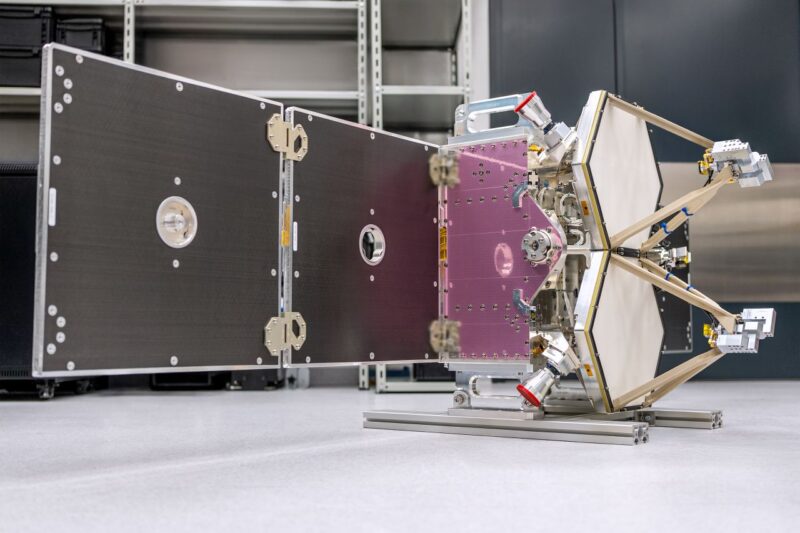
The bus and launch selection will be tightly coupled. Akella says the satellites will launch in a flatsat configuration, stacked into the launch fairing.
The company has hired Jorge Delgado, former chief engineer for the Airbus U.S. satellite bus, to lead its in-house bus team that will work with the chosen supplier. Logos Space will build payload technologies in-house, and may partner on specific aspects like silicon, Akella said.
Q- and V-band Development
Another way that Logos Space differs from satellite broadband constellations is use of the Q- and V-band for user links. These frequencies are seen as a future technology for satellite systems, but have not been widely deployed at this point. Blue Origin, for example, is also targeting Q- and V-band for its TeraWave constellation plans.
Akella says that while the terrestrial industry failed in using millimeter wave bands, there was significant technology development in pursuit of the goal. He explains these frequencies were not a good fit for terrestrial systems and carry challenges for use in space because of sensitivity to weather, but these challenges can be overcome.
“There are clear solutions that make this spectrum quite useful. Because there is existing technology, we are not talking 10 years out. Taking the 5G technology and modifying to work for space — as we will announce shortly — is maybe two years out,” he said.
These bands will have implications for the user terminal, as Akella notes there are no existing terminals that can be used for the network. Logos Space plans to design the terminal and may partner with a contract manufacturer.
Because the network is geared toward enterprises, the terminals will be deployed on roofs, for example. In this case, the look and feel is not as important as a consumer terminal, and it will be optimized more for throughput than size, he notes.
From SpaceX to Startup
Akella has deep experience in wireless networking and satellite communications. He joined SpaceX in early 2017 during the early planning for Starlink to lead the wireless engineering group. He served as the overall network architect for Starlink during the constellation’s commercial launch in November 2020, then went on to seed the direct-to-cell program up to lab demonstrations.
After SpaceX, Akella went on to lead the silicon program at Amazon for Amazon Leo. But he felt a pull to return to a startup.
“I progressively felt convinced that the idea and the specific network vertical that we could build and the capabilities that we could bring in the mission were very exciting,” he said. “Before I’d gone to SpaceX, I’d spent 12 years in startups so I always had this desire to go back and be on the ground-floor of an ambitious, mission-focused startup, and I felt Logos had all the right ingredients.”
He compares the current space industry to the 1920s, when the Ford Model T was ubiquitous in the automotive industry — but that was just the beginning of what was to come.
“In that moment, you can wonder if the automobile market is done. I believe we are in the 1920 equivalent,” Akella says. “Yes, [SpaceX] has a system and they have captured a good market, but they’re also broadly friendly. It’s in their interest for the space industry to grow and not to keep it small and captive. We believe there are multiple decades of both innovation and growth possible.”