WASHINGTON — The upcoming World Radiocommunication Conference in 2027, will be “satellite heavy,” with critical agenda items for the blossoming space sector — but U.S. space executives warn about China’s influence as the host nation.
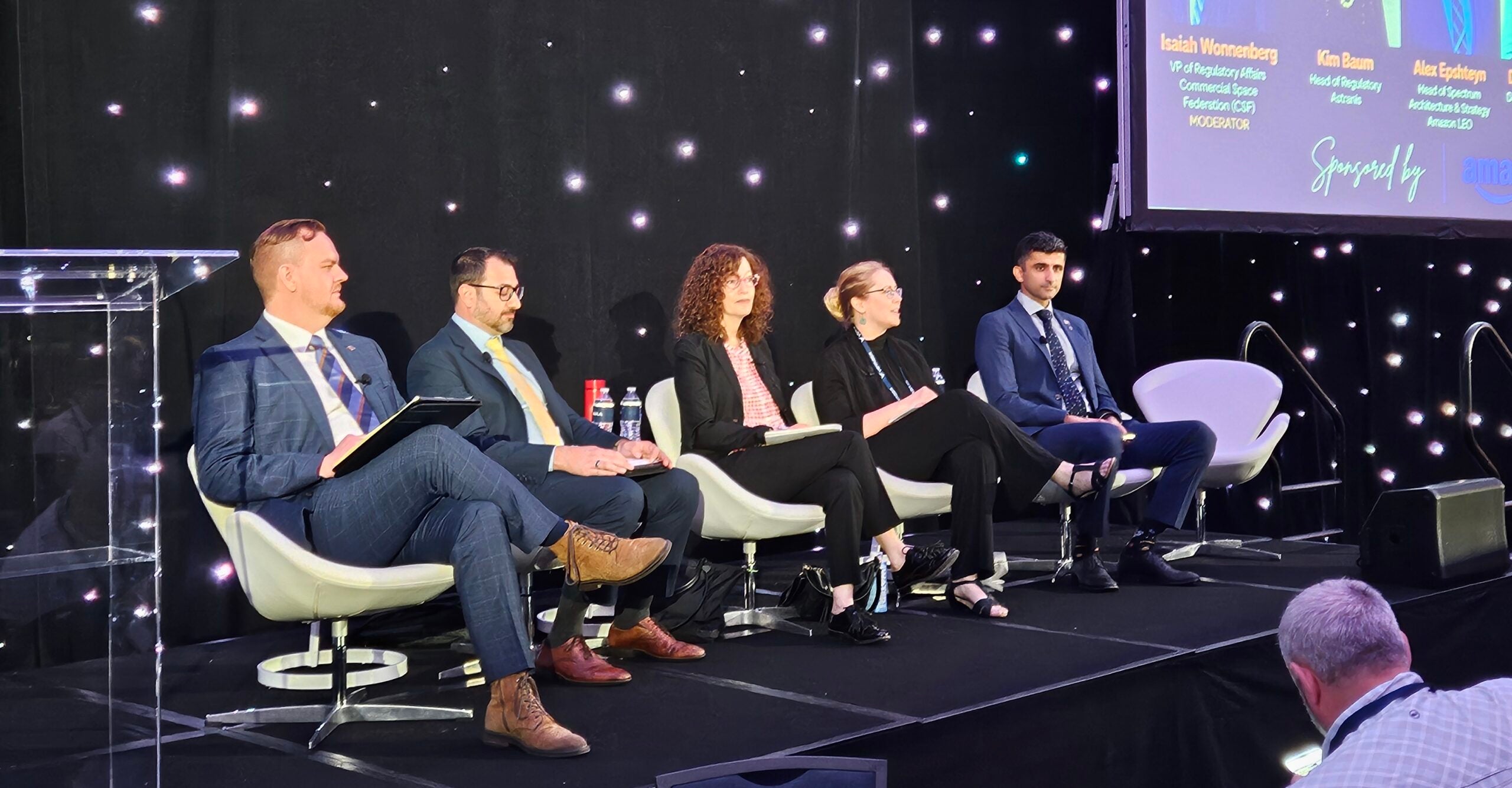
WRC-27, a quadrennial global telecom regulatory summit, will be hosted by the Chinese government in Shanghai. The U.S. delegation, which includes both multiple federal agencies and a large private sector contingent, has a lot of work to do to develop a national position, win over allies, and push for reform of the WRC process itself, executives said Tuesday at the ASCEND conference in Washington.
“This year is an important time for the United States to show up in force,” said Danielle Pineres, deputy general counsel and vice president of Earth Observation company Planet Labs. “It is a very satellite-heavy conference, and so a wonderful opportunity to consensus-build with other like-minded nations,” to work on agenda items critical to a new generation of satellite constellations.
Over 80% of the agenda for WRC 27 is directly or indirectly related to Non-Geostationary Orbit (NGSO) satellite systems, like the new Low-Earth Orbit (LEO) megaconstellations, or the Medium-Earth Orbit (MEO) constellations favored by many Earth Observation companies, said Alex Epshteyn, the head of Spectrum Architecture and Strategy at Amazon Leo.
He said key agenda items for Amazon included additional spectrum in the V-band, but a big issue is reforming the broadcast power limits that govern spectrum-sharing rules between the new NGSOs and the existing Geosynchronous Orbit (GSO) constellations.
The ITU “does struggle to keep pace with technology,” he said. In a consensus-based organization, “It is very difficult to come up with truly innovative ways forward that really keep up and allow technology to move forward,” he said.
A quadrennial cadence for regulation doesn’t allow for the current pace of change in the space sector, said Epshteyn. “Every four years we set the agenda for the next four years. But in the middle of that, there might be breakthrough innovations that [aren’t] taken into account [by] outdated regulations that might have been developed for different times,” he said.
He pointed to the equivalent power flux density (EPFD) as an example. It’s a regulatory metric the ITU uses to measure radio signal interference with GEO satellites from those in lower orbits. Epshteyn said these limits, which were developed in the late 1990s, don’t reflect the capabilities of contemporary constellations.
“The ITU needs to evolve,” said Epshteyn, “It can keep up.”
Not everyone agrees with Epshteyn’s view on EPFD limits, which were a hot-button issue during WRC-23. The limits were not adopted for the formal agenda for WRC-27.
“We are working on studies and we hope that we do not need to wait another four years,” he told Via Satellite after the session.
The FCC recently moved on EPFD limits independently of the ITU, approving an update last month that was applauded by LEO operators like SpaceX and Amazon Leo and drew concern from many GEO operators.
In the lead-up to WRC-27, the U.S. needs to get moving on developing national positions on key agenda items, said Kim Baum, head of Regulatory Affairs at Astranis.
“We have a bifurcated process for developing U.S. proposals,” she said. The private sector worked through the transparent process of the FCC’s WRC Advisory Committee, involving government agencies as observers. The government worked through an interagency process conducted by the NTIA behind closed doors.
At the end “There’s some sort of murky reconciliation … to bring those divergent proposals together,” she said.
The location of WRC-27 in Shanghai, China, is already posing barriers to U.S. participation, given fears about American visitors potentially falling victim to hacking, said Baum. She said U.S. participation at previous regional preparatory meetings had been “incredibly limited” by security concerns.
“We’re going to have to figure out a way to protect our information security and whatever else is needed, but we can’t go with a skeleton delegation and hope to really win the day for the United States,” Baum said.
The host nation also traditionally had a great deal of influence over the conduct of the summit, said Epshteyn.
“Generally, whoever hosts the WRC has home field advantage,” he said, pointing out that the development of NGSO constellations . The concern is that “they can use these regulations on the home field advantage to really impact U.S. systems and U.S. operations,” he added.