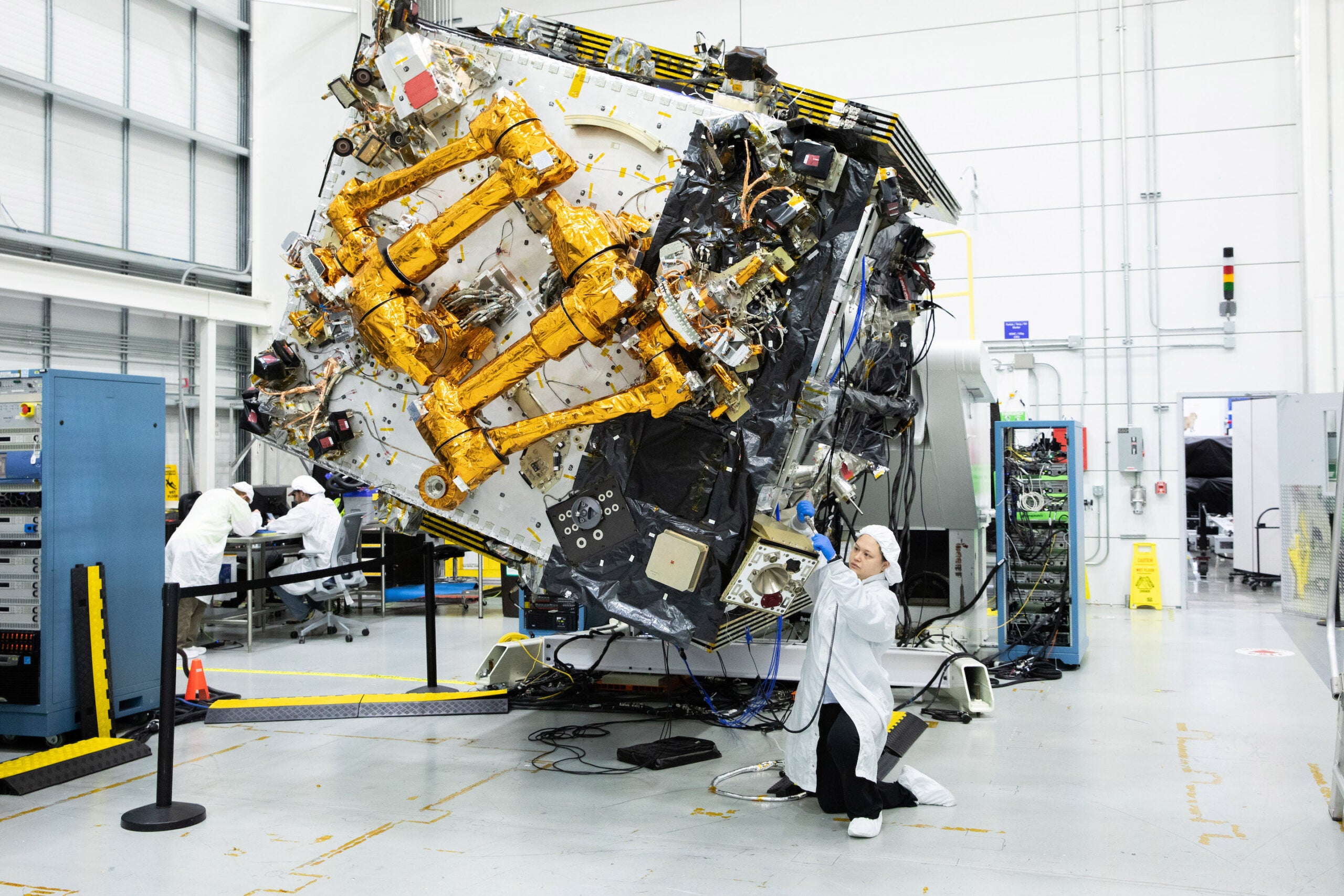
STERLING, Va. — Northrop Grumman’s SpaceLogistics is scheduled to launch its next-generation space vehicle for on-orbit refueling and satellite life extension this summer, program leaders told reporters Tuesday. The company said it secured a dedicated SpaceX launch for its Mission Robotic Vehicle (MRV), which is in testing at the company’s satellite manufacturing facility in Virginia. It will launch along with three Mission Extension Pods (MEP) for Geostationary (GEO) satellite life extension services.
The MRV will be the first commercial robotic in-space servicing mission in the emerging and increasingly competitive market for in-space servicing, assembly and manufacturing. The vehicle, outfitted with two robotic arms and a suite of advanced technologies, sets a baseline capability for satellite life extension and refueling, program leaders said, while paving the way for future services, such as in-orbit inspection, repairs and assembly.
“The toolkit that we have right now when there are problems in space is very, very limited,” said Ryan Tintner, vice president and general manager of Northrop Grumman’s Space Superiority Division. “It’s about to be widely expanded.”
Via Satellite attended a Tuesday event at Northrop Grumman’s Dulles Satellite Manufacturing Facility, where the company showed the MRV’s dual mission capabilities of refueling and life extension before it ships for launch.
The MRV’s robotic arms were developed in partnership with the Naval Research Lab and NASA and the vehicle has multiple ports for future tools, as well as a standardized refueling interface designed for the U.S. Space Force and Space Systems Command Elixir mission. The vehicle will debut a suite of sensors, as well as propulsion and robotics technologies for rendezvous, proximity operations and docking (RPOD).
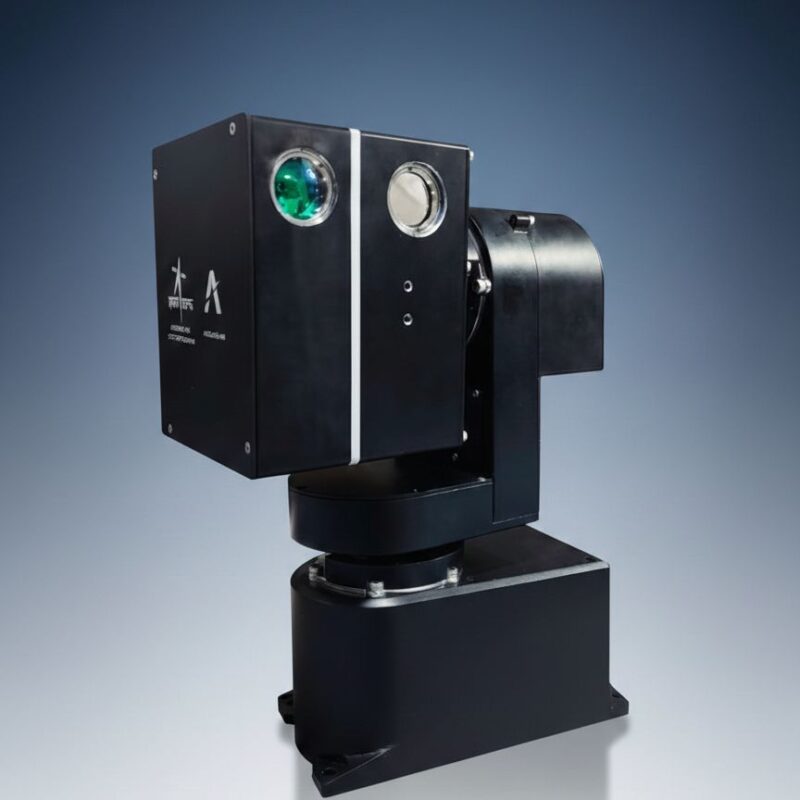
“There are a lot of companies that are doing RPO. Doing docking is a whole other level of sophistication and complexity,” said Rob Hauge, president of SpaceLogistics. The MRV is designed to grapple a client satellite for refueling by attaching itself to the liquid apogee engine, a cone-shaped nozzle found on a majority of deployed GEOs. For soft capture, it uses visible sensors, infrared and LIDAR to guide the approach before inserting a lance into the engine nozzle to secure the spacecraft before docking for service.
The Space Force and Defense Innovation Unit drove the development of the refueling interface, or Passive Refueling Module (PRM), as a standard interface with significant hardware commonality to existing spacecraft designs. The first demonstration of the refueling capabilities has not yet been announced, but will come as the Space Force readies its maneuver warfare strategy, with an emphasis on “maneuvering without regret.”
Lauren Smith, program manager for Northrop Grumman’s in-space refueling portfolio, said refueling has the potential to change the way mission architects think about the limits of maneuverability, design frameworks and concepts of operations. “There are so many things that constrain what we do,” she said. “I think this infrastructure … opens the aperture to really question if we could do things differently.”
The development of MRV and other robotic vehicles for orbital operations has been driven by government investment and policy initiatives to cultivate a commercially viable in-space servicing, assembly and manufacturing (ISAM) market. Analysys Mason has estimated the ISAM market could represent a $15 billion global opportunity by 2031.
With hundreds of GEO satellites at the same orbital inclination and roughly 10 to 20 reaching end of life each year, the potential addressable market is significant, according to Defense Advanced Research Projects Agency (DARPA) Tactical Technical Office Program Manager James Shoemaker.
“If you look historically at the kind of anomalies and opportunities for servicing that happen in GEO, it’s on average between 20 and 25 opportunities per year across the commercial and government market,” Shoemaker, told reporters. Shoemaker cited relocations, retirements, standoff inspection, cooperative inspection and deployment anomalies, noting that having a service vehicle on orbit can reduce response times when issues arise in GEO.
The ISAM landscape is evolving and becoming increasingly competitive with companies successfully flying missions for various on-orbit services. Late last year, SES signed an agreement with Infinite Orbits for a GEO life extension mission with the company’s Endurance docking vehicle. Astroscale US and in-space refueling startup Orbit Fab are expected to launch the first refueling mission of a DOD satellite this spring. Additionally, Astroscale has successfully deployed ADRAS-J and ELSA platform with advanced RPO and robotic capture, and it is currently developing the LEXI Life Extension In-orbit vehicle. Impulse Space, Rocket Lab and Starfish Space have each demonstrated or fielded space tugs or orbital transfer vehicles.
After launch this summer, the MRV will take roughly one year to reach its orbit. Northrop Grumman did not share the specifics of which satellites this MRV will service, but it has sold MEPs to Australian operator Optus and SES’s Intelsat.
The MEPs are designed to extend the life of an average 2,000 kg GEO satellite for at least six years, according to Rob Hague, president of SpaceLogistics. The MRV has a design life of more than 10 years with plans to deliver addition MEPs after completing its initial mission.
The MRV builds on SpaceLogistics’ flight legacy with the Mission Extension Vehicles (MEV), MEV-1 and MEV-2, which made history in 2020 by docking with and extending the life of two Intelsat satellites using larger scale, first-generation MEPs.