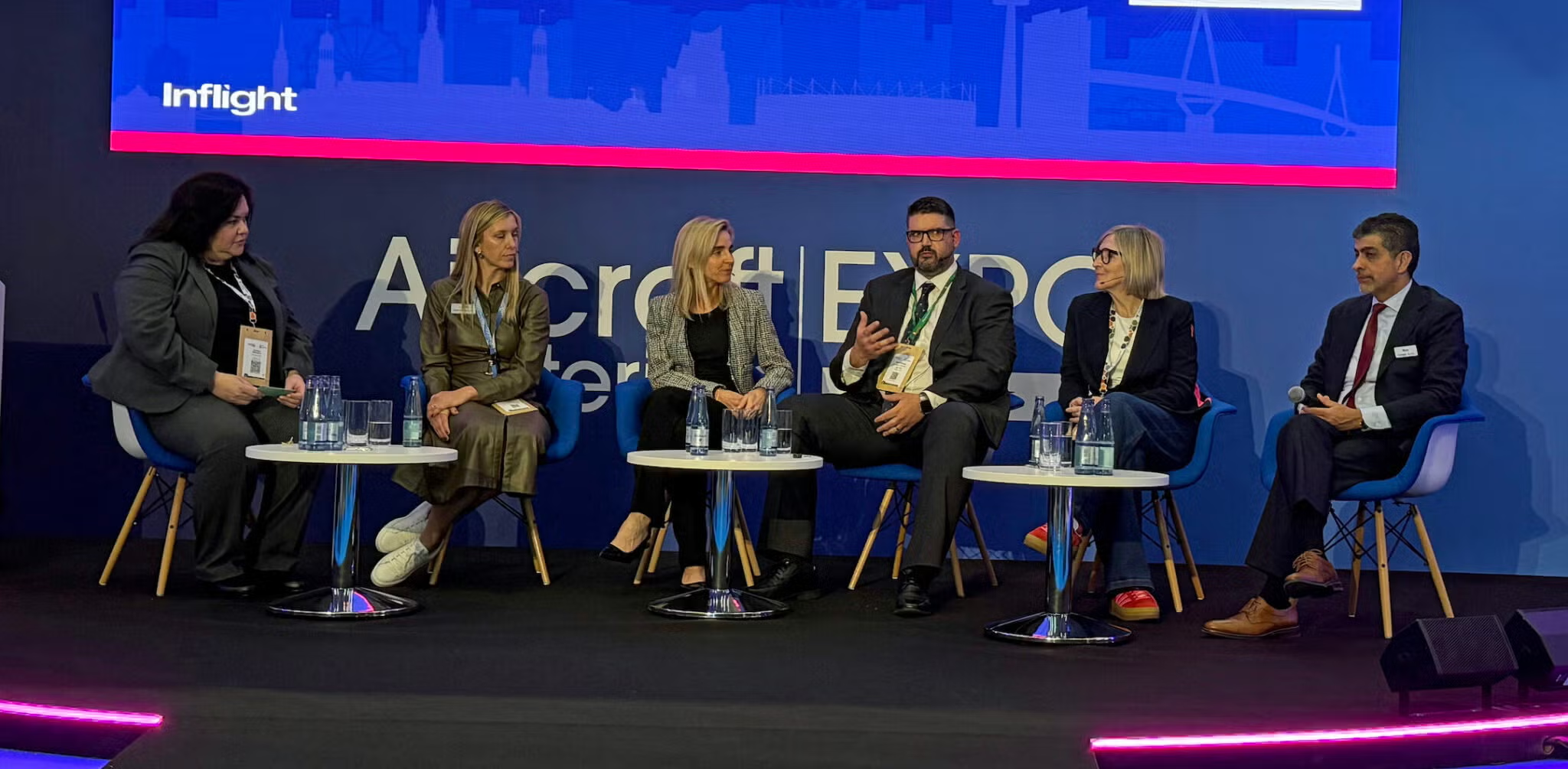
Airlines, OEMs, and satellite providers are working through the challenges to design the ideal in-flight connectivity (IFC) experience amid rising customer expectations, leaders said last week at Aircraft Interiors (AIX) in Hamburg, Germany.
Melanie Berry, chief customer officer of Spanish low-cost airline Vueling, said the mentality among customers has changed and talked about how customers now want to carry on with their everyday lives and that IFC can no longer be considered as just a “nice to have” but something that is now considered essential.
“Customers are expecting it to be for free. It is resetting the bar. They expect it to work. People have paid a lot for Wi-Fi to work in the past, and it hasn’t worked. People now expect it to work for free,” Berry said during the Cabin Airspace mini-conference at AIX.
Moving forward, Berry said that connectivity is about more than just the customer experience, expanding to connected crew and airlines reliant on the data as the technology improves.
“The way we measure connectivity needs to evolve. I have spent many meetings where people say there was a heartbeat [connectivity] to the aircraft but no one was connected,” she said. “We are going through this huge shift, where we won’t just be talking about whether there is a heartbeat.”
Berry touched upon some of the technology changes that she would like to see and how they could impact some of the satellite players. One of the industry’s biggest problems is that changing to a new technology takes a long time for airlines.
“Hopefully we won’t need to have antennas on the plane in the future to add weight. Maybe the future is ‘antennaless.’ We want to work with different people and have more flexibility. Everything we put on an aircraft has a cost. We need to make the aircraft as light as possible. Anything involving an aircraft takes a long time,” Berry said.
Over the last few years, there has also been a lot of customer confusion and even apathy towards IFC given the inconsistency of services. Berry explained that customers expect to be connected, but communication from airlines about on-board connectivity can be a “difficult jigsaw.”
Eva Birgitte Bisgaard, president of Connectivity business unit for Eutelsat OneWeb, also believes the conversation has shifted with Low-Earth Orbit (LEO) services entering the equation. She spoke of how low latency can have a significant impact when looking aircraft maintenance.
“Being able to have these planes online and have this data secured is going to become key to get an even more connected environment. Security goes hand-in-hand with connectivity being constantly available to passengers and crew,” Bisgaard said. “The airlines want to test different set-ups but want continuity. They need a resilient and secure solution that works.”
The theme of continuity was a key aspect of this panel discussion. Courtney Callicut, regional director, BCA Cabin and Features Marketing for Boeing, gave a perspective from an OEM and how it needs to work to deliver a holistic connectivity experience. A key aspect is to learn how an OEM partner can work with its providers. For example, making sure security is integrated into the connectivity experience.
“It is all about getting into these finite details for the passenger experience. We are seeing a lot of changes in passenger behavior. You now have the office in the sky. Messaging is the entire experience. There are latency expectations now. A lot of airline partners use NP scores to monitor customer satisfaction. It is extremely significant that in research connectivity is really high,” Callicut said. “From an OEM perspective, we are analyzing this conundrum of continuity. We need to make sure there is a consistency when working with service providers and deploying these services.”
Reza Rasoulian, senior vice president and general manager of Hughes, said the company is “laser focused” on creating the best connectivity environment for customers. He said satellite networks are pushing the envelope on what can be delivered now and into the future.
“There is huge amount of opportunity for the airline/OEM. We have roadmaps to Gigabits per second to the aircraft in both directions. I am confident the architectures we are bringing forward will push us to add resiliency, redundancy. There will be applications that we haven’t even contemplated,” Rasoulian said.