Fielding more systems for orbital warfare has been the top priority of the White House’s nominee to succeed Chief of Space Operations Gen. B. Chance Saltzman.
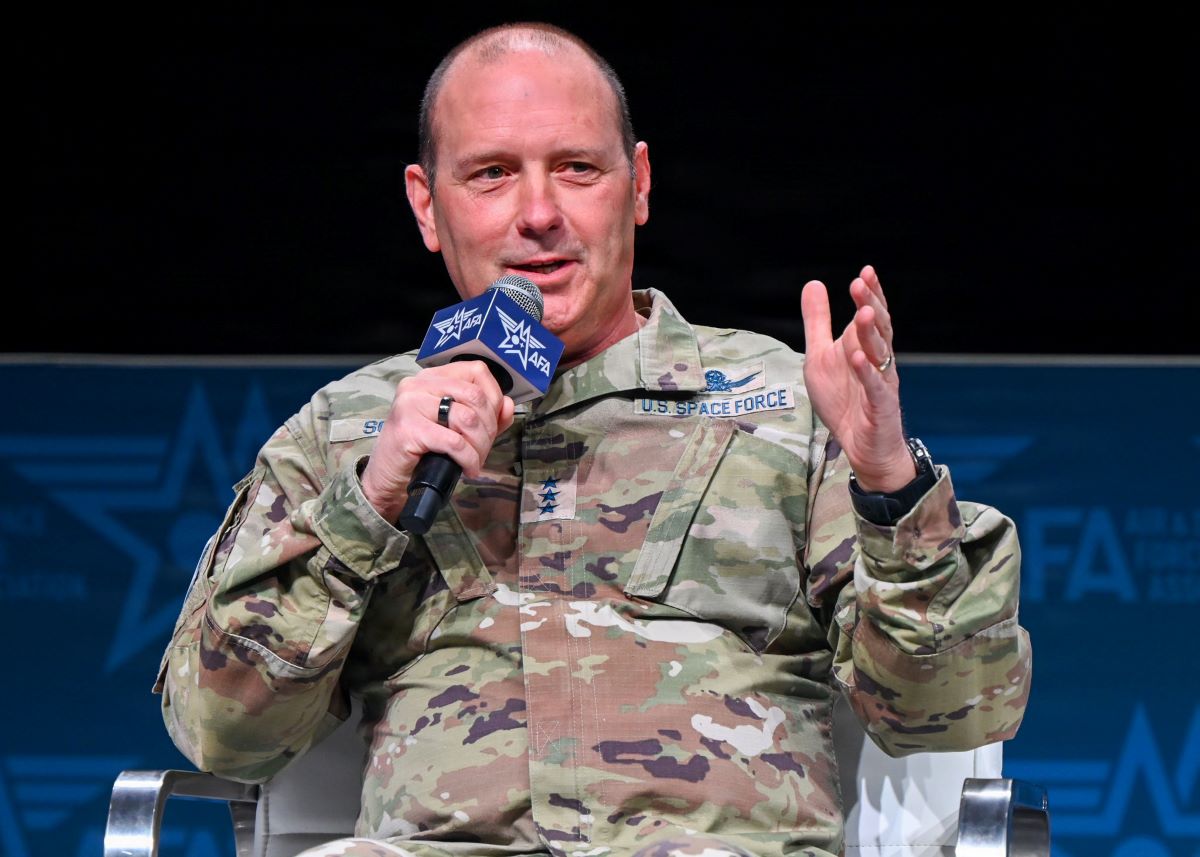
The Trump administration on April 30 tapped Lt. Gen. Douglas Schiess for a fourth star and to be the Space Force’s next uniformed head, pending Senate confirmation.
The 56-year-old Schiess has been the Deputy Chief of Space Operations for operations since November and before that served for nearly two years as the inaugural commander of U.S. Space Forces-Space, the service component of U.S. Space Command. In his 34-year career, he has had a variety of positions, including ICBM crew commander, GPS crew commander, head of space forces for U.S. Air Forces Central Command during the war in Afghanistan, and commander of the 45th Space Wing — now Space Launch Delta 45, which manages all East Coast rocket launches.
In September, Schiess said that his top priorities were more orbital warfare systems; better space domain awareness through such systems as the classified Space Force-National Reconnaissance Office (NRO)-led SILENTBARKER and the Northrop Grumman-built ground-based Deep-Space Advanced Radar Capability, and improved command, control, and communications.
“When it comes to orbital warfare, I need more fires,” Schiess said at the time. “I need the ability to deny, degrade, disrupt our potential adversaries so that they cannot attack our forces and they cannot attack our homeland.”
Schiess has also supported more companies becoming part of Space Command’s Commercial Integration Cell (CIC) and more data sharing between the CIC and NRO’s commercial contractors.
Last month during Space Symposium, Schiess spoke about burden-sharing between U.S. allies and partners to build resilient architectures.
“We want to make sure that, whatever we are doing together, we are building resilient architectures that can withstand some of our potential adversaries and things that they may do,” Schiess said in Colorado. “We want to have redundant capabilities so that we can go from one to the other, and we can work together with that.”