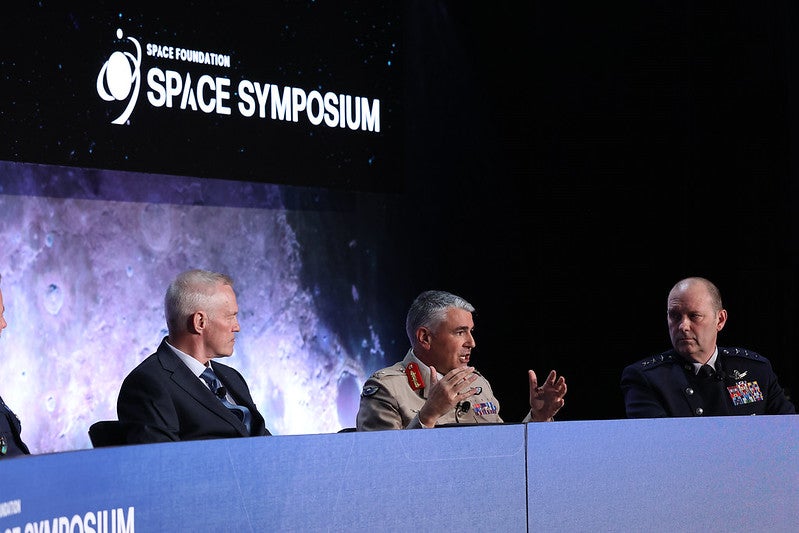
COLORADO SPRINGS, Colo. — Burden sharing in the current space domain is about how allies and partners contribute in ways that strengthen collective capability, resilience, and deterrence. This type of collaboration looks like investments in national space capabilities such as hosting critical infrastructure or contributing data and operational expertise.
Burden shifting is also about doing different things in complementary ways that allow each country to operate more effectively together in a space domain defined by speed, scale, and global interdependence. Industry experts representing five countries around the world agreed no single nation can provide every capability everywhere all the time. The advantages come from how different countries integrate what each brings.
France needs partnership in their space strategy, according to Maj. Gen. Vincent Chusseau, space commander for the French Space Command.
“We must be ready from the beginning to be able to work together,” he said. “We need for those ingredients to ensure the partnership that can be efficient from the beginning. It’s a question sometimes of policy to be able to share data, and a question of networking interoperability by design.”
There are many developments going on in the NATO command structure, said Maj. Gen. Michael Traut, commander of the German Space Command, where policies may be undergoing changes.
“NATO depends fully on national contributions,” he said. “That means that with NATO, the burden sharing is not primarily about the existence of capabilities, reliability, or availability of capabilities in order to conduct common NATO operations. But what ultimately matters to us is assured access and seamless integration into operations. We try to build up sovereign national capabilities, and our own strong capabilities, in order to be able to collaborate and contribute. Interoperability is one of the biggest issues and one of the biggest goals for Germany in strategic terms.”
Nils Andreas Stensønes, chief of the Norwegian Intelligence Service, also recognized the need for some sovereign capabilities, but said the goal is to build capabilities that complement, not compete.
“Our belief is we should aim at providing different pieces to the puzzle to make it as complete a picture as possible. Norway has some unique knowledge about the challenges that that represents,” Stensønes said. “I hope that we do not embrace the traditional European problem of competing instead of cooperating and sharing the work task.”
There is a need to focus more on data sharing than hardware development, he said. “We must all establish confidence in each other, trust in each other, so that shared data is used appropriately and cannot be compromised.”
There has been enormous progress through the U.S. Space Force cooperating with other countries over the last few years, according to Maj. Gen. Paul Tedman, commander, U.K. Space Command. “It’s proven to be a really formidable organization to bring us together and drive us towards common gold standards,” he said. “I think that’s working really well. There’s infrastructure to move data around. And ultimately, they’re aligning tactics, techniques, and operating procedures.”
From a U.S. perspective, said Lt. Gen. Douglas Schiess, U.S. Space Force deputy chief of space operations, this country has to communicate with allies and partners. “We want to make sure that, whatever we are doing together, we are building resilient architectures that can withstand some of our potential adversaries and things that they may do,” Schiess said. “We want to have redundant capabilities so that we can go from one to the other, and we can work together with that.”
The U.S. burden is that it shares with allies capabilities together with managed interoperability. “We’re stronger together,” Scheiss said. “Then when our nations align under this great allied partnership, our potential adversaries see this is not something that they want to go after.”
When asked about Germany’s capabilities to lead in some mission areas, Traut said that they are working with a limited budget and have faced restraints as a result.
“We have to focus on where Germany adds value to the collective system, rather than just merely adding another layer,” he said. “My view is that Germany should lead where it can provide enabling functions for others. Germany should rely on allies where cooperation creates greater resilience and greater capabilities than duplication.”
The United States Space Force perspective is that the space environment will always be undergoing change, Scheiss said. He emphasized its important that the U.S. shares the key initiatives and target capabilities with allies and partners for their own planning.
“If we don’t share that, then you have no idea what we’re doing,” Scheiss said. “But as we’re working together to be able to get after our collective needs, that a few nations, or maybe multi nations, are getting their needs met, and that we are getting after not just what the United States needs but what other nations need as well, and do that while being complementary to each other to get their mission done.”