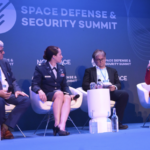
The U.K. military is seeing more evidence of network enabled capability, as officials from the U.K. Ministry of Defense emphasized the importance of satellite communications in next-generation warfare.
“We now have more capable and resilient networks,” said Cdre. Eric Fraser of the Royal Navy and assistant chief of staff at the Permanent Joint Headquarters (PJHQ) J6 Division. “There is more extensive satellite communications availability. There are now an increased number of satellite ground terminals. Satellite communications is crucial to the way we do business. There is an availability of extra channels through Skynet 5. We have been much more rigorous in information management. We can’t underestimate the challenges but improvements are being made,” he said at Global Milsatcom 2008 in London.
Group Capt. John Wariner, Ministry of Defense chief of staff for information systems and services, agreed with Fraser about the increasing influence of satellite communications in theatre. “Satellite communications is truly essential. It has worked well in theatre. The military are a satellite communications vacuum. We suck whatever capacity there is up,” he said.
While the two agreed on the growing importance of satellite communications, there have slightly different viewpoints on the role of commercial satellite operators in providing those services
Wariner believes that commercial satcom is extremely attractive. “We have to work out how we work with them going forward. However, there are issues such as response to stress, security, sovereignty etc. You have to weigh up the risks,” he said.
Fraser questioned the role of commercial satellite operators in the military arena. “The risk of using commercial satellites is their availability and there are security issues. I see a role for commercial, but I don’t want it to take over from X-band, which gives us the resilience and security we crave,” he said. “We want only a limited use of this [commercial] capacity.”
Wariner said such were the demands for information, that efficiently using scarce bandwidth resources is now a key task. “Capability should be designed with expansion in mind. We work in a multi-national sense,” he said. “We have got to find a way of utilizing the scarce capabilities we have in a more capable way.”
Information sharing between different units also is key, said Fraser. “The network stretches from the tactical level to the [United Kingdom] and beyond,” he said. “From a J6 perspective, there is a demand for a seamless network from Afghanistan base-to- base. We have the increasing problem of smaller units operating in difficult terrain. The boundaries between tactical and strategic have long gone. The demand for information intelligence is growing exponentially. There is an ever-increasing range of systems. We also see our troops working daily as part of a coalition, so information sharing is now key. We need to move information between different domains.”
Another challenge for military satcom is the need for reliability and resilience. “There are efficiencies to be made in theatre,” said Cdre. Nigel Chandler of the Ministry of Defense’s J6 Operations. “No longer can all three services use their own infrastructure. You need a common infrastructure that will give efficiency. Across the board, we are all desperately short of UHF channels. We are 30 percent short of what we need. We need to improve operational agility.”
The move to the Skynet 5 system and use of a private finance initiative (PFI) to fund the program also changed the rules of the game, said Chandler, who added that the development of a new culture in terms of the demands for capacity is essential for it to prove a success. “You need to understand the links between sensible military risk and resource. Innovation is about understanding what a PFI offers. No longer do we have to go through tortuous process of acquiring capacity. However, you need something that is assured and delivered. We need to develop a PFI culture amongst the user community. You need to get the culture right,” he said.
Wariner added, “Ownership is nothing. Capability is everything. We are now out of the business of ownership. If we owned it, we could fight with what we got. Industry is there to deliver a profit and a service. You need to make sure the vision is shared and understood between the different parties. You need to know the risks then mitigate them.”
 Hear senior officials of Europe’s leading defense ministries and industry experts share their opinions on the pace of change in this market in European MilSatCom: Trends for the Next Half-Decade and Beyond at SATELLITE 2009, March 24 – 27, 2009 at the Walter E. Washington Convention Center in Washington D.C Hear senior officials of Europe’s leading defense ministries and industry experts share their opinions on the pace of change in this market in European MilSatCom: Trends for the Next Half-Decade and Beyond at SATELLITE 2009, March 24 – 27, 2009 at the Walter E. Washington Convention Center in Washington D.C |