SpaceX reported its second quarter earnings on Tuesday reporting revenue of $7.8 billion – nearly doubling year-over-year. Leadership set a bold target of $100 billion in annual recurring revenue for this year, and made it clear SpaceX intends to challenge top U.S. telcos with Starlink.
The company’s loss narrowed year-over-year to $143 million, but CapEx ballooned by 550% year-over-year to $18.4 billion, driven by AI spend.
This was SpaceX’s first time reporting quarterly earnings after going public in June. Revenue of $7.8 billion and adjusted EBITDA of $3.5 billion beat analyst consensus, but SpaceX’s stock price fell more than 13% on Wednesday after the results.
CEO and founder Elon Musk told investors the company expects to hit $100 billion in annual recurring revenue by the end of the year. “That’s what we would achieve if we basically did nothing,” Musk said.
SpaceX CFO Bret Johnsen added that growth in all three business segments will support $100 billion in ARR, adding that cloud computing deals with Google and Anthropic are expected to ramp up during the third quarter or in October. “It’s really all three segments that are driving that, but the cloud services piece being the largest contributor of that piece,” Johnsen said.
That’s a massive revenue gap to make up for in the second portion of the year. Year-to-date, SpaceX has earned $12.5 billion in revenue.
Starlink led the company in revenue and adjusted EBITDA as the only segment to generate income from operations. Connectivity revenue in Q2 was $4.3 billion, up 66% year-over-year.
Connectivity revenue growth was driven by an increase in Starlink subscribers, with more growth in enterprise and government than consumer. SpaceX hit 12 million Starlink subscribers as of the end of the quarter, doubling subscribers year-over-year.
Space revenue, which includes the company’s launch business, posted $962 million in revenue, up 29% year over-year-year. The space business had a $542 million loss from operations.
The AI segment consumes the vast majority of SpaceX’s CapEx. The company spent $15.8 billion on AI CapEx during the quarter, more than doubling AI CapEx from the first quarter of 2026.
AI CapEx made up 86% of the company’s total $18.4 billion in CapEx during the quarter.
AI segment revenue was $2.6 billion, up 247% year-over-year due to an increase in AI solutions and infrastructure revenues from new cloud service agreements.
Starlink Mobile Eyes Telco Market
President and COO Gwynne Shotwell gave an update on the Starlink Mobile roll-out, making it clear SpaceX intends to compete with major mobile providers in the U.S.
Shotwell mentioned the “big three” in the U.S. of AT&T, Verizon and T-Mobile, with combined annual revenue of roughly $600 billion a year. “I anticipate us to be able to acquire quite a few of their customers because I think our service will be better,” she said.
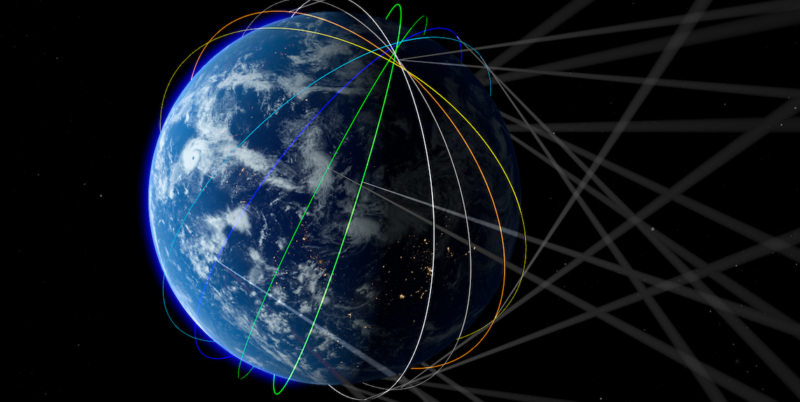
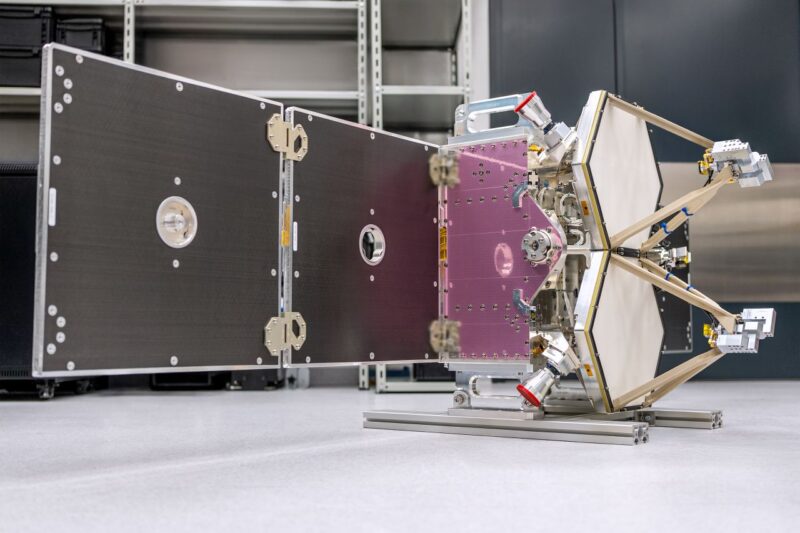
Starlink Mobile is the renamed direct-to-cell capability, separate from the broadband capability. SpaceX plans to start flying the second generation of the Starlink Mobile satellites next year, providing service by the end of next year, Shotwell said.
The second generation Starlink Mobile satellites will operate in 65 MHz of spectrum purchased from EchoStar, compared to the 5 MHz the system currently operates with. The second generation will likely be 10 times the amount of satellites as the current Starlink Mobile constellation Shotwell said, which is roughly 650 satellites.
“You could look at the Starlink Mobile leveraging this next-generation satellite and the EchoStar spectrum as being 100 times better than what we’ve got right now,” Shotwell said. “It’s a pretty decent service. You can do voice and video calls over Signal and WhatsApp. We anticipate really strong uptake of that capability.”
Shotwell also indicated SpaceX intends to build out the terrestrial side of the spectrum acquired from EchoStar. “You will have not only the capacity from the satellites themselves, but you will have a build-out of the terrestrial, basically the hardware and systems necessary to make a true mobile service exactly what you want it to be.”
Musk added that SpaceX intends to deploy a large number of small cellular base stations designed like Starlink dishes, instead of large cellular base stations.