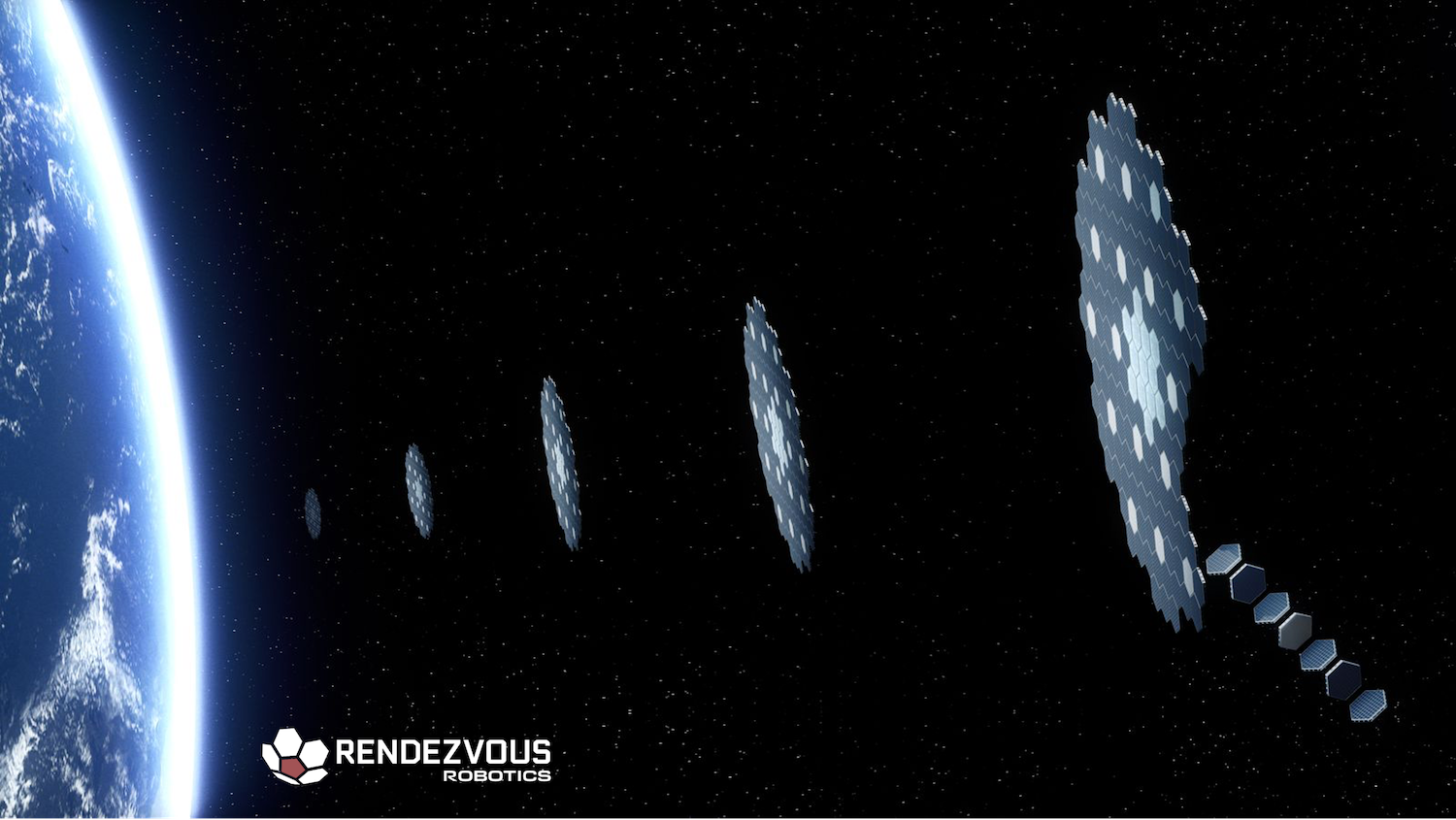
Rendezvous Robotics has shifted its focus to spacecraft that can autonomously build themselves in orbit. The company announced a $20 million seed round on Wednesday, staking a plan to demonstrate a self-assembling and re-assembling spacecraft in orbit in 2028.
Rendezvous Robotics came out of stealth last year to commercialize modular self-assembly TESSERAE technology developed by co-founder Dr. Ariel Ekblaw at MIT. The company started out focused on in-space assembly of large phased array antennas, solar panels, in-space manufacturing sites, and future space habitats.
Co-founder and CEO Joe Landon tells Via Satellite this in-space assembly technology can meet the urgent need for missions like remote sensing and communications for both commercial and government.
“Large habitats and space stations [are] all still very much in our vision for the company. But we’ve decided to focus on the missions that we know there is an acute need for today — for more performance and more flexible spacecraft,” he said.
Landon and Rendezvous want to challenge satellite operators to think beyond the launch fairing. What if satellites didn’t have to be designed to fold up inside a fairing?
“Instead of spending time and money and energy designing systems to be intricately folded up and to survive launch in that folded up form, send the parts to space and build there,” Landon says. “It’s a simple concept — but having to fit every satellite into a rocket is a ridiculous constraint that we cannot tolerate going forward.”
The company’s core technology is a stealth assembly system, made up of hexagonal tiles about 3 feet in diameter. The tiles use electromagnets to maneuver and physically latch together to establish a power and data connection. Landon explained the company builds the magnets and other core assembly systems in-house, and will work with partners to add payloads, propulsion systems, and other elements to the tiles.
MaC Venture Capital and Toyota Ventures led the financing, which also included University of Michigan Endowment, new investment from Astera, Industrious Ventures, and existing investors Aurelia Foundry, ATX Venture Partners, and Mana Ventures.
That funding will support the company through a number of upcoming demonstrations. Rendezvous has a planned parabolic flight campaign in November 2026 to further test electromagnetic actuation and mobility in microgravity.
Then it will conclude an existing TESSERAE research program with a final demonstration onboard the International Space Station scheduled for December, which will demonstrate 32 tiles autonomously assembling into a three-dimensional structure in microgravity.
The full spacecraft mission planned 2028 will demonstrate seven independent spacecraft tiles autonomously joining to form a single spacecraft, then separating and reassembling in a different configuration. Rendezvous has booked a rideshare spot for no earlier than April 2028.
Landon gives the example of a spacecraft with a failed component, where one new modular element can be sent to orbit to swap out.
“If you have a spacecraft that’s modular and assembled in space, you can change out the parts that need to be changed or upgraded,” he says. “If you want to change one part — instead of starting over and building a new satellite, which is what we have to do today — just send one tile up and replace the one part that needs to be fixed.”