
Telesat is pushing back the full entry into service for its Lightspeed constellation by three months as it deals with a tight launch market to get its initial two satellites to orbit.
CEO Dan Goldberg updated investors on the Lightspeed deployment schedule on Thursday, while saying that the recent situation with Starlink disruptions in Ukraine have put even more focus on the role of low latency satcom as “essential.”
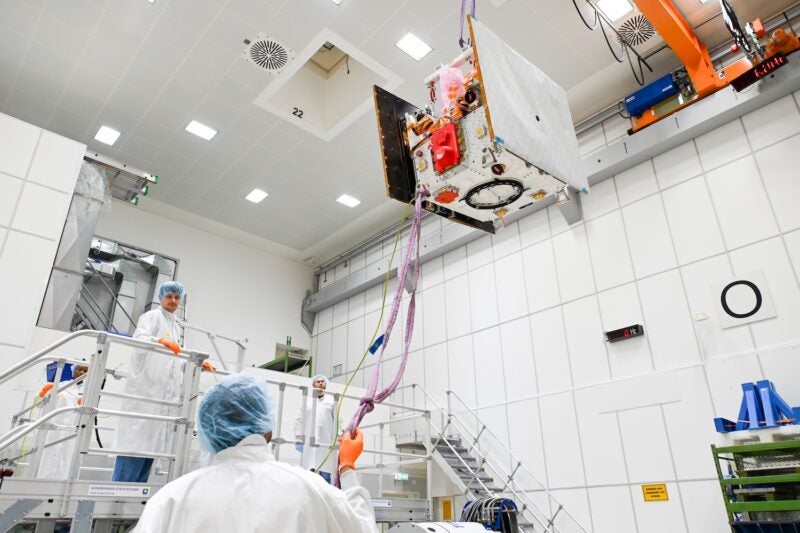
Before launching the full Lightspeed constellation, Telesat will launch two initial satellites for testing. Goldberg said that Telesat is dealing with the tight launch market and is “loath to use one of our valuable Falcon 9 launch slots” for two satellites. Instead, Telesat will piggyback on a third-party Falcon 9 rocket, set to launch in mid-2027.
Those satellites will test in orbit for about two months, before Telesat proceeds with its Falcon 9 launch campaign with 15 satellites per launch. Goldberg added that the two satellites are not yet ready for launch, but will be ready in time for the launch opportunity around June 2027.
This pushes back the start of global service from the end of the first quarter of 2028 to the end of the second quarter of 2028. Telesat is also altering its deployment to support service in Canada.
“To mitigate that slight delay, we’ve altered our satellite deployment strategy so that we can still support service in the higher latitudes by the end of Q1 2028. Which means we’ll be able to start the services for the Canadian military in the Arctic under the ESCP-P program, as well as our other northern rural broadband services, as previously planned,” Goldberg said.
The initial satellites were previously expected to launch by the end of this year, and the service launch had already slipped from late 2027 to early 2028.
Impact of Starlink/Ukraine Disruptions
The Starlink and Starshield disruptions in Ukraine in the last few weeks have “animated various governments,” Goldberg said. “The way modern warfare is waged right now … having a high throughput, low latency, highly resilient network has become really essential.”
He was asked about how Lightspeed will work with sovereign governments in regards to terms of service, and said that in Telesat’s experience working with allied governments, customers are required to comply with the law and all the applicable regulatory frameworks.
“We would be in close coordination with the government of Canada in particular to make sure that you know we’re onside in terms of the use of the network,” Goldberg said. “And the government of Canada would have its own relationships and understandings with allies who would make use of the constellation … that’s how we would approach it.”
Goldberg said Telesat is “bullish” on the pipeline to sign meaningful contracts over the next year, “from those conversations and the environment that that we’re in right now.”
Q3 Financials and GEO Debt
Telesat’s GEO business continues to decline as expected throughout the fiscal year, as revenue declined 20% to the same time last year.
In the third quarter, Telesat reported $81 million Canadian dollars ($58 million) in revenue. Adjusted EBITDA of CA$12 million ($8.5 million) was a decrease of 74% from the third quarter of 2025.
This GEO revenue decline has been ongoing throughout the year with non-renewal and reduction in service for broadcast customers. Telesat maintained its GEO revenue outlook of CA$300 million and CA$320 million — which will be a nearly 26% decline at the midpoint.
“In our GEO business, we continue to be laser-focused on maximizing the revenue and cash flow from our existing GEO satellite fleet while at the same time taking a highly disciplined approach to cost management,” Goldberg said in a release.
Goldberg said Telesat is still working to refinance the Telesat GEO debt, which begins to mature later this year.
According to its financial filing, the operator has a total of CA$3.1 billion in debt (about $2.2 billion) that will mature between December 2026 and October 2027. The company’s cash flow and resources are not enough to meet these debt obligations.
“Our advisors continue to seek good faith engagement with the Telesat GEO debt holders, and we’re evaluating other alternatives as well, with the goal of reaching an outcome that’s fair to all stakeholders,” Goldberg told investors.