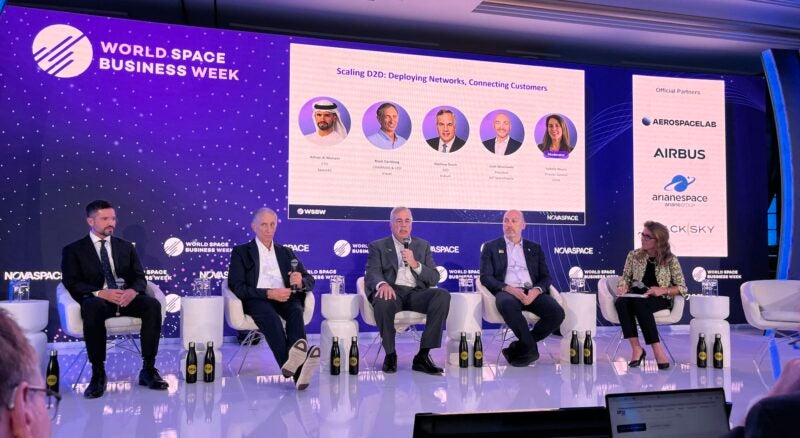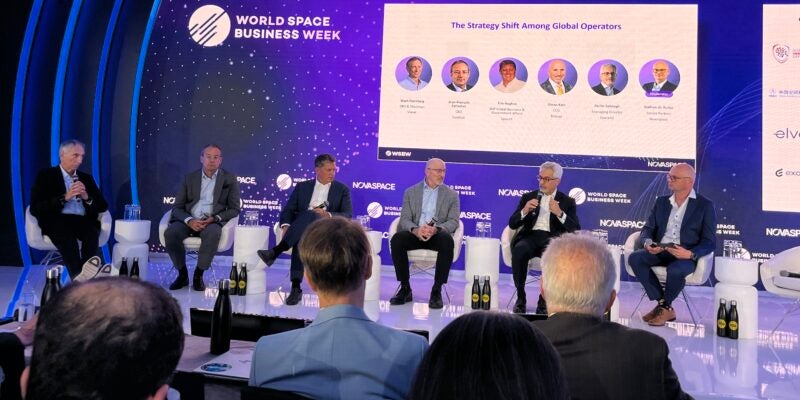
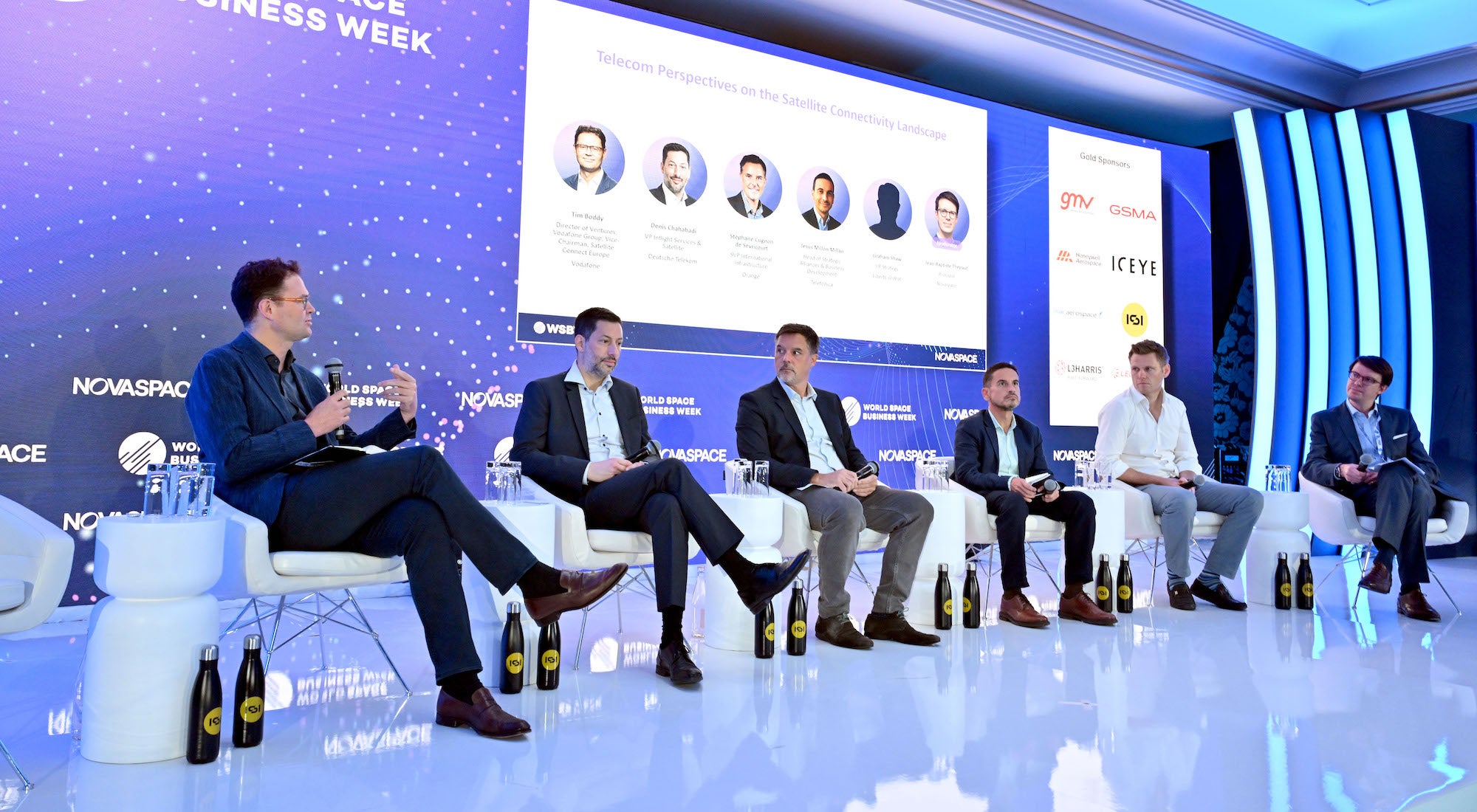
PARIS — How important will direct-to-device services be to mobile network operator offerings? The jury is out as European MNO execs disagreed on the value proposition and what they’re willing to pay for such a service during a discussion at World Space Business Week on Wednesday.
Deutsche Telekom, Orange, Vodafone and Telefonica — all of which were on the panel — are reportedly in talks to create a consortium to bid on the European Union’s MSS spectrum under a new proposal which will allocate much of the spectrum to EU-based operators. Bloomberg first reported the MNOs are in talks.
Jesus Millon Millan, head of Strategic Alliances and Business Development for Telefonica, confirmed there is “a group” that is studying the issue with the European Union, saying a decision could potentially be made in the coming weeks or months.
European sovereignty is an issue, Millan said, with the goal to avoid “an external operator” taking all of the spectrum in the region.
“It’s not only the operators; it’s the government, the European Union,” Millan added. “It’s something that we have to decide … what is going to be the future. It’s complicated.”
Tim Boddy, director of Ventures for Vodafone Group, said the company has responded to the official consultation and has not commented on any speculation. Yet he also talked earlier in the discussion that it’s “natural” for MNOs to partner to shape better industry outcomes.
“One industry outcome we obviously need to avoid is a monopoly. We have one very big player in this industry who has an incredible head start in broadband, less so in direct-to-device. We need to create competition,” Boddy said. “In the world we live in now, there are sovereignty objectives that regions and governments have, and there are opportunities to share spectrum. Some level of partnership can make sense as an industry.”
Debate Over D2D Utility
Mobile coverage in Europe is strong and roughly 98% to 99% of the population is covered by mobile networks, Stephane Cugnon de Sevricourt, senior vice president of International Infrastructure for French telco Orange, emphasized — meaning that D2D is an edge case service in Europe.
“It’s the 1% that when you miss the connection [it] potentially could be an issue in terms of emergency call. …In terms of the value proposal, it can be very critical for customers when you’re lost and you lose the connection,” de Sevricourt said. “It’s very different for the U.S. or the African market, where the population coverage gap can be much higher.”
Orange offers SMS by satellite in Europe through a partnership with Skylo. de Sevricourt said the number of devices for the solution is limited today. Orange currently includes the service in Google Pixel plans through the end of this year; afterwards it will cost 5 euro.
“We are progressing, we are learning,” he said. “I think it’s a pretty long journey together with SNOs [satellite network operators] as well to understand the way we can monetize the service and if it’s a volume-based service or if it’s a premium service.”
Graham Shaw, vice president of Strategy for Liberty Global, which operates in the the U.K., Netherlands, and Belgium, called D2D just a “nice to have” in a region of Europe with strong 5G coverage.
“There’s massive uncertainty on the customers’ willingness to pay for these types of products,” Shaw said. “Customers are used to prices going down, if anything. We are starting to see competition from a lot of low-end MVNOs on prices. The big question mark for us is [are] customers willing to pay for this enhanced coverage or reliability?”
Shaw believes that if the five to six prospective satellite D2D market entrants successfully enter the European market in the next few years, it will be an oversupply. He believes prices should be lower for the service in Europe because there isn’t as much value as geographies like the U.S. or Africa where there are more gaps in mobile coverage.
Yet any time disconnected drives an emotional response, argues Vodafone exec Boddy, who also serves as vice chairman of Satellite Connect Europe, the joint venture between Vodafone and AST SpaceMobile. Beyond the 1% problem, Boddy also believes satellite can solve the “1-bar problem” of coverage holes within the network, and more critical use cases.
“The fear of disconnection is emotionally a big driver for customers from the testing we’ve done — so even that 1% can matter,” Boddy said. “I think this idea of having a permanent, premium layer of connectivity, people will pay for in specific scenarios for resilience, not just public sector/enterprise customers. There are a lot of use cases beyond coverage for direct-to-device.”
Germany’s Deutsche Telekom made headlines in March as the first partner to sign on for SpaceX’s second-generation Starlink Mobile service. This service will require new satellites from SpaceX and will operate in mobile satellite services (MSS) spectrum SpaceX purchased from EchoStar. SpaceX President Gwynne Shotwell has said the service will be “100 times better” than the current direct-to-device offering.
Denis Chahabadi, vice president of In-Flight Services & Satellite for Deutsche Telekom, said the telco was intentional about choosing a next-generation service.
“We would like the seamless customer experience, which means we would like to see 5G-like services,” Chahabadi said. “We don’t just want to see SMS and voice or narrowband — we really would like to transfer that experience also to the satellite layer. That’s why we will go out only when we have that capability.”