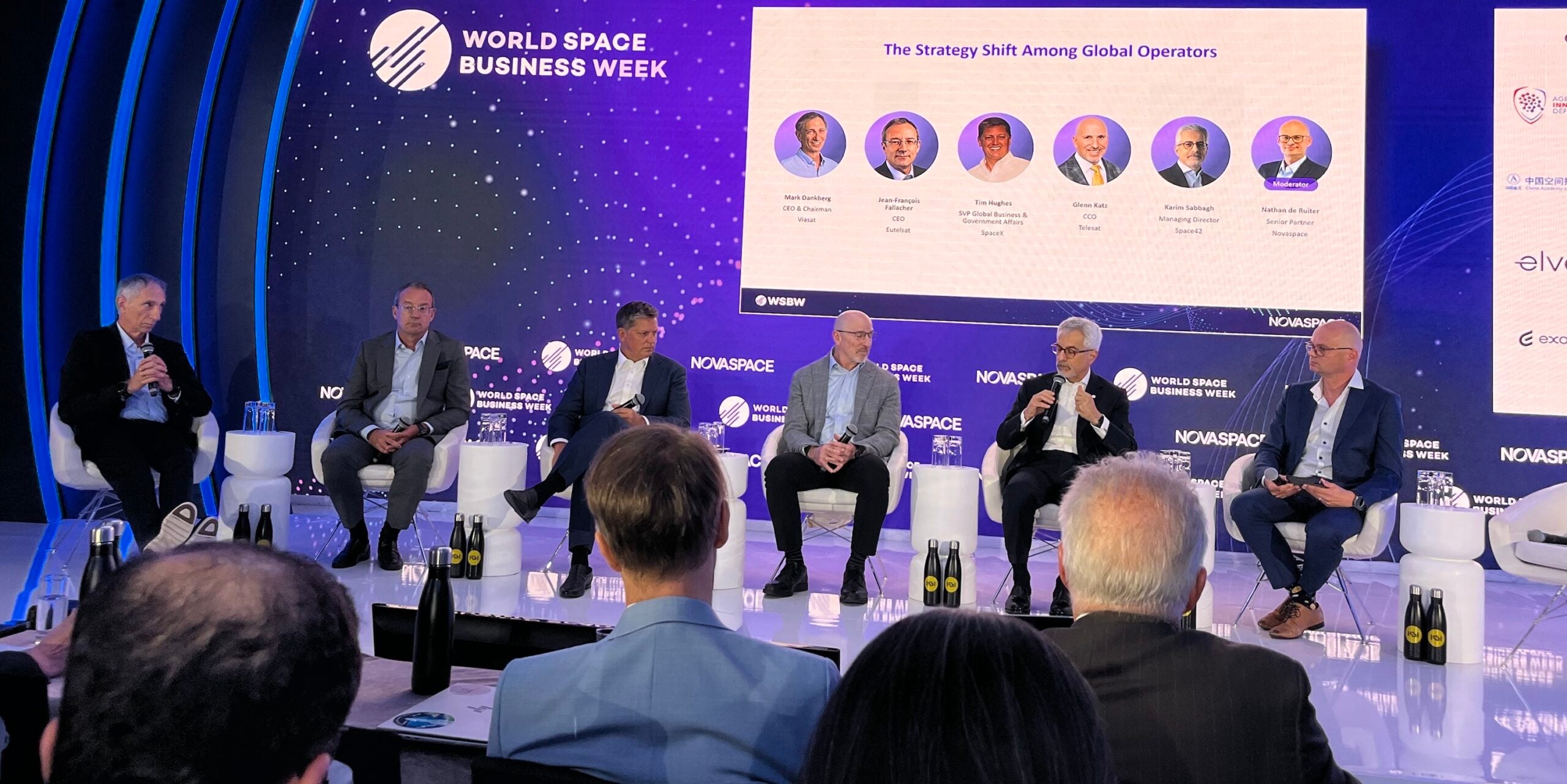
PARIS — Satellite operators find themselves at the intersection of sovereign space strategies, capabilities across multiple domains, and integration and collaboration with the tech ecosystem and AI.
These issues drove the discussion between top satellite operators at World Space Business Week, a sign of how much the operator business has evolved from selling capacity to commercial markets.
“We’re moving from a world that is quite monolithic,” said Karim Michel Sabbagh, managing director of Space42. “Had we had this conversation in 2016, we would be talking about high throughput satellites and payloads and digital processors. It was a very different conversation. Here we are covering multiple domains, vertical and horizontal integration, and integration of launch-based capabilities.”
As operators expand deeper into defense and security, continuing to provide services throughout geopolitical changes is one of the most important metrics and one that UAE-based Space42 has had to address head-on, Sabbagh said.
“I think it’s accurate to say that Space42 is the only global satellite operator that had to demonstrate continuity of operation in a very dynamic environment,” he said. “The No. 1 value we put on what we bring to the table as an operator is the ability to demonstrate continuity of business, even in a very dynamic environment. I know it’s easier said than done, but we’ve gone through this experience. We’ve passed the test.”
Canadian operator Telesat is taking a more direct role in Canadian military communications capabilities by adding Mil Ka-band satellites into its Lightspeed constellation and subsequently securing a nearly $2 billion contract from the government of Canada for Arctic military satcom connectivity.
Although Telesat Lightspeed has faced numerous delays, the delays coinciding with increased government demand resulted in “lucky timing” to add Mil Ka- to the constellation, said Chief Commercial Officer Glenn Katz.
“We saw what was happening around the world with satellite communications relative to the geopolitical situation and said, ‘What else can we add to this constellation to move into a market that’s really untouched in the LEO world, which is Mil-Ka,’” Katz said. “Besides the frequencies of Mil-Ka, there is a whole suite of attributes that are specific for military and defense use on a LEO network.”
French operator Eutelsat is also joining its commercial future to sovereign space, as its LEO contribution to Europe’s IRIS² will form the second generation of OneWeb through a public-private partnership model.
Last week, Eutelsat ordered an additional 229 OneWeb refresh satellites, and 264 satellites for the LEO component of IRIS². CEO Jean-François Fallacher explained that once the more than 600-total refresh satellites are launched, OneWeb will have a constellation of around 1,300 satellites. Some of which will replace aging OneWeb satellites, others will strengthen the constellation and add capacity. This will be followed by the IRIS² satellites.
“In 2032, we will have 66 [Mil Ka-] and 264 IRIS² satellites flying. This is the moment at which we will start migrating our customer base — which will be using OneWeb Gen 1 and Gen 1.5 — slowly migrating to the Gen 2 constellation, which will be the commercial part of IRIS²,” he added.
Fallacher pointed out that SpaceX’s IPO and related disclosures helped illustrate how important government anchor customers are. He pointed to unnamed customer detailed in SpaceX’s prospectus, understood to be the U.S. government, which accounts for 20% of the company’s revenue.
“It was a way to open the eyes of a number of our authorities in Europe that the space sector is very capital intensive and having anchor public contracts is of the essence,” Fallacher said.
Although SpaceX isn’t a “traditional” satellite operator as a LEO-only player, its push into AI also illustrates how space is colliding with other industries.
Tim Hughes, SpaceX senior vice president of Global Business and Government Affairs, compared SpaceX’s connectivity initiatives to a “layer cake” of broadband, direct-to-device, and AI in space. All of these layers are enabled by Starship, which is the company’s largest strategic bet, he said.
Starship has not entered commercial service but the upcoming flight planned for Sept. 18 is targeted to be the first to deploy operational Gen 3 Starlink satellites.
“We will grow the AI side of the business in space and terrestrially. I think space deployment of artificial intelligence will address a lot of the questions that are of such great concern globally about terrestrial-based AI,” Hughes said. Space is a great place to address that. It is a critical part of our overall journey, but it combines with these other elements: the broadband system, the direct-to-device capability, and let’s not forget that we’re also hoping to make humanity a multiplanetary species.”
Viasat has long been a part of different parts of the value chain building technologies and working in the defense business. Part of the company’s expansion is the move into direct-to-device as a founding partner in Equatys with Space42. On Monday, the partners announced an agreement to formally establish Equatys as a shared space and ground infrastructure platform with an initial equity contribution of up to $1 billion.
Dankberg said the governance structure of Equatys has been a critical discussion, because individual countries want a say in the way that mobile networks are operated within their countries. LEO satellites are inherently global, but the interests of mobile networks are inherently national, he said.
“It makes complete sense if the countries and regions cooperate in a way where they each don’t have to try to compete with whoever invests the greatest amount of capital,” Dankberg said. “You can aggregate that capital — to do that you need a scalable constellation. The big thing that we’re really betting on is that concept of shared infrastructure, which on a national scale works very well with tower companies, but can be made to work on a global scale with regions and nations.”