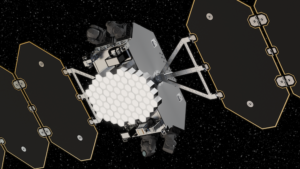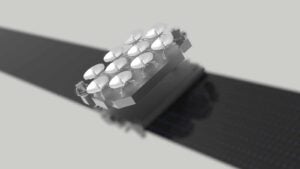
COLORADO SPRINGS, Colo. — Developing orbital space data centers has become more appealing because of reductions in satellite launch prices, and a demand for alternatives to terrestrial data centers. Access to 24-hour solar power, and a more accepting attitude about data centers in space by business and the general public, are just a few of the factors behind the push to build out orbital data centers, experts said Wednesday during Space Symposium in Colorado Springs.
“We sum it up rather simply,” said Dennis Gatens, president of LEOcloud, now part of Voyager Technologies. “There’s real advantages [to] deploying cloud capability in space. That’s the net of it.”
Philip Johnston, co-founder and CEO of Starcloud, explained some of the drivers to build orbital data centers is because data center developers are running up on constraints about where new high energy projects can be built terrestrially. “In space, we can take advantage of the almost limitless low cost energy in the form of solar,” he said.
Sophia Space, represented by CEO Rob deMillo, is focused on doing space native computing. “Our end goal is orbital data centers,” he said. “But initially we’re working on servers that work within the constraints in the orbital environment, which means thermal shedding and concentrations on automation on the platform itself, and how to get those to scale out in a way that makes sense for an orbital environment rather than a terrestrial environment.”
Lonestar Data Holdings is building up a cloud above the clouds in space, which CEO Steve Eisele described as a resilient layer focused on securing data storage. “With the AI revolution, and LLMs and everything else, that all generates about 100 quintillion bits of data every day,” he said. “Currently it sits in data centers, and these data centers are being overburdened with power, with policies, with location needs. Space becomes an attractive alternative, and part of that is because you’re looking at it from a secure, physical, isolated place to store data, especially if you’re looking for immutable data that you need to have absolutely secure for continuity of operations resiliency purposes.”
Salem El Nimri, CTO of AWS Aerospace and Satellite division, offered a different take.
“I’m going to bring it back down to Earth,” he said, referring to his work with Amazon Web Services. “We established an Aerospace and Satellite business unit that is basically focused on servicing and supporting all the commercial aerospace companies and all the pursuits in moving to space, operating in space, and providing all the services that we can.”
In his mind, an orbital data center is dependent on the structure. “If you’re going to look at it from the perspective of it being on a space station, then it’s going to be more about the maintenance of the hardware,” he said. “If you’re going to look at it as more distributed, where you have compute on different satellites, and they are interconnected, then you need to look at the algorithms that you need to use and leverage to orchestrate the compute when it has to happen on multiple satellites at the same time.”
Compute is one of the three main components of data centers, Eisele said, along with telecom and storage. “Data storage in space fundamentally is not really a hard problem that needs to be solved,” he said. “There has to be the appropriate radiation shielding. But as we’re working a kind of proliferative LEO model to start, we’re building in resiliency as well. All of that has to be thought through. It has to be studied. It is a balance between finding those commercial ready components, and then space hardening them from a data storage perspective.”
He said that all of orbital data center developers are not trying to reinvent data centers, but create a new infrastructure layer that’s a hybrid Earth-space data center network that is going to complement each other and work together.
“Space just punishes terrestrial assumptions, it just does,” deMillo said. “Physics is always going to be with us. So we’re taking the approach that the problem to solve first is the thermal shedding problem. Designing systems that don’t need large heat pumps, that don’t need shielding to protect those heat pumps, that don’t need infrastructure around those heat pumps. Having that heat scaling problem solved from the get-go is job number one,” he said. “Everything falls in line after that.”
The cost of launches for building an orbital data center has always been an issue — down from $56,000 a kilogram a few years ago to $2,800 a kilogram today, according to Johnston. “My expectation is on the order of three to five years, we’ll be seeing frequent Starship launches. That’s going to enable huge amounts of mass to orbit, and that enables cost competitive data centers in space versus terrestrial.”
As the technology matures, and obstacles are overcome, Eisele said that he wanted to mention small victories that go a long way.
“Who here six months ago thought data centers in space was a thing or a good idea? It’s amazing how much momentum we’re putting in our efforts. And we’re going to push forward. It’s remarkable. Suddenly we all look like the smartest people in the room.”