
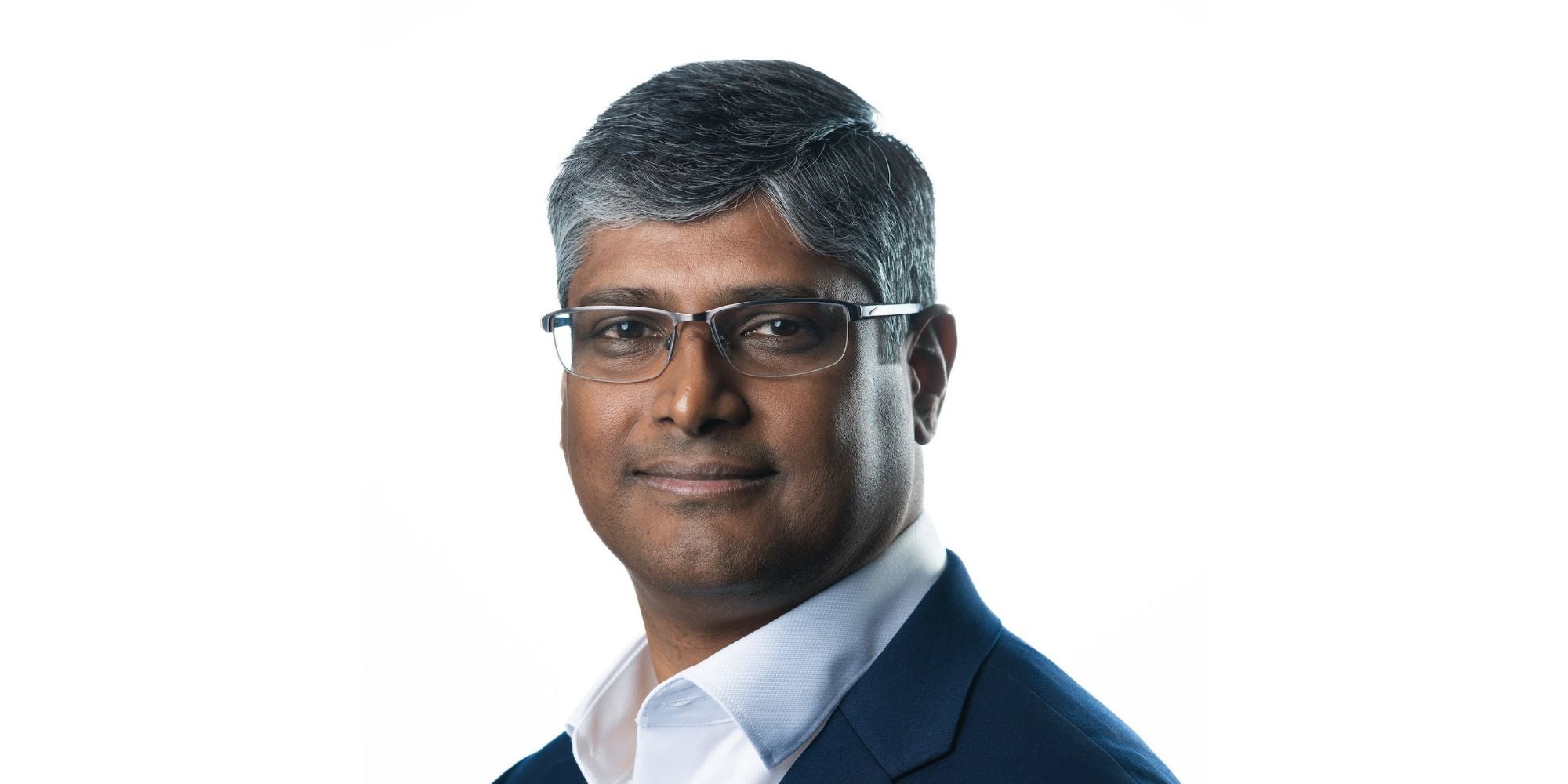
In late March, ST Engineering iDirect appointed Sridhar Kuppanna as its new CEO as the company navigates an increasingly dynamic and evolving market for ground tech. With Starlink shaking up the market not just from an operator perspective, but also with its vertically integrated approach, competition for ground tech solutions is increasingly competitive.
Kuppanna takes the helm as CEO after leading the company’s technology roadmap and product strategy as CTO including advances in cloud‑native, multi‑orbit connectivity and 5G non-terrestrial networks (NTN). In his first major interview as CEO, Kuppanna talks about the company’s roadmap, the impact of Starlink, the opportunities in sovereign space and why he’s optimistic that satellite is no longer niche, but part of a large communications ecosystem.
VIA SATELLITE: You have taken over at an interesting time for the company given the state of the market. Will the company change direction in any dramatic way after Don Claussen’s departure?
Kuppanna: We have a strong vision and strategy. I don’t see a need to change our direction significantly at all. But having said that, the market is pretty dynamic, so we will be nimble and respond to the market needs. I would say our focus is on pristine execution of our strategy to drive value for our customers and continue to drive and lead the modernization of the satcoms infrastructure.
VIA SATELLITE: With your previous experience with ST Engineering iDirect as CTO, will you take a different approach with technology solutions? How do you plan to evolve the company’s tech approach?
Kuppanna: In my previous role as a CTO, I worked with the rest of the leadership team to come up with the product and technology strategy and the roadmap. Having met with many of our customers over the last couple of years and receiving positive feedback on our strategy, I do believe that we are on the right track from both the technology and product strategy point of view.
We want to continue to focus on key pillars. The first one is going to be digital transformation. This is all about evolution towards cloud, native, scalable, secure, software-defined architecture and solutions. The second one is going to be the convergence of the terrestrial, non-terrestrial network (NTN), ultimately trying to deliver ubiquitous connectivity that leverages assets across all the orbits.
It is going to come down to moving towards standardization, evolution towards software and, most importantly, interoperability. That’s going to be critical as we move forward.
VIA SATELLITE: You have experience in the networking and telecom industry, how does that inform your perspective for the satellite industry?
Kuppanna: I think one of the things in the telco industry, and this dates back several decades, is how they use standards. The telco world moved away from bespoke solutions a long time ago. Standards, whether ITU standards or IETF standards, or what we know now as the 3GPP standards for the wireless have been around for quite some time. The telco industry has been doing this for quite a long time, which leads to interoperability, and avoids vendor lock-in. Because it’s a standardized, interoperable platform, you could deploy solutions from multiple vendors in a given network. If you go to Verizon, AT&T, BT, or Deutsche Telecom, you will find that they have network equipment from multiple vendors that interoperate seamlessly with a common management and orchestration layer.
By doing that, they are able to leverage a common infrastructure, to deploy these solutions. With the 5G evolution, every piece of equipment is already virtualized and it’s cloud native. So you don’t have bespoke hardware solutions that are as dominant as they are in the satcoms industry today.
The evolution towards cloud was much easier in the telco world, and that happened about 10 years ago. It started with OpenStack. Most of our customers adopted OpenStack about 10 years ago in telco, and we built our network functions that could be deployed as a virtualized machine, and then it evolved more towards cloud native, Kubernetes-based architecture lately.
In the case of the satcoms industry, what we are going to see is that you are not going to go through the intermediate stage of virtualized machines and OpenStack solutions. It is going to directly jump to a Kubernetes-based cloud native architecture, instead of going through that intermediate hop.
VIA SATELLITE: ST Engineering iDirect has been going through a turnaround effort under parent company ST Engineering. In November of last year, ST Engineering said the turnaround effort was “taking longer to show results.” What needs to happen next?
Kuppanna: A lot of the dynamics have to do with how the market is evolving, the momentum shifts and timeline shifts due to the disruption that we had. And it’s no secret that Starlink coming in has disrupted the market pretty significantly.
I joined in 2023. When I attended conferences, the tone was pretty much, ‘What do we do now?’ Because Starlink is here. It is growing, and everybody was faced with this new world that they’ve not prepared for. Over the last 12 months, I’ve seen a significant shift-at SATShow this year, or even World Space Business Week last year. I observed a different trend, with a renewed focus and energy. The incumbents are now focusing more on innovation and looking at how to solve different kinds of problems. There is more emphasis on multi-orbit solutions to better compete, reducing the operational cost, moving towards virtualization. It has led to greater focus and acceleration of all the things that the incumbent should have been focused on to begin with. But sometimes you need disruption.
We are pretty optimistic that the market will settle down and players will find their niche. And one of the good things that Starlink has done to bring about a change in terms of the addressable market for the industry itself. It has accelerated virtualization. It has accelerated paths toward converged networks with 5G NTN, and the conversion between terrestrial, non-terrestrial. It is going to increase our target addressable market. We are not just going to be in this niche space, but it is going to be a broader market segment that we can target. We are optimistic that we are going to be turning the corner with this opportunity. We launched our new platform with all the key capabilities. We are positive that the results are going to show in short order.
VIA SATELLITE: SES CEO Adel Al-Saleh has recently talked about how SES is looking to vertically integrate. With Amazon Leo and Starlink already going down this road, what do such strategies mean for ST Engineering iDirect, as well as other ground segment players?
Kuppanna: Ground infrastructure is a critical component to this entire solution. Even though our customers are talking about vertically integrated solutions. I don’t think that equates directly to a system like what Starlink has.
There is going to be tremendous value in adopting standardization, and you can offer vertically integrated solutions using a standard, interoperable ground infrastructure without being vendor-locked. I do believe that when we talk about vertically integrated solutions, it can be by adopting standardization, still being vendor-agnostic, having a multi-vendor solution, and using common infrastructure to deploy a software-defined solution. Most importantly, I do believe that gone are the days when the customers used to think about these bespoke solutions as vertically integrated solutions. It is going to be a more open architecture, enabling more vendors to come in and compete for the ground infrastructure to leverage the best technology. However, you can still offer a vertically integrated solution value, but by allowing more vendors to play with more innovative solutions. This also brings down the cost.
You are going to find more vendors competing at cost and at higher value. If I look at again the telco industry, you are going to see that there is gear from Ericsson, Nokia, etc. You are going to see lot of these vendors providing network gear to these large operators. I do see that kind of trend playing here as well. You can still bundle it up with common infrastructure, common management, orchestration, and offer integrated services to the end user.
VIA SATELLITE: It seems all across the value chain, companies are finding it difficult to compete with Starlink. Your predecessor talked about that challenge a lot. Do you think the company has gotten a handle on that challenge?
Kuppanna: I do. There are certain segments in the low-end consumer market and some of the commercial verticals are going to be a challenge to beat and compete on price. I don’t think there is any dispute on that.
But having said that, I believe convergence and standardization is going to bring down costs. And the reason for that one is you have more satellites being launched. You are going to see a lot more bandwidth available. The bandwidth costs are going down. You also have the geopolitical dynamics that will play a big role. We are going to see more emphasis on sovereign networks, critical infrastructure. You are going to see more countries wanting to own their own network. You are also going to see that the regional operators are going to play a significant role. That is because the countries use satellite communication for critical infrastructure, their defense use cases and sovereignty is going to become extremely important.
When you think about high value critical infrastructure, they don’t want to be locked into a single vendor, whether it is Starlink, Amazon or any other. You are going to see more multi-vendor solutions that they can pick and choose between multiple service providers to have a resilient, robust infrastructure that protects them from not only availability and resiliency, but also from the geopolitical dynamics.
VIA SATELLITE: You mention sovereign networks, which have been a large topic of conversation recently. How does ST Engineering iDirect fit into the conversation around sovereign space?
Kuppanna: We are working with many of our customers who are looking for sovereign networks. There are various layers of sovereignty. The base level is they will acquire gear from trusted partners, but they would like to have complete control over the operations of that network. The second tier is they will they want to control the operations, but also have certain elements of the network, especially around cryptography, security and those kinds of use cases that they want to layer on top of the platform that they control. The third tier is complete sovereignty, in which case they want to be able to manufacture the components. They want to have complete control over the waveform and the security technology. In many cases, they also want us to recruit people locally in those geographies for building the product or the use of the product that they consider as sovereign. We see lot of those kind of asks.
The good news is we have expertise in building waveforms. You have seen with the European Protected Waveform (EPW) that we are developing, we have the ability all the way from the physical layer to the application layer to be to cater to these needs and build the solution specifically for these customers as well.
We have the technology know-how, and we have the experience deploying incumbency in MoDs, and we can definitely meet the customer requirements in that area. The 450 modem we recently launched is a software-defined modem that can host multiple waveforms. By allowing multiple waveforms to be hosted, it enables sovereign networks to operate with their own waveform, but also have another waveform simultaneously hosted to enable them to roam with other partners if needed. Multi-waveform software defined radio modems are going to be important.
VIA SATELLITE: Could you tell us about the traction that ST Engineering iDirect has seen for Intuition and what the levels of take-up have been? Would you say it has been a success so far?
Kuppanna: We launched this product last year and it has received a positive response. The timing was appropriate, because the customers are being to get their footing back after being disrupted by Starlink. The RFP activity has been strong, so we are going to be deploying our solution at some of the key operators and customers. We have responded to more than two dozen plus RFPs over the last few months, so the activity from our customer base has been good, and the interest has been good. We do expect that we are going to be getting a lot more traction as we move forward.
Unbound, our ground-infrastructure-as-a service offering, is gaining lot of traction because from a business model point of view. It aligns very well with our regional operators and lot of our customers who are crunched on capital for now. They don’t have the capital to spend heavily on CapEx, but they have the cashflow and they have the OpEx to spend. So having the Unbound offer there is helping us gain traction with many of our customers as well.
VIA SATELLITE: Finally, what do you hope to achieve in the first 12 months of being the CEO?
Kuppanna: As I look to the future, I will refer back to my previous role as the CTO and head of product. I have been part of this transformation journey over the last couple of years and I have played a significant role in leading the technology product strategy, launching the Intuition platform, the four pillars that I talked about, the Intuition core for the gateway, the edge strategy that we have, the 4-series modem and other modems that we have in the portfolio.
We also have AI-driven technology for driving automation and the management and orchestration layers and a flexible go-to-market strategy. These things are going to be positioning us well as we move forward. For me, success would look like growing revenues in the market. And it should be a profitable revenue.
Our acceleration of adoption of Intuition will be a key objective of ours, and helping our customers evolve more towards cloud native architecture, more towards standardization, driving the five-year adoption and convergence of terrestrial non-terrestrial networks, enabling seamless roaming. We will be aiming to bring AI for modernization of the management and orchestration layer, and this is going to be critical. I will be looking to establish a culture where we focus on our customers — everything we do must revolve around the customers.
Correction: A previous version of this story misquoted Kuppanna in reference to the ‘Kubernetes-based cloud native architecture’