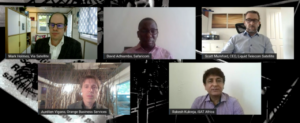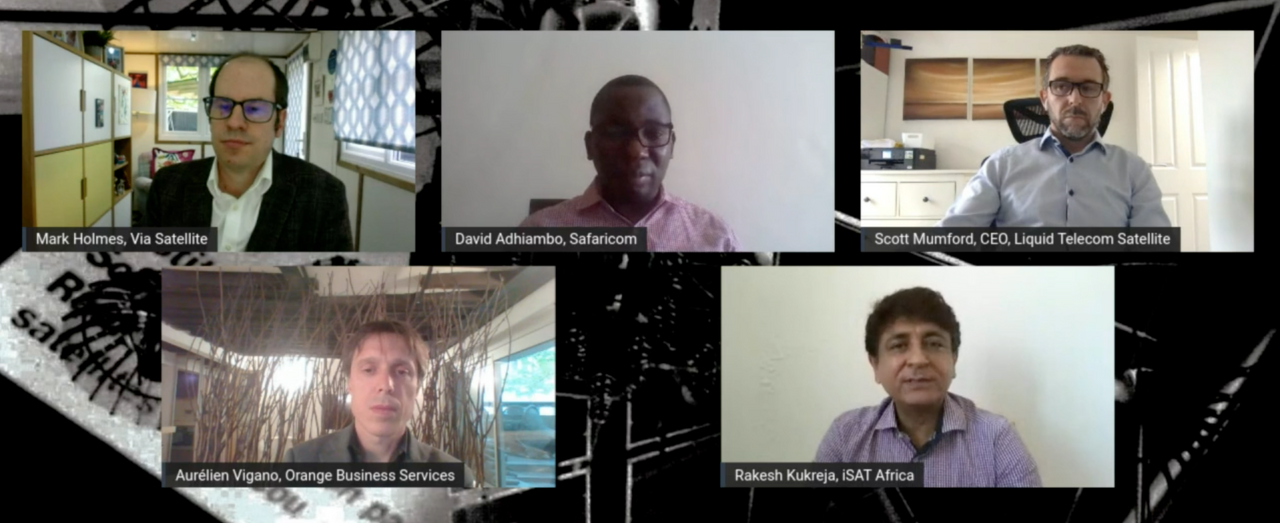
Executive leaders from four regional telco and Mobile Network Operators (MNOs) did not pull any punches when discussing their sometimes frustrating relationship with satellite service providers during SATELLITE 2021’s EMEA + Asia virtual conference on Wednesday, May 19.
While telco/MNO panelists expressed excitement for new satellite technologies and services, especially in Low-Earth Orbit (LEO), they also shared concerns about satellite industry value chain issues that they believe are driving up the costs of bandwidth.

Explore the Show Daily 2021 EMEA/Asia Digital Forum Issue
Check out more from this issue and find your next story to read.
Safaricom Transport and IP Planning lead David Adhiambo best explained what’s at stake for satellite operators in maintaining good relationships with telcos. If satellite operators are genuine about reaching the billions of unconnected customers on the other side of the digital divide, they need to provide regional telcos with large amounts of bandwidth at low costs, according to Adhiambo.
“Telcos have always characterized the satellite industry by very high costs,” he said. “The nature of partnerships with satellite operators is naturally long-term because of how difficult it is for telcos like us to switch providers. Historically, this has locked us into high costs.”
Adhiambo sees the entrance of new satellite systems in LEO and Medium-Earth Orbit (MEO), as a big opportunity for African telcos to finally overcome their years-long struggle to penetrate services deep into rural Africa, where connectivity is needed most. “Before these new LEO and MEO systems, backhaul was very limited for us in the Africa region. In most cases, we were only able to provide voice services. Now, we see the potential to incorporate new satellite services to meet the demands of customers that are hungry for the next-gen data 3G, 4G and 5G applications that they see around the world. Safaricom can only realistically reach those customers if we get competitive rates on bandwidth that will reduce our cost of carry.”
Rakesh Kukreja, managing director of iSAT Africa, joined the consensus reached by fellow panelists by stating that telcos need to see better pricing from satellite service providers. He believes that the satellite industry can lower prices by clearing up confusion along its value chain.
“There was a time when the satellite industry ecosystem of satellite operators, service providers, equipment manufacturers, integrators, and installers were all in sync with each other,” said Kukreja, referring to a time when the satellite industry was much smaller. “As connectivity markets evolve, that synchronization seems to have disappeared. Each segment of the satellite value chain has different ideas of how to serve today’s market. Not being on the same page creates overlap, which kills innovation.”
Aurelien Vigano, vice president of International Transmission Networks for arguably one of the satellite industry’s largest customers, Orange Business Services, said that the relationship between telcos and satellite operators has never been more important to the future of connectivity.
“We feel like we have a very close relationship to satellite operators, which makes it even more frustrating when you see that their manufacturers and equipment providers aren’t always on the same page in terms of how to best serve us, the customer,” said Vigano. “With some satellite operators, the problem seems to be confusion about the identity of their own businesses. Some aren’t sure whether or not they’re competing with us or partnering with us. It’s hard to build win-win relationships in that kind of setting.”
Liquid Telecom Managing Executive Scott Mumford, like his peers, agreed that partnerships with satellite operators are essential to bridging the world’s still vast digital divide. His frustrations with forming productive partnerships with satellite providers stem from high terminal costs.
“The satellite industry’s lack of movement toward an open standards base for terminal equipment is very frustrating for me,” said Mumford. “The continued development around proprietary systems, especially in the VSAT [Very Small Aperture Terminal] arena, is a real issue. That keeps price points high from a terminal perspective, and prevents us from reaching the distribution numbers we need to be profitable.”
Mumford is not alone in his views on open terminal standards. SES Executive Vice President of Technology Stewart Sanders recently told Via Satellite that the operator is working to connect data centers with its O3b mPOWER platform by leveraging open standards such as ONAP that are more common in the terrestrial world.
Liquid Telecom is currently partnered with Intelsat to connect more than 2,000 additional VSAT terminals in Africa that were supplied by terminal manufacturer Kymeta.
The telco/MNO leaders do express hope in some of the new business models and approaches they are seeing from LEO and MEO constellations and in Geostationary (GEO) operators who are realizing that their services are a “natural complement” to Non-Geostationary (NGSO) services in a hybrid network.
“We’re very pleased by the rapid progress being made by the LEO constellation operators,” said Orange’s Vigano. “When it comes to using satellites to bridge the digital divide, there is no ‘one-size-fits-all’ solution. The more options we have, the better. The more capacity that’s available at more competitive rates, the better.”
Safaricom’s Adhiambo thinks opportunities for partnerships between telcos and LEO and MEO operators can extend beyond just consumer markets. He said Safaricom would optimally want to create a completely convergent satellite and terrestrial network for all markets.
“My advice to the NGSO constellation operators is — when you come to do business with us in Africa, don’t come in with the mentality of wanting to compete with existing telcos in the overall connectivity space,” warned Adhiambo. “Rather, try to work to meet the unique needs of all prolific telcos to complement all of their systems. The only way we’re going to be able to bridge the digital divide and create a win-win situation for satellite and telco operator is by being flexible, genuine, and clear in our understanding of each other’s need.” VS