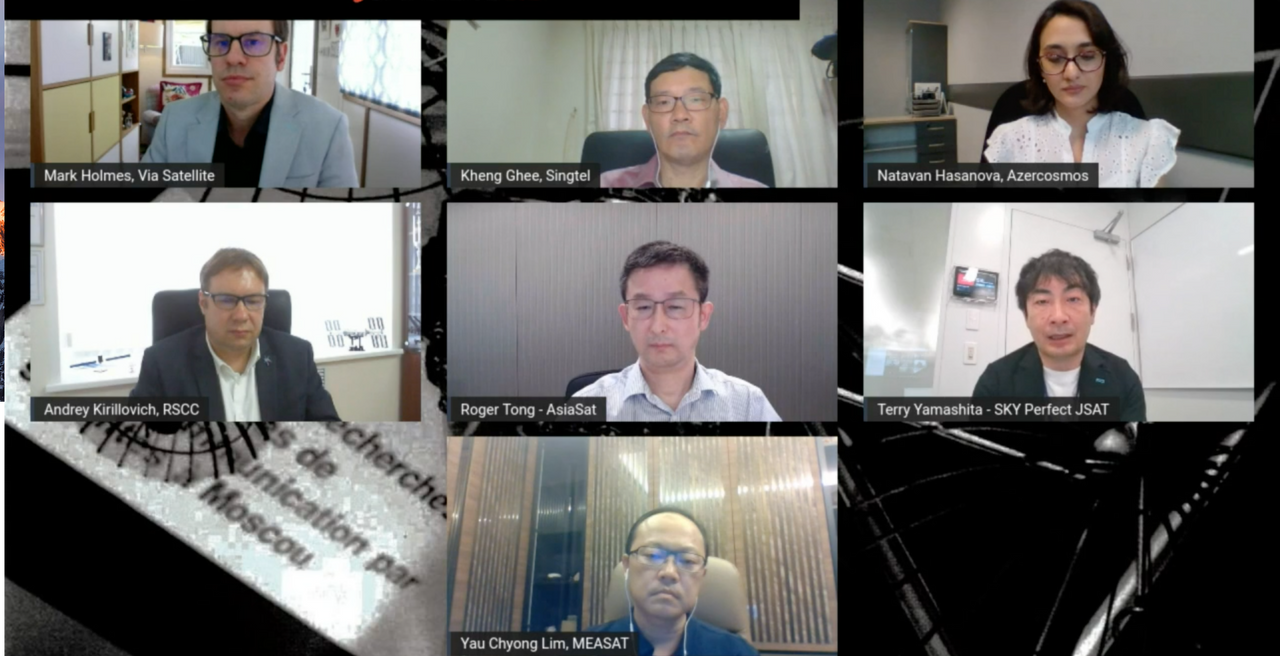
The executive leaders of Asia’s regional satellite operators share a common strategy for long-term profitability in an increasingly unpredictable environment — expand the scope of their businesses beyond just satellites. “We don’t want to be a pure infrastructure play anymore,” Asiasat CEO Roger Tong told attendees at SATELLITE 2021’s EMEA + Asia Digital Forum on Tuesday, May 18.
Tong was one of six executive speakers on a panel that marked a rare and insightful moment of reflection on the future of one of the world’s most vast and diverse connectivity markets. Like many of its peers in the region, Asiasat has been enjoying increases in demand for connectivity and healthy subscriber growth, but declining revenue and net profits.

Explore the Show Daily 2021 EMEA/Asia Digital Forum Issue
Check out more from this issue and find your next story to read.
“We’ve been enjoying a CapEx holiday since we launched our AsiaSat 9 satellite in 2017,” said Tong. “There’s no pressure for us to invest more in [Geostationary Orbit] GEO, or [Low-Earth Orbit] LEO, or any particular orbit. Our future CapEx doesn’t have to go to space.”
Azercosmos Strategic Development and Planning Manager Natavan Hasanova said that the Asia region’s connectivity markets are following the same trajectory of markets in Europe, the Middle East, and the United States. “The markets are maturing and while paid broadcast subscribers are increasing, subscriber revenue is declining because of increasing competition, which drives prices down,” said Hasanova.
Tong added that satellite broadband data revenues will also start declining because data service prices are dropping even faster than those for broadcast services.
“People say that broadcast is dying and that more of our business is migrating toward data,” said Tong. “But, we don’t see it as broadcast versus data. Broadcast has just changed from a 1-to-many distribution model [Direct-to-Home] to a 1-to-1 [Direct-to-Network] model. At Asiasat, we’ve been thinking about how we can better serve our network customers in the 1-to-1 distribution model. To do that, we’re looking at terrestrial delivery mechanisms and focusing on customer needs instead of the specific nature of our infrastructure.”
While the operators agreed on the need to evolve beyond traditional satellite infrastructure, each are charting their own specific paths to diversification.
SKY Perfect JSAT‘s Global Business Group President Teruo Yamashita said his company wants to expand its presence across several applications from 5G to data analytics. “We’re also beginning to invest in a space debris removal project,” said Yamashita. “We want to diversify both on the ground and in space. We plan to integrate non-terrestrial assets across GEO, NGSO, and even HAPS [High-Altitude Platforms]. We’ll use NGSO, for example, to star providing a data analytics service to our customers.”
Measat, represented on the panel by COO Yau Chyong Lim, is getting ready to launch its replacement MEASAT-3d satellite next year on an Arianespace Ariane 5 heavy-lift launch rocket. Beyond that, Lim said the company is not limiting itself to space infrastructure. “We’re looking to completely transform our company, and that means investing in developing terrestrial infrastructure, specifically with ground terminals and small-cell technology,” said Lim.
Andrey Kirillovich, director of integration services for Russian Satellite Communications Company (RSCC) is busy developing a range of technology for its Express-RV system — a regional constellation of four satellites that will serve Russia’s mobility markets from a Highly-Elliptical Orbit. RSCC will stick mostly to space, but also work on complementary ground and terrestrial systems.
“We want to invest in something different that would serve the specific needs of our growing markets, like mobile maritime,” said Kirillovich. “We’re now finalizing our investments in our new constellation. The four Express-RV satellites will support 4.4 gigabits per second connectivity, with 80 megabits-per-second download. The ground system will be a 60 centimeter-to-70 centimeter dish.”
When asked why RSCC wasn’t following other operators by designing a LEO constellation, Kirillovich explained that LEO systems are more suited for global coverage and not designed for more localized systems. This touched on a general feeling of skepticism about the LEO market from the panel.
“We got feedback from LEO customers that the service over-promised and under-delivered,” said Kirillovich. “They were expecting fiber-like experiences. LEO constellations can really shine in enterprise markets, but the enterprise terminal costs are still high. While latency isn’t as important for these customers, it’s still too high from existing systems.”
Azercosmos’ Hasanova expressed her belief that global LEO systems will get bogged down in the region’s exhaustive regulatory processes, making it difficult for them to penetrate Asian markets.
Kheng Ghee, Singtel Satellite‘s head of satellite and voice support, said that LEO brings both positive and negative developments for the industry.
“The good thing about LEO is that it has driven significant investment into research and development on ground systems, multi-band terminals, and terrestrial infrastructure, which is very much needed,” said Ghee. “The bad news is that LEO constellations send thousands of satellites into an already cluttered space environment. If we have no governance on the debris issue in space, it will only create a more hazardous environment for business. As satellite operators, we all need to sit down together and really talk about how we’re going to solve this issue.”
While Measat’s Lim agreed with the panel that global LEO systems have to be locally oriented in order to achieve success in Asia, he said the operator was not closing the door on new opportunities. “We believe that the LEO systems can complement our GEO businesses as part of a diversified infrastructure,” said Lim. “If we feel the new systems in LEO have something positive to offer us, we’ll look to start incorporating those services into our portfolio.” VS