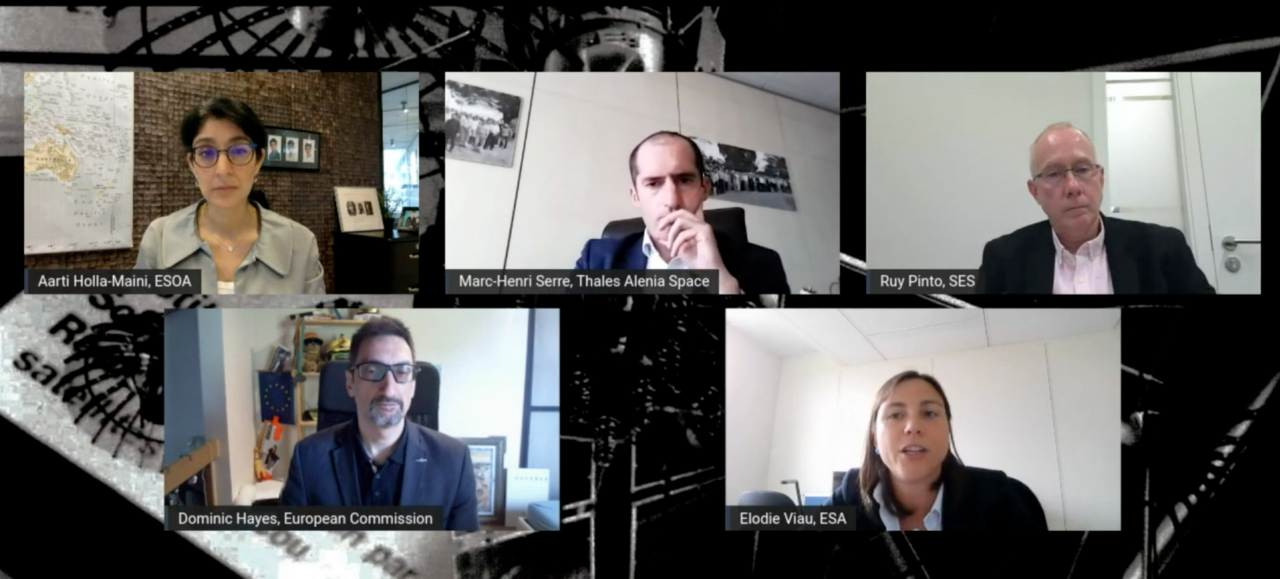

The European Commission made news at the close of 2020 by announcing a consortium of industry players to study the build of a Low-Earth Orbit (LEO) system for European Union use. European industry players dug into how the collaboration and the constellation may turn out during the SATELLITE 2021’s EMEA + Asia Digital Forum on Tuesday, May 18.
Dominic Hayes, who works on spectrum management and international relations for the European Commission, said that as other constellations in development, like SpaceX Starlink, or Telesat Lightspeed, are not European, it creates a challenge for European member states, who want to provide secure connectivity across Europe. This led to the European Commission’s study to investigate its own constellation.

Explore the Show Daily 2021 EMEA/Asia Digital Forum Issue
Check out more from this issue and find your next story to read.
“The key objectives are to make broadband available everywhere in the EU, places where it’s not feasible or economic to provide terrestrial coverage. There are still places in Europe that don’t have the necessary coverage,” Hayes said of the system’s goals. “We see a need for secure connectivity for government-type applications, be it networks, police, military, government users. There is a whole range of activities that need to be provided with secure, autonomous connectivity.”
Hayes said the group of commercial players has already made initial proposals on the frequency and orbital characteristics of the system, and will be firm deliverables in the next few weeks. By the end of this year, he expects to have further plans for requirements for the constellation, and start discussions with EU member states and the European Parliament.
In terms of the frequency of the constellation, Marc-Henri Serre, executive vice president of the Telecommunications Business for Thales Alenia Space, said Thales is “discussing” with the consortium if its own LEO filings could be used in this project, but he could not provide more specifics.
As this project has a variety of stakeholders and is in its nascent stages, it will be years until any satellites in the constellation are launched to orbit. Meanwhile, commercial constellations like Starlink, OneWeb, and Lightspeed will already be in operation. Yet Hayes sees this as a positive for the European initiative.
“It’s inevitable that we will miss the initial potential available on the market, Starlink is just so far ahead of us. In some ways I actually see that as being beneficial. They are the ones that will establish the market, and we will come in later,” he said. “We won’t have the first-mover advantage, but we will potentially take advantage of some of the economies of scale in the development of receiver technologies.”
SES CTO Ruy Pinto addressed another key question about the system — how will the collaboration be impacted by Eutelsat’s investment in OneWeb? Pinto said the investment makes the landscape “a little bit more complicated,” but stressed that this is an example of Eutelsat investing in Non-Geostationary Orbit (NGSO) capabilities, like SES is investing in Medium-Earth Orbit (MEO) capabilities with its O3b mPOWER system.
“At the end of the day, this is not bad,” Pinto said. “It may make it a little bit more complicated, but it’s not necessarily bad. It’s just the nature of a competitive market.”
On how the public/private partnership will work for the EU LEO system, Pinto said as a satellite operator, SES has a clear preference for a mostly private model, unlike the approach taken with Galileo and Copernicus. At the same time, it remains to be seen how the EC will deal with commercial competition, but Pinto said joint ventures or a competitive process are two options.
Overall, Pinto believes the project will be successful because the EU is taking ownership and funding the project from the start, whereas Starlink has received U.S. government funding after the fact, and Lightspeed as well, after the system specifications were established.
“What drives our confidence in the success of the initiative is that the European Commission is actually driving the use cases, the requirements. What is it that Europe needs to drive a New Space architecture?” It’s not post-funding. It’s pre-funding, so that conversation makes it different from what’s happening between the Canadian government and Telesat, and between Starlink and the U.S. government,” Pinto said.
Elodie Viau, director of Telecommunications and Integrated Applications for the European Space Agency (ESA), said ESA is ready to support this project in terms of 5G, quantum computing, optical technology, and Artificial Intelligence (AI).
“We are looking at this connectivity constellation in the broader picture that’s enabling these visions,” Viau said. “The European Space Agency adds value in strong support to the European Commission in this partnership — like we did in other big programs — but taking the specificity of the telecom market into account.” VS