The National Oceanic and Atmospheric Administration (NOAA) awarded contracts on Wednesday to Muon Space, Orbital Micro Systems doing business as (DBA) Weather Stream, and Spire Global to develop new weather satellite instruments for NOAA’s Temperature and Moisture Advanced Technology Evolution (TMATE) project.
The combined award value is nearly $46.5 million, $27.9 million of which was awarded to Spire. Muon Space recieved $11 million and Weather Stream received $7.5 million. The agreements were made under NOAA’s Other Transaction Authority (OTA), which allows NOAA to partner with industry for technology maturation of future data sources to improve weather forecasting.
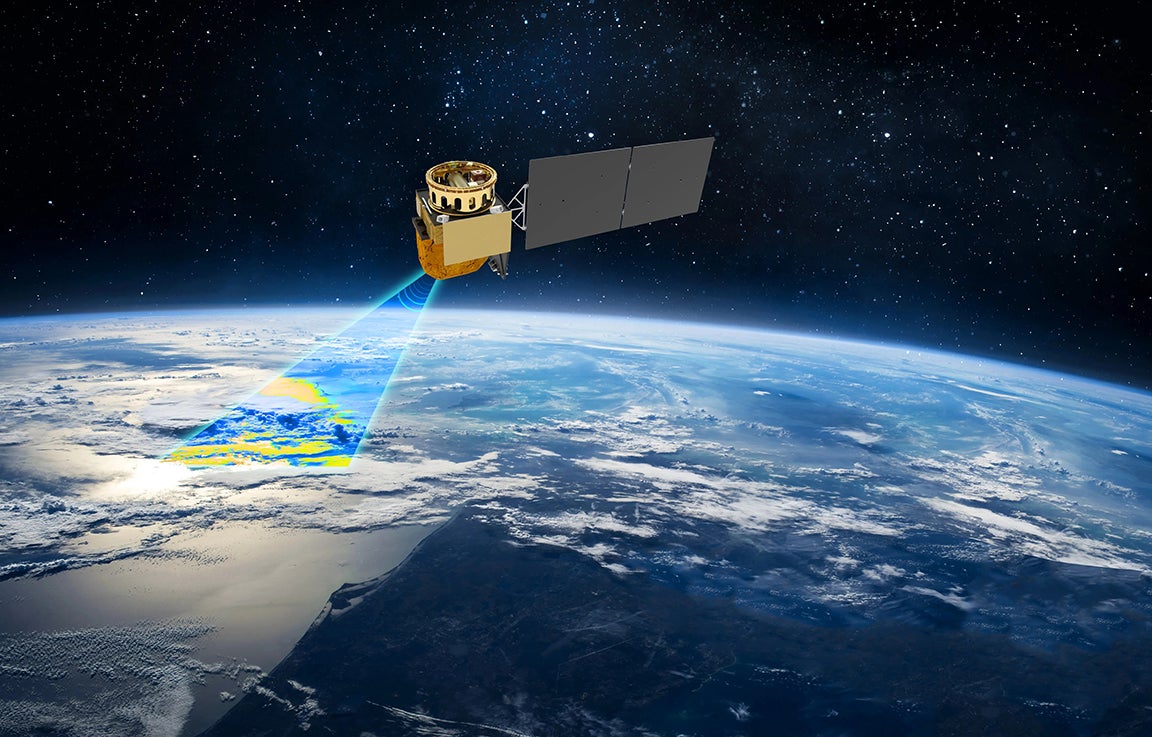
NOAA’s TMATE project needs satellite data that will advance the prediction of extreme weather and daily forecasts. Under this new award, the three selected companies will develop microwave sounding instruments — remote sensing instruments carried aboard satellites to measure natural microwave energy emitted by atmospheric molecules. They can be used to measure global atmospheric temperature and water vapor from the Earth’s surface to the upper atmosphere.
Each of the three companies will develop, launch, and operate their own microwave sounding instrument, and the data will be available for NOAA to purchase commercially. The project will take place over the next 24 months.
“The TMATE project brings together government and industry partners to meet critical data requirements to improve our nation’s weather forecasting. Microwave sounders are a national priority because their data are essential for the accuracy of weather forecasts,” said Tim Walsh, acting deputy assistant administrator of systems for NOAA’s National Environmental Satellite, Data, and Information Service (NESDIS).
Spire noted the company launched its first hyperspectral microwave sounder (HyMS) demonstrator in January of this year to validate hyperspectral microwave sounding in a compact form factor in orbit. Spire also recently recieved a $3 million contract extension from NOAA to evaluate data from the demonstrator across a range of atmospheric conditions and weather patterns.
“Hyperspectral microwave sounding has the potential to change what’s possible in weather forecasting,” commented Spire CEO Theresa Condor. “By bringing this advanced capability to a commercial satellite platform, we can deliver richer observations of the atmosphere at the scale and speed needed to make a meaningful difference in forecasting.”