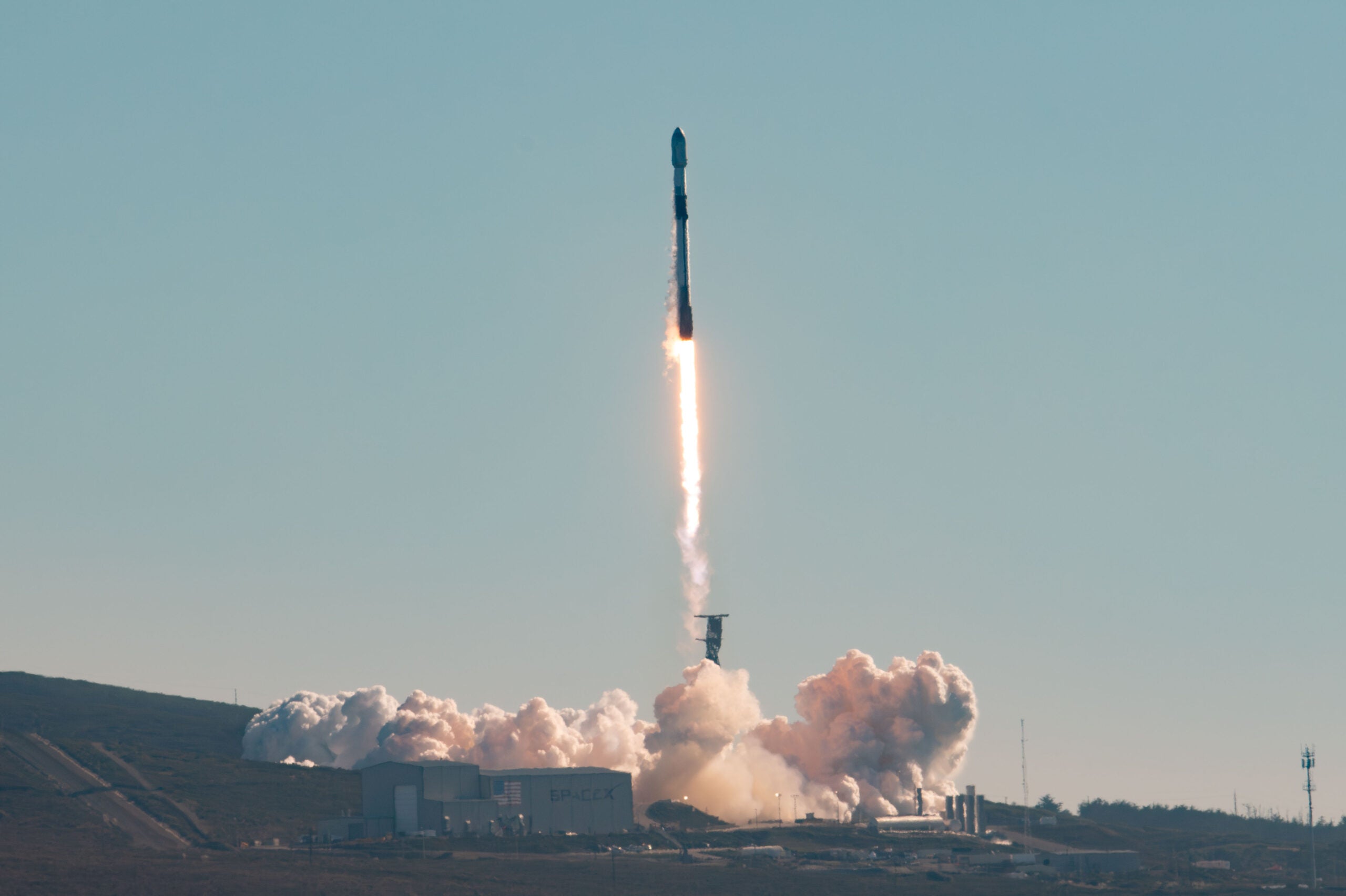
In March, the Space Development Agency’s Acting Director Gurpartap “GP” Sandhoo said the agency was strategically pausing launches until May. He described technology hurdles, supply chain challenges, and balancing speed in the decision-making process.
“Speed does not alleviate you from the fact that you still have to do the diligence you need to do,” Sandhoo said. “You still have to make sure the satellites are working, and make sure you know you’ve done all the right things.”
SDA was founded to work on tight deadlines. It issues contracts to numerous commercial partners at an unprecedented rate, in a model designed to boost speed and lower costs, industry experts said. But, an SDA spokesperson said, it tolerates a level of increased risk beyond what previous space acquisition programs have accepted.
To mitigate these risks, industry experts told Via Satellite, SDA is increasingly demanding proven results before extending contracts or subcontracts. Startup companies are adapting to this cultural shift. But watchdogs have warned that the agency’s approach may be overconfident and at risk of failing to deliver capabilities on time.
A Shift Towards Speed
The Department of Defense founded SDA in 2019 to establish communications and data infrastructure for military space missions. The agency is currently developing the Proliferated Warfighter Space Architecture (PWSA) Transport Layer, a global multi-band constellation for communications and missile detection. Tranche 0, its first wave of satellites launched in 2023, has demonstrated early communication capabilities, and the following Tranche 1 started launching last September.
SDA acquires satellites and services through an Other Transaction Authority (OTA) solicitation process, which operators bid for individually or in teams.
Ian Cinnamon, CEO and co-founder of Apex Space, said he built his company around the shift away from big, expensive satellites toward proliferated systems, or large constellations of smaller satellites that can be built quickly.
Since Apex’s 2022 founding, the SDA has progressed in two key areas, Cinnamon said. It has moved towards building proliferated systems, and toward a “Ford Model T” model of production, which favors commercial off-the-shelf products over specialized engineering.
“We’re seeing a big shift, where the buying behavior is very focused on speed, to get those systems on orbit and make sure they actually work on orbit,” Cinnamon said. “And that is a very different buying behavior than, I would argue, the last seven decades of the space industry, which has been more cost-plus, slow, and not in what I would call a rush.”
In 2024, Apex joined SDA’s HALO program, a pool of non-traditional space companies eligible for rapid SDA awards to experiment with new technology for the PWSA.
Cinnamon said the SDA’s efforts to expand transparency and display a long-term roadmap have been helpful to his company. The agency has reduced classification barriers by pushing the limits of what it can speak about openly, he said.
He said the agency’s transparency when laying out information like tranche programs, numbers of satellites demanded, and timelines for procurement have helped establish a clear long-term demand signal and build an industrial base.
“I think they’ve been able to be transparent about the vision, but also, they’ve been able to execute on it with very clear repeat buying behavior, which is very different from how most of the industry works,” Cinnamon said. “Most of the industry, they’re changing the requirements. Things are adjusting constantly.”
But speed brings a trade-off with engineering rigor. To mitigate the risk of using ready-made systems, Space Force should look at the quality of systems and how they’re accomplishing their mission, not just whether they’re on orbit, Cinnamon said.
“There’s a lot of partners who are proven and on orbit, and there’s a lot of folks out there who are on orbit and their systems don’t work,” he said.
Disrupting the Procurement Process
SDA has leaned toward solutions that are not 100 percent perfect but are delivered on time and can be improved upon later, said Starfish Space Chief Growth Officer Michael Madrid.
“The Space Development Agency in particular of all the Space Force organizations has really leaned into this iterative model where they recognize that it makes sense to acquire things and field them and start to learn from that,” Madrid said. “To have some initial capability, and then to learn from it, and then to make it better over time. And that that can be a more effective way to achieve their objectives.”
SDA Chief of Strategic Engagement Jennifer Elzea told Via Satellite that SDA’s unique values speed and lowers costs. SDA’s spiral development model, where rounds of development build on each other and older satellites are frequently replaced with modern capabilities, lets the agency incorporate new capabilities every two years, she said.
“This also enables SDA to predictably solicit new capabilities through competitive solicitations,” Elzea said. “SDA prioritizes mature capabilities and not funding development.”
In January, SDA awarded a contract to Starfish Space to deorbit a PWSA satellite. Madrid said Starfish entered a study phase for SDA before receiving a Strategic Financing (STRATFI) contract. He said it was an opportunity to understand the agency’s needs and build relationships.
Madrid said SDA paid Starfish to analyze how it would approach a mission for the agency. The agency also asked for plans to make the solution commercially scalable, to ensure it would not be the only customer, he said.
“They didn’t really want it to be bespoke and built just for them, because that usually translates into things being more expensive and not scalable,” Madrid said.
Starfish received its first Space Force contract in 2024 under a Strategic Funding Increase (STRATFI), to dock with a national security spacecraft in orbit.
As Starfish prepares its deorbiting mission for launch in 2027, it meets about biweekly with SDA, with Madrid calling it a collaborative partnership. The Space Force works more closely with Starfish during R&D than Starfish’s other customers, he said.
Grounding Expectations
Observers have reported risks to SDA’s approach. A Government Accountability Office report in January said the agency overestimated the readiness of the technology it was buying and was in danger of failing to deliver PWSA capabilities on schedule.
The report said the SDA relied on contractors to report their own schedule risk analyses, which created inconsistencies between SDA’s timelines and the contractors’ real-life delays. It also said SDA’s requirements for Tranche 1 were unclear and not well understood by contractors.
The report also said SDA awarded contracts for Tranche 1 and 2 before it had demonstrated Tranche 0’s optical communications capabilities, and that it did not fully understand what would work in PWSA’s critical data transport layer.
The Department of Defense concurred with five of the GAO report’s recommendations and partially with a sixth.
Elzea said SDA disagreed with the specifics of many of the report’s assertions, but is working through its recommendations to identify areas for improvement.
“SDA’s spiral development model balances technical and programmatic risks in ways that were not previously accepted in space acquisition programs; however, these balanced acquisition risks are likely to result in operational capabilities ultimately delivered more quickly to the warfighter,” Elzea said.
Trade-Offs Within Trade-Offs
Chuck Beames, board chairman of SmallSat Alliance, said risk comes when officials request proposals for solutions that are commercially impossible, not from speed. This happens often, he said.
“If you go to buy a car and you say, ‘I want a car that goes 5,000 miles an hour,’ there isn’t one that does that,” Beames said.
Beames, who formerly worked in executive roles in the DoD including as principal director of Space and Intelligence systems at the Pentagon, now serves on the board of commercial space companies including as Chairman of York Space Systems and Executive Chairman of SpiderOak and TrustPoint.
The best way forward for the government is to award contracts competitively, pay only when a solution works, and then continue to iterate on it, he said.
One might think that only using proven systems could limit market access for less-resourced startups with fewer opportunities to demonstrate new tech. But the government is capitalizing on the large amounts of private capital that have flowed into space startups in recent years.
Madrid said the increase of private investment in defense technology could make it easier for government officials to expect companies to fund their own R&D. Even five years ago, this wasn’t the case, he said.
When Starfish entered its study phase with the SDA, he said, it had already fully developed its Otter spacecraft.
“Now that there is a lot of private investment in defense tech, you could ply a case where defense acquisition strategies would evolve and say, ‘Well, there is a lot of private investment going into this industry. Now maybe we can rely on it more,’” Madrid said.
Still, government funding is non-dilutive and a strong demand signal, which can help a company attract private investors, he said.
Government involvement in R&D might vary based on the project, Madrid said. For instance, procurers for the Golden Dome missile defense system expect contractors to perform their own demonstrations, while funding through the Small Business Innovation Research (SBIR) and Small Business Technology Transfer (STTR) funds will prop up early-stage R&D. But overall, the Space Force increasingly expects its contractors to fund its own development, he said.
Beames said competitive contracts paid on delivery encourage disruptors to enter the industry. This creates the opposite of the 1990s’ mass consolidation of defense companies, a process he regrets helping to lead, he said.
“That’s the way,” Beames said. “Not what they call cost-plus, where you just get reimbursed for your effort. That era needs to be completely thrown into the trash bin and these things need to be competed. There’s still a lot of sole source contracting going on and it’s vicious, it’s un-American, frankly, and it leads to a lot of corruption.”
He added that competitive contracting would encourage companies to fund R&D themselves instead of relying on government awards.
Elzea said SDA relies on private sector development to deliver the PWSA. To incentivize private innovation, the agency publishes a technology roadmap to signal its capability needs and uses programs like STRATFI to help small businesses bridge the “valley of death” between early R&D and operational fielding.
Apex Space, for example, is embarking on Project Shadow, an host platform for missile interception satellites. The company has noted this is an example of a Golden Dome-oriented product funded through private capital. The company has also received $36 million in SBIR funding between 2023 and 2025, according to the program’s website. Cinnamon said Apex was fortunate to have collaborated with SDA on the SBIR contracts and looked forward to doing so over coming years.
On the other hand, using mostly-complete off-the-shelf solutions mitigates development costs. But SDA invests in new technology development only when no existing alternative exists, an SDA official told Via Satellite.
For instance, SDA expanded a contract with Atombeam in February to improve Link 16 data transmission because there was no existing capability or indication that companies would develop one at scale, the official said.
Still, defense and civil buyers naturally have specific requirements, which creates another balance to be struck, Madrid said.
“You’re going to have to do a lot of additional development work or a lot of additional overhead to meet those government-unique requirements, and then you erode some of the value of it being a commercial product or service in the first place,” Madrid said. “Now it’s no longer so affordable, maybe no longer ready so quickly.”
Looking Forward
To break into Space Force contracting, non-traditional operators are partnering with established companies and demonstrating their proprietary technology.
Elzea told Via Satellite the agency often sees one or more newer satellite operators team up with traditional operators to compete for large contracts.
To bring capabilities to Space Force, Beames said startup companies should have something that works. Then, they should work with other companies to develop a pitch to demonstrate what it can do.
“You want to take it to the next level and get the government to pay for you to demonstrate something with industry partners,” Beames said. “Just like no man is an island, no space company can operate completely on its own. Especially a startup.”
While the SDA has disrupted traditional modes of government contracting, more changes could be on the horizon. The Space Force’s 2027 budget request contains no funding for the Tranche 3 Transport Layer of the PWSA, with reports that communications for PWSA would become part of a larger Space Data Network.
And with the move toward Portfolio Acquisition Executives (PAE), Sandhoo recently said at Space Symposium that the Transport Layer would fall under a separate PAE from the Tracking Layer.
“Five years from now the names of the organization will be different than what you see today,” Sandhoo said, adding that the culture of how SDA approaches and solves problems, and delivers capability “are still going to be important.”