The Pentagon has decided to end the GPS Next Generation Operational Control System (OCX) by RTX and instead move forward on upgrades to the existing ground system for GPS, the Lockheed Martin Architecture Evolution Plan (AEP).
Lockheed Martin said last Thursday that it had received a $105 million AEP contract.
In response to a Defense Daily question on Thursday just after the award on whether Space Force was cancelling GPS OCX, the service on Friday afternoon said that it “continues to use OCX for launch and checkout of the GPS III satellites while AEP is used to command and control all GPS space vehicles, including GPS IIIs.”
On Monday, Space Force said that Defense Department acquisition chief Michael Duffey had cancelled GPS OCX on Friday, “based upon the recommendation” of acting space acquisition chief Thomas Ainsworth.
GPS OCX, which had received more than $6 billion in funding through January, “was unable to deliver needed capabilities on an operationally relevant timeline at an acceptable level of risk to meet the GPS constellation modernization needs,” the Space Force said on Monday evening.
Congress had criticized GPS OCX for being a decade late, and system cost estimates significantly increased from the $3.9 billion estimated in November 2012 to more than $7 billion.
RTX’s Raytheon business delivered GPS OCX on July 1 last year through submitting DoD Form 250, the required Material Inspection and Receiving Report.
“In July 2025, following a multi-year regimen of factory testing, the Space Force contractually accepted OCX from Raytheon and began extensive integrated systems testing to resolve liens carried over from factory testing, as well as to ensure the system could operate within the broader GPS enterprise of ground systems, satellites, and user equipment,” the Space Force said on Monday, but Col. Stephen Hobbs, Mission Delta 31 commander, said in the service statement that “extensive system issues arose during the integrated testing of OCX with the broader GPS enterprise.”
“Despite repeated collaborative approaches by the entire government and contractor team, the challenges of on-boarding the system in an operationally relevant timeline proved insurmountable,” he said. “We discovered problems across a broad range of capability areas that would put current GPS military and civilian capabilities at risk.”
The Department of the Air Force fielded AEP in 2007 to replace the mainframe-based GPS master control system.
Chief of Space Operations Gen. Chance Saltzman said on April 1 that GPS III and the GPS Follow-On satellites will require ground system and cyber upgrades.
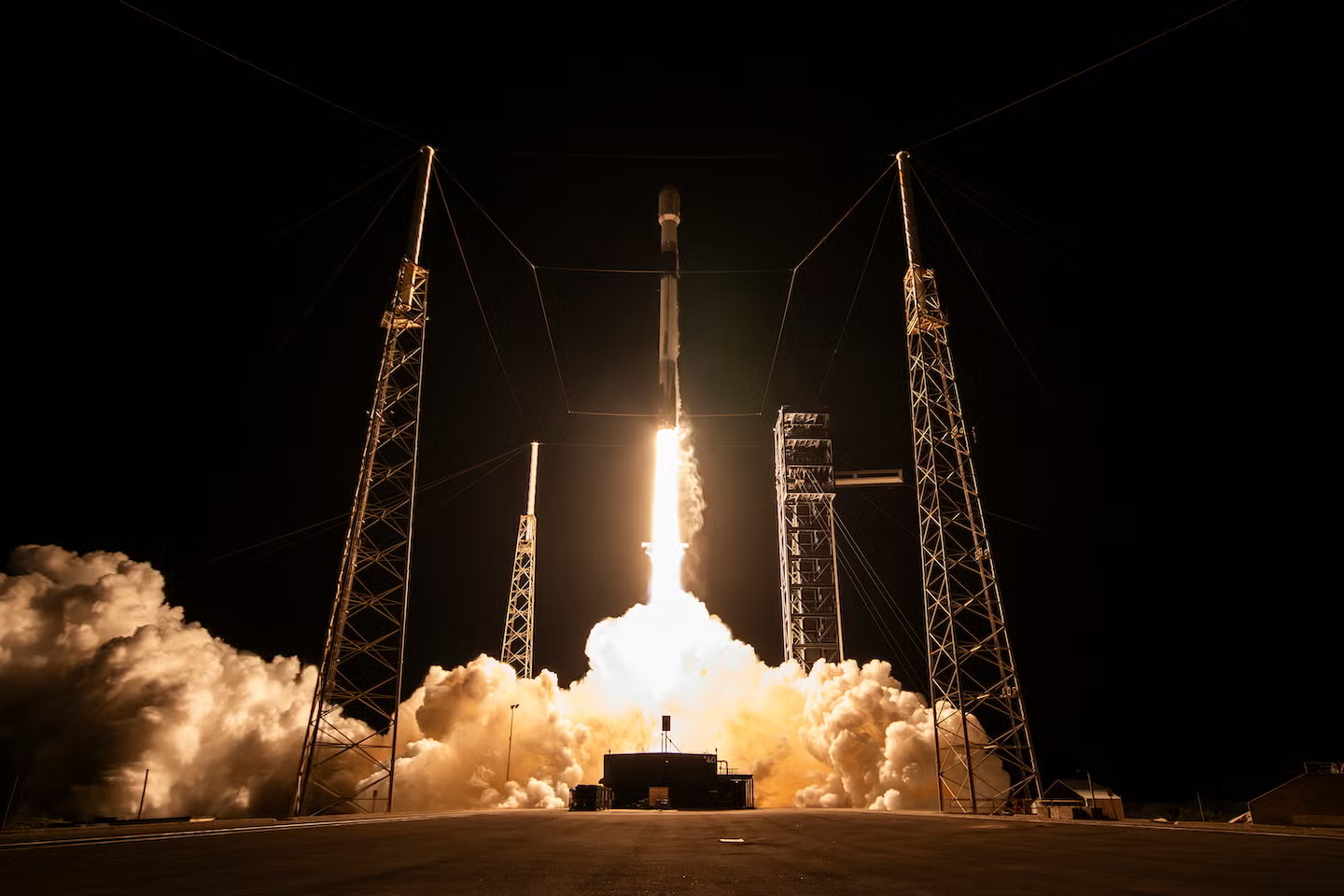
SpaceX launched the final GPS III satellite for the Space Force early on April 21, with the mission lifting off at 2:53 a.m. ET on a Falcon 9 rocket from Cape Canaveral Space Force station.
The mission payload includes “a development payload for a cross-link demonstration, new space-qualified atomic clock, a Laser Retroreflector Array, and first-use of a 3D-printed Omni Antenna,” the Space Force said.
Last month, the Space Force switched the rocket planned for the GPS III-8 mission from the Vulcan Centaur to Falcon 9, as the service continues to investigate an engine problem during a Feb. 27 launch of the ULA-built rocket engine. This was the fourth GPS III launch swap from Vulcan Centaur to Falcon 9 since December 2024.