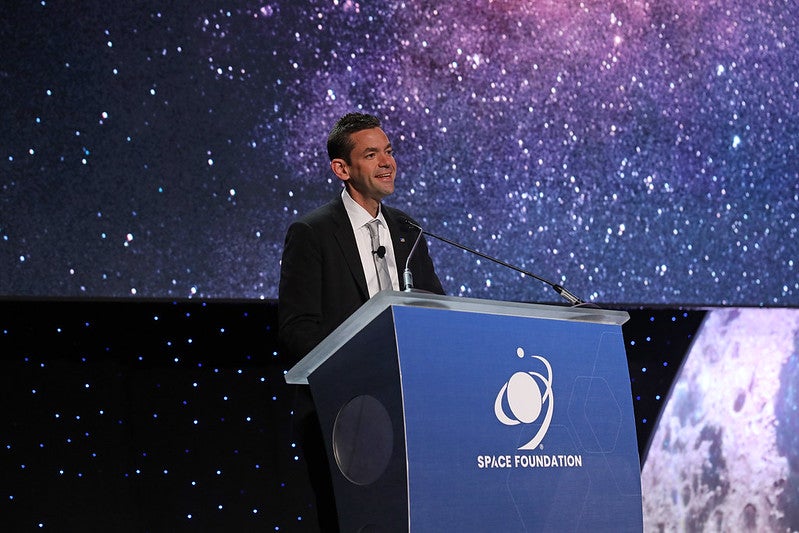
COLORADO SPRINGS, Colo. — Getting back to the Moon with Artemis II has ignited plans to accelerate building a base on the Moon, while NASA takes steps to launch Artemis III and IV, NASA Administrator Jared Isaacman said during a keynote speech at the 2026 Space Symposium in Colorado Springs on Tuesday.
“We’re going to start launching Moon rockets at a frequency measured in months, not years, pursuing the secrets of the universe, with flagship science and discovery missions,” he said.
Speaking just days after the Artemis II crew safely splashed down after a nearly 10-day mission, he congratulated the Artemis II crew and the entire NASA workforce on the success for the “opening act” in America’s return to the Moon.
“We can celebrate Artemis II and the impacts those four outstanding human beings had on the world and prepare alongside all of you for what inevitably comes next,” Isaacman said. “This is how NASA changed the world on July 20, 1969, and this is how we’re going to do it again.”
Efforts are already in motion for uncrewed robotic landings on a near monthly cadence, starting in early 2027. The Moon base will serve as a technology proving ground, he said, “where we will master the skills necessary for when the day comes that NASA astronauts embark on a journey to plant the stars and stripes on Mars.”
The early stages of building a Moon base will “look more like a construction site or even a junkyard, and that’s okay,” he said.
Beyond the base, NASA will also embark on building out space commerce, partnering with industry to expand and prioritize research and manufacturing.
“We can’t force an orbital economy or even a lunar economy to exist, but we can do everything possible to try and ignite one,” Isaacman said. “That means supporting more private astronaut missions, more commercial astronaut monetization opportunities, more high commercial potential research to the space station, and more incentives to pioneer commercial breakthroughs in space and on the lunar surface.”
During a follow-up session to his keynote, Isaacman added that NASA is rolling the success of Artemis II into another mission.
“That’s the big change here,” he said. “We need to get into a good cadence, and establish muscle memory. We will launch again, Artemis III in 2027. We will gather good data, roll that into Artemis IV, so we have an achievable path to the surface of the Moon by 2028.”
NASA recently added a new Artemis III docking mission to the Artemis lineup in a move to standardize the approach and increase flight rate safety. The next Artemis mission, targeted for 2027, will feature a crew capsule docking with a commercial lunar lander built by either SpaceX or Blue Origin, before the Artemis IV mission to land on the Moon.
Isaacman spoke to the energy at NASA right now, and said it goes beyond the success of Artemis II.
“If you show up to work every day at NASA, it’s because you want to change the world in air and space. And many were inspired by what we did in the 1960s,” he said. “This national imperative to return to the Moon is going to be measured in months, not years. And I think that’s gotten everybody moving in the right direction. We want to clear out the bureaucracy and the obstacles that impede progress so the best and brightest can do their jobs.”