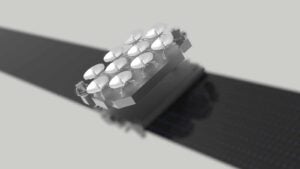

Space Force Space Systems Command (SSC) gave a boost to Boeing‘s confidence last week, as SSC chose the company over Northrop Grumman for a $2.8 billion contract to build the first two Evolved Strategic SATCOM (ESS) satellites.
ESS is to replace the six Lockheed Martin Advanced Extremely High Frequency (EHF) satellites for U.S. nuclear command, control, and communications (NC3). Space Force has looked to deploy ESS in fiscal 2030 to achieve an initial operational capability in fiscal 2032. The Extended Data Rate Advanced EHF has supplemented the five orbiting Milstar satellites built by Lockheed Martin. The latter satellites feature low and medium-data rate communications.
The ESS constellation is to be interoperable with Advanced EHF and eventually replace it.
In 2020, Lockheed Martin, Boeing and Northrop Grumman received contracts for ESS rapid prototyping, which SSC leaders have said is key to the command’s approach to NC3 modernization. Air Force Lt. Gen. Andrew Gebara, the service’s deputy chief of staff for strategic deterrence and nuclear integration, has said that NC3 has more than 250 nodes, and the Department of the Air Force controls about 75% of NC3, which ensures that nuclear forces are able to launch upon orders from the president.
Air Force Maj. Gen. Ty Neuman, the director of strategic plans, programs, and requirements at Air Force Global Strike Command, has discussed a role for artificial intelligence in aiding cyber protection for NC3 and in choosing the best NC3 inputs among over the air high frequency waves, SATCOM, voice, beyond line of sight, and future fiber optic cables that are to replace the Minuteman III’s copper-wired Hardened Intersite Cable System in the Air Force’s NC3 Next architecture for the future Northrop Grumman LGM-35A Sentinel ICBM.
“The ESS system of systems is composed of cryptographic, ground, and space segments procured by the Space Force and a user terminal segment procured by the individual [military] services,” SSC said last week in announcing the award to Boeing for the first two ESS satellites. “The first four satellites will be delivered under a cost reimbursement contract. As part of the larger $12 billion ESS Space Segment acquisition, additional satellites are planned to be procured through fixed price contract actions that may be awarded as sole source to support Full Operational Capability and attain global coverage, including enhanced Arctic capability.”