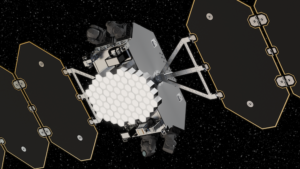

Canadian satellite operator Telesat’s latest financial results paint a picture of short-term pain in the first six months of 2026 and raises concern over debt that matures in the next year and a half. According to its first half report issued Thursday, the operator remains confident that it go into full global commercial service with Telesat Lightspeed in early 2028.
In the the six month period ending in June, Telesat’s revenue dropped 25 percent compared to the same stage last year to C$79 million or Canadian dollars ($56.7 million). It had a net loss of C$559 million ($401.2 million) for the quarter, a high number. In its GEO segment, revenue for the quarter was C$78 million ($56.0 million), a 26 percent decline compared to the same stage last year. Telesat said the revenue decline was driven primarily by non-renewals of certain broadcast contracts in 2025 and, to a lesser extent, reductions in services for fixed broadband customers, partially offset by new contracts in its aviation vertical.
Telesat also noted in its filing that it’s current consolidated cash resources alone are insufficient to pay $1.7 billion debt that matures in December 2026 and that it will have to refinance or raise money to ensure it meets the obligation. Telesat’s Lightspeed project has increased in projected costs during the past 3 years. On an earnings call following the report, Telesat CFO Donald Tremblay said that the cost of the Lightspeed constellation is now expected to reach about $5.2 billion, compared to the $3.8 billion price tag previously reported.
Despite its challenges, the operator remains optimistic. It has made a number of key announcements in August. Earlier this month, it signed a C$2.7 billion ($1.9 billion) agreement, including option periods, with Canada’s Defense Investment Agency to deliver Telesat Lightspeed Military Ka-band services to the Canadian Armed Forces for the Enhanced Satellite Communications Project – Polar (ESCP-P) program. The contract is for a period of 15 years. Also, this month, Telesat recently borrowed $120 million to be used for general corporate purposes at a subsidiary of Telesat GEO, providing the company with further financial resources to support its business.
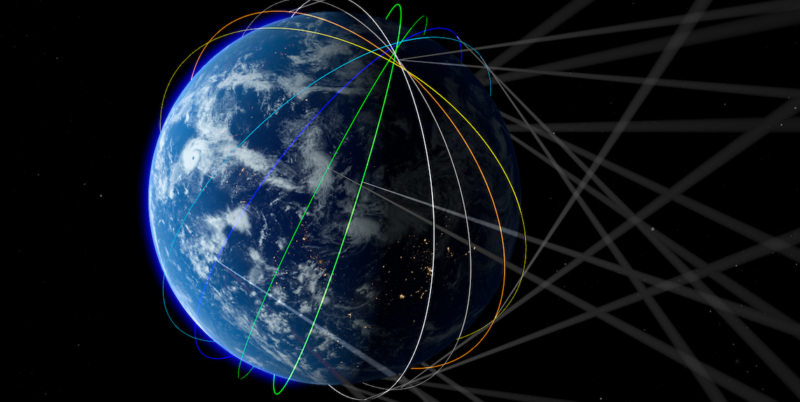
Telesat is also expanding its Lightspeed satellite constellation to 225 satellites, a 44 percent increase over its prior plan, which is being down to aim accelerate the growth of its LEO business while serving the evolving and mission critical requirements of defence and commercial customers. The operator is also eligible for up to $189 million in Upper C‑Band incentive payments recently announced by the Federal Communications Commission (FCC).
“It has been an eventful past few months for Telesat and I’m very pleased with the rapid progress the company is making and the strong traction we are seeing with customers for Telesat Lightspeed,” Dan Goldberg, Telesat’s CEO, said in a statement.