
The final ViaSat-3 satellite entered service late last week, completing deployment of Viasat’s high-capacity satellite trio. This satellite, ViaSat-3 F2, was actually the second satellite to launch, and it launched in November of last year.
All three satellites are now in service and the ViaSat-3 constellation is fully operational after the F3 satellite entered service about a month ago in late August.
The F3 satellite covers the Asia-Pacific region and F2 covers the Americas. Each satellite adds more than 1 terabit per second of capacity to Viasat’s network to bolster its business in aviation, maritime, government, and broadband. The F1 satellite, which launched in 2023, suffered an anomaly with its antenna deployment. That satellite is operational, but only delivering a fraction of the capacity that was expected.
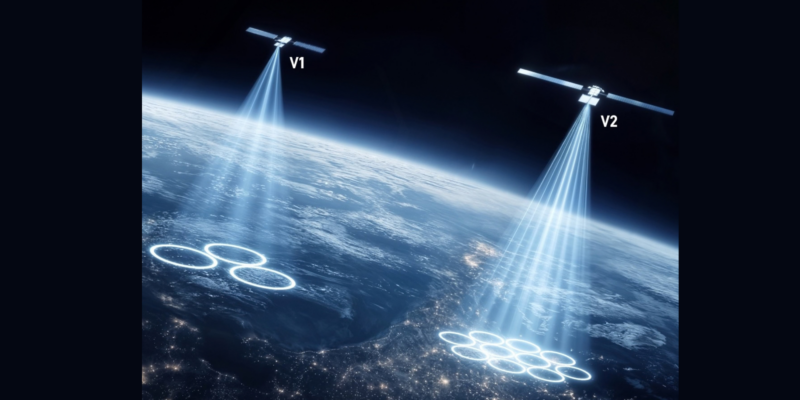
Beyond the capacity, the satellites are equipped with beamforming technology to allocate beams based on the location of demand, which Viasat sees as a critical differentiator.
“We believe that the VS3 satellites are the most advanced commercial satellites in the world in terms of adaptive beam forming for cost efficiencies, user performance improvements that offer higher speeds on both forward and return links, and resilience to interference,” Viasat CEO Mark Dankberg said in a statement. “We also believe VS3 technology sets new commercial standards for solar power generation and thermal dissipation – both critical technology challenges for developing economical data centers in space.”