The FCC granted Amazon a deadline waiver to launch half of its constellation by the end of July, but the waiver came with conditions on spectrum priority.
Amazon has had an FCC deadline to launch half of its planned 3,232-satellite Amazon Leo constellation by July 30 – a deadline that was set in 2020 when the constellation was initially approved.
At this point, Amazon has 331 satellites in orbit, just a fraction of the 1,616 satellites needed to meet the deadline. Amazon asked the FCC for a waiver or extension on the 50% deployment milestone earlier this year, citing a shortage in launch availability.
Amazon is working with multiple launch providers to get the constellation launched, this waiver comes as Arianespace readies for the third Amazon Leo mission in under five months, set for next week.
Conditions on the Waiver
The FCC granted the waiver on June 5, but it came with conditions. According to the FCC order, any Gen1 satellites launched after the July 30 deadline will temporarily lose priority status granted in previous FCC processing rounds, referring to both the 2020 Ka/Ku-band processing round and the 2021 V-band processing round.
This loss of status will last for 20 months until March 30, 2028, or until 50% of the constellation is launched and operational. Amazon can shorten the 20-month period to 15 months if it can prove that it has constructed half of the Gen1 satellites, and secured enough launches for those same satellites.
It seems likely Amazon will be able to avoid that full time period — the company says it has hundreds of satellites on standby and more than 100 launches on contract.
The order says that “during the temporary reassignment period, Amazon Leo will have the same coordination status as any system the Space Bureau licensed following the 2020 Ka/Ku-band and/or 2021 V-band processing rounds.”
SpaceX had filed comments in opposition to the waiver, proposing that the undeployed portion of the Gen1 system be subject to a new processing round.
The FCC will also stick to the requirement that Amazon forfeit a surety bond when the July 30 milestone is not met.
The FCC order called these “meaningful conditions” to incentivize Amazon to deploy its satellites rapidly, while meeting the public interest of promoting a second large satellite broadband constellation.
“The Bureau’s approach strikes the correct balance of enforcing the rules to encourage other operators to meet their deployment milestones while still encouraging and incentivizing deployment of valuable services to the American public and promoting American leadership in space,” FCC Space Bureau Chief Jay Schwarz said in the order.
Amazon thanked the FCC and said the decision provides regulatory certainty.
“We appreciate Chairman [Brendan] Carr and the FCC’s continued support of Amazon Leo and American leadership in space. We are excited to begin rolling out service in the coming months and bring even more innovation, investment, and competition to the industry,” an Amazon spokesperson said in a statement shared with Via Satellite.
This waiver does not impact Amazon’s final deadline of deploying the full constellation by July 30, 2029, which Amazon has said it is on track to meet.
When Amazon asked for a waiver earlier this year, the company cited a shortage in near-term launch availability with manufacturing disruptions, failures and grounding of new launch vehicles, and spaceport limitations.
Those challenges have only continued since that request. Two of the vehicles in Amazon’s launch plans United Launch Alliance’s Vulcan and Blue Origin’s New Glenn — are currently grounded as ULA works through booster issues with Vulcan, and a New Glenn booster exploded on the launch pad during a test last week.
Ariane 6 Mission to Deploy Record Payload
The upcoming Ariane 6 mission for Amazon Leo will feature an upgraded booster, delivering the largest payload launched to date for both Amazon Leo and Arianespace.
The Leo Europe 3 (LE-03) mission is targeted for Wednesday, June 17 at 7:53 a.m. ET from Kourou, French Guiana, the companies confirmed Friday. This is the third Arianespace mission for Amazon Leo overall; the launch campaign kicked off in February.
This will be the first Ariane 6 mission to introduce P160C boosters, which are designed to to replace the P120C version of the booster that has flown on the first flights of Ariane 6. The engines are one meter longer and carry more solid propellant, to increase performance by 10%.
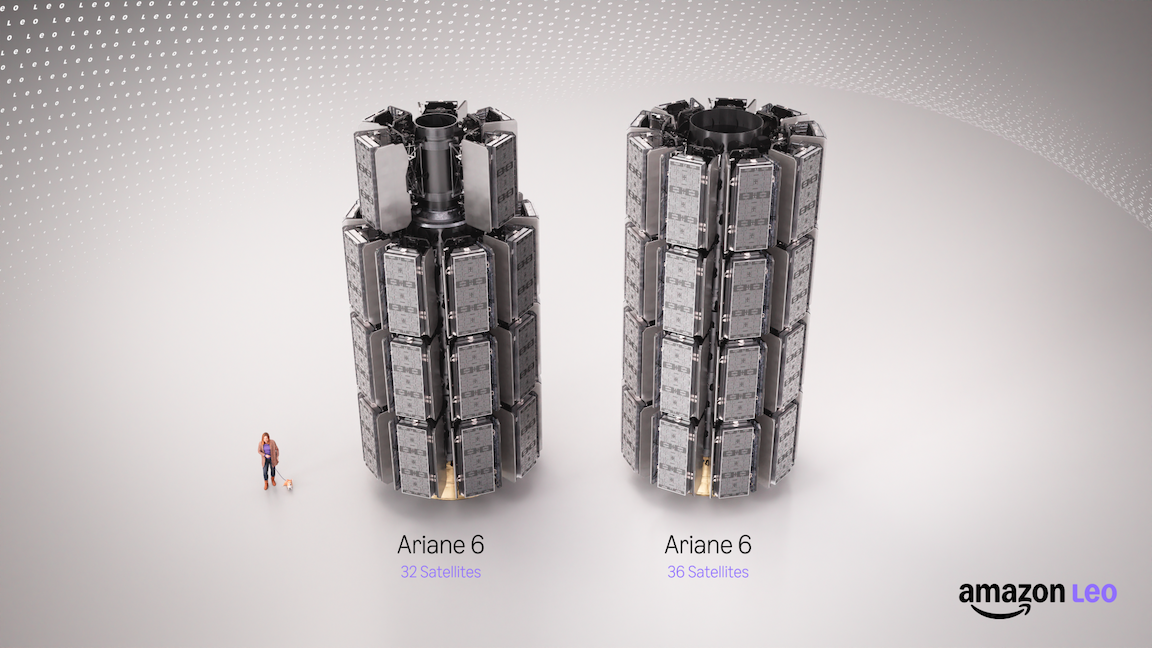
This mission will deploy 36 Amazon Leo satellites, compared to 32 satellites on the previous Arianespace missions. This will be the most Amazon Leo satellites deployed in a single mission to date.
“Every additional satellite we can safely deploy on a single launch accelerates the pace at which we scale our constellation and bring reliable connectivity to customers around the world. The upgraded P160C boosters give us the performance margin to do that confidently, and we’re already looking ahead to further optimizations as we continue building out Amazon Leo,” commented Melissa Wuerl, director of Launch Systems, Amazon Leo.
Increasing the pace is critical for Amazon Leo, which is preparing for an initial service rollout this year. The constellation currently has 331 satellites in orbit after a May 29 United Launch Alliance Atlas V launch.
Other launch vehicles will be able to launch more Amazon Leo satellites — ULA’s Vulcan rocket and Blue Origin’s New Glenn — but neither vehicle is currently in service. The Vulcan rocket will be configured for 40+ Amazon Leo satellites, and 48+ for Blue Origin’s New Glenn.