
Talk to space industry aficionados about their vision of the not so distant future and you’ll hear about a world of science fiction turned reality. Fleets of orbital data centers will circle the planet, harvesting clean solar energy to power gigawatts worth of computers and relieve Earth from polluting data-crunching infrastructure. Hundreds of thousands, or even a million satellites, may orbit the planet, beaming data via powerful laser links at the speed of light all over the globe. AI apps in your pocket (if you choose to download them) will tell you whatever of interest may be happening anywhere in the world as soon as a satellite sees it. Some even think a flurry of lunar operators will be supplying a permanent Moon station with goods and services, possibly even mining the Moon for valuable materials to be shipped back home.
But space is notoriously hard, and while some past visions have materialized surprisingly quickly (think satellite megaconstellations), others, like space tourism, have not outgrown their teething problems after years in the media spotlight. Here we take a close look at some of the most frequently discussed futuristic space ideas and sift out the likely developments from technologists’ fancy.
Explore the September 2026 Issue
Check out more from this issue and find your next story to read.
Orbiting Data Centers
In February, the internet broke when Elon Musk’s SpaceX applied to the FCC to launch up to 1 million data centers to space. Pundits both for and against shared their views on the feasibility or lack thereof of such plans, and astronomers began issuing alarmed statements about the destructive impact on the study of the universe.
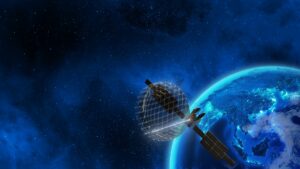
A few months later, SpaceX’s President Gwynne Shotwell said the company will be ready to launch its first data center satellite — the AI1 — in 2027. With a solar panel span of 70 meters and 20 meters wide body, AI1 will be among the largest artificial objects in space.
SpaceX is one of several companies extolling the potential of space-based computing. Starcloud launched its experimental Starcloud-1 satellite fitted with a Nvidia AI-capable H100 GPU in November last year. The spacecraft is a demonstration, paving the way for a planned constellation of 88,000 satellites, which Starcloud wants to deploy by the early 2030s. A few months prior, Lonestar launched a small experimental data-processing payload to the Moon aboard the Intuitive Machines Odysseus lander. The firm envisions future super secure permanent data storage facilities under the Moon’s surface and in its orbit. Google, too, is eyeing the orbital data processing business.
On paper at least, the proposition makes sense. The boom in AI has prompted a massive spread of large computing infrastructure on Earth, which mars the landscape, strains power grids, produces greenhouse gases, and requires large amounts of water to keep cool. In space, data centers would be in nobody’s way, and powered and cooled for free.
Still, many experts doubt whether and how fast such visions may become feasible. Pacome Revillon, the CEO of space consultancy firm Novaspace, tells Via Satellite that for the foreseeable future, the price per one gigawatt of power generated on Earth will remain at least three or four times lower than that produced in space. Ten years from now, he added, the proposition may begin to make economic sense, but still, he expects large orbital data centers to be fairly few, serving mostly governments that require the highest amount of security for their data.
Dallas Kasaboski, a space industry analyst at Analysys Mason consultancy, thinks that out of the flurry of recent announcements only a handful will materialize.
“There will be winners and losers,” Kasaboski tells Via Satellite. “There’s been a lot of announcements that are bigger than the rest of the industry. But a lot of those announcements have no solid foundation under them.”
Both Revillon and Kasaboski think that computing infrastructure in orbit will grow. For the foreseeable future, however, most of it will be crunching data gathered by Earth Observation satellites to speed up access to insights for users on Earth. First developments in this direction have already arrived. Earlier this year, space intelligence company Planet released the first images that had been analyzed in real time by onboard algorithms to flag objects of interest on Earth’s surface.
Solar Power from Space
Fueling the idea of space-based data centers is the availability of abundant, free, and constant energy from the sun. A photovoltaic panel in Earth’s orbit generates up to 13 times as much energy as an identical panel on Earth, according to industry experts. A careful orbit selection ensures that a photovoltaic plant in space almost always sees the sun and barely ever faces the shadow. Thus the technology does away with the intermittency problem that plagues Earth-based renewable energy resources. Some think that fleets of vast orbiting solar power plants could cover the majority of the world’s energy needs in the next 25 years.
But just like orbital data centers, such vast structures would be expensive to launch and difficult to assemble and maintain. Moreover, technology is not quite there yet to beam megawatts of power from space to Earth efficiently.
“The efficiency of transmitting solar energy from orbit to ground is currently very low,” Emiliano Kargieman, CEO of EO company Satellogic, tells Via Satellite. “If you use microwaves or lasers to transfer the energy to antennas on the ground, you lose around 60 or 70 percent of the power in the process. So, space-based solar power is a very long game, although we might see the beginnings of that in the next 15 years.”
He added that before giant orbiting power stations begin supplying cities on Earth, spaceborne power infrastructure might emerge to support satellites in space and spare them the need to launch with bulky batteries and enormous solar arrays.
In fact, Star Catcher has raised over $88 million to build an off-planet power grid; a network of energy-harvesting satellites designed to beam electricity to other spacecraft. The company plans to fly an orbital demonstrator later this year.
Kasaboski agrees that the emergence of such specialized space infrastructure could facilitate further growth of the sector and free satellite operators to perfect their core technologies.
“Rather than launching a megasatellite that does everything, you could concentrate on your main payload and then receive power from somebody else or offload your data to somebody else,” he says. “So far, however, we see more companies wanting to do everything themselves.”
AI-Powered Planetary Intelligence at Your Fingertips
The expected growth in satellite numbers paired with advances in AI will usher in a new era of Earth Observation. The entire planet will be under constant supervision with AI agents aboard satellites instantly scouring images for insights relevant to users.
“In the next 15 years, the Earth Observation industry will finally be able to monitor the entire world in real time,” says Kargieman. “The surface of Earth is huge, some 150 million square kilometers of land mass and another 450 million square kilometers of ocean. If you were to put people to look at all those pixels to understand what’s happening every day, it would be impossible. But AI will be able to not only look at all these things, but to start understanding how things are connected.”
Kiruthika Devaraj, Planet Labs vice president of Engineering, thinks that in the future, specialist vision language models will be able to sift through the data and send keyword-based alerts to smartphone apps of subscribed users.
“You can host LLMs on your satellites to get text answers to what [the satellite] sees,” she says. “In five or 10 years, we will all get used to accepting what the LLMs give us and won’t always require to see the underlying imagery to check that there is a ship coming.”
Planet envisions that AI agents in the future will aptly manage the company’s growing constellation of satellites, scanning high-frequency revisit lower-resolution data for events of interest and automatically tasking higher-resolution spacecraft to revisit the flagged spots.
“It’s a global orchestration,” Devaraj said. “It’s an orchestrating tip and queue framework that AI is going to unlock. We call this planetary intelligence.”
Omnipresent Satellite Connectivity
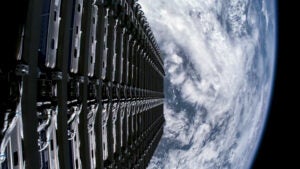
Whilst some 16,000 satellites orbit Earth today, 15 years from now, the night sky above our heads may be abuzz with hundreds of thousands zooming dots, each of them a satellite delivering connectivity, imaging the planet or crunching data. That vision excites space industry enthusiasts but alarms astronomers. How much the satellite industry will grow, however, is still a question.
Kasaboski says that before the talk about orbiting data centers became serious, Analysys Mason forecasted some 40,000 satellites to orbit the planet in the next 10 years. The majority of those was to belong to internet-beaming constellations, such as SpaceX’s Starlink, which now consists of around 10,400 satellites.
“There are currently around 250 constellations that we are tracking in various stages of development,” says Kasaboski. “The number of satellites per constellation continues to increase. New players are coming to the market wanting to build a thousand or ten thousand satellites.”
With the addition of data centers, he says, the number of spacecraft in orbit in the next decade can easily reach 100,000.
Revillon thinks that the future can be even grander with a minimum of 50,000 satellites but possibly up to half a million orbiting the planet ten years from now. The success of SpaceX’s Starlink, he says, has inspired other players but also other nations who now seek to deploy their own vast capabilities.
Revillon doesn’t think that satellite connectivity will replace ground-based infrastructure, but expects satellite links to become rather ubiquitous. In addition to direct-to-device smartphone connectivity, satellite links will be indispensable to the growing ecosystem of remotely controlled robots and autonomous cars that is expected to blossom in the next decade.
Emile de Rijk, the founder and CEO of Swissto12, an emerging firm manufacturing innovative small satellites for Geostationary Orbit (GEO), tells Via Satellite that “by 2040, satellite communications will be integrated into our everyday lives and digital infrastructure”
“Users will not think in terms of terrestrial versus space networks or applications; they will expect seamless connectivity or services wherever they are on the Earth, often not even realizing those are space enabled,” he says.
The first hints of that superconnected future are already here. After smartphones and Apple Watches, Starlink-connectivity has made its way into trackers that enable dog owners to keep an eye on their pooches wherever they are.
Speedy Laser Links
The transfer of data around the planet will speed up over the next decade thanks to laser links, which can pack up to a thousand times more data compared to traditional radio waves. Inter-satellite links have become a staple in the industry in the past five years but companies are now trying to crack the challenge of using lasers to beam data from space to Earth. Unlike radio waves, optical links get disturbed by Earth’s atmosphere and struggle to get through clouds. But a new generation of companies is already testing cheaper optical terminals to help transfer vast amounts of data from space to Earth in a heartbeat.
Rohit Jha, the founder and CEO of Transcelestial, envisions that space-based laser links could in the future replace undersea fiber optic cables and route hundreds of terabits per second of data across continents cheaply and without the risk of being damaged by earthquakes or deliberate sabotage.
“Optical links will become more important for high-capacity connections between satellites, between space and ground, and across places where fiber is too slow, expensive, or impractical to install,” Jha tells Via Satellite. “For satellite operators, that could mean faster data offload and better use of their constellations. For telecom operators, governments, and enterprises on the ground, it could mean fiber-like capacity in places that have always been hard to connect.
With a planned constellation of only 40 satellites, Transcelestial envisions delivering fiber-grade connectivity to areas in hard-to-connect areas of the equatorial belt, which would then be redistributed locally using ground-based systems.
Business on the Moon
Despite the media buzz around lunar exploration, the analysts remain skeptical whether the Moon might sustain any sort of truly commercial economy in the foreseeable future. While a Moon base, or two (if China proceeds with plans to set up its own research base), are likely to host regular crews within the next 15 to 20 years, most lunar business is set to remain bound to government contracts.
“It’s difficult to imagine how a commercial company could purely make money without selling it to a government entity on the Moon,” said Kasaboski.
Revillon agrees that for “at least the next decade” a “minority” of lunar operations will be driven “by commercial matters outside government contracts.
The analysts have similarly lukewarm views about commercial space stations in Low-Earth Orbit (LEO) that are expected to replace the retiring International Space Station by the end of this decade. “I think there will be one semi-major commercial space station in orbit focused on human spaceflight operated by a commercial player,” predicts Kasaboski. “There may also be a few players who launch standalone modules capable of doing life science experiments and working for big pharma and things like that.” VS