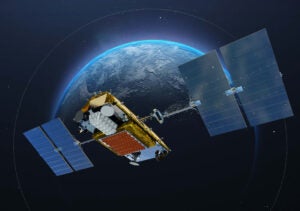

Autonomous systems, ubiquitous sensors, and AI-optimized targeting are positioned to transform tomorrow’s warfighting domain, where the ability to see, decide, and act first may rest with constellations in orbit rather than troops on the move.
To explore how space defense could evolve by 2040, Via Satellite asked experts to weigh in on the larger strategic shifts, including the growing role of commercial space, AI, and autonomy.

Explore the September 2026 Issue
Check out more from this issue and find your next story to read.
“The U.S. has moved from space as a sanctuary to space as a warfighting domain,” says Steve Kitay, senior vice president of Space Defense at True Anomaly and former deputy assistant secretary of Defense for Space Policy. That recognition came with the standup of the U.S. Space Force in 2019, in response to growing threats. Kitay envisions a maneuver-driven domain by 2040, with proliferated autonomous constellations operating across all orbits out to cislunar space. “We’re in the midst of a major inflection point in how we use space,” he says.
Those dynamics will likely play out in a far more crowded orbital environment, with more than 500,000 satellites potentially orbiting Earth by 2040, according to a NASA-led study, raising questions about how militaries will protect infrastructure spanning precision strike, missile warning, and global commerce.
Few leaders have had a closer view of that transition than retired U.S. Space Force Lt. Gen. John Shaw, who served as deputy commander of U.S. Space Command from 2020 to 2023, and emerged as a leading voice for joint all-domain operations. “Space is only going to continue to become more important to warfighting and to society,” Shaw says. “The way you’re going to be able to track and detect threats to our homeland is going to largely be through space.”
For Shaw, that shift marks what he calls a third space age, defined not by a handful of exquisite national systems but also by proliferated constellations, heavy commercial participation, and a domain that must be continuously monitored. Space, in his view, will be less about spectacular “space weapons” and more about the sensing, command-and-control, and resilience that underpin every other domain of warfighting.
Daniel Gerstein, a former acting undersecretary for Science and Technology at the U.S. Department of Homeland Security, imagines a “transhuman” AI defense future in his just-published future warfare novel, “War Without Humanity.” Gerstein divides space development into three eras: early exploration, a government-led “assured access” phase, and today’s commercialization surge. He sees the current era driving proliferated Low-Earth Orbit (LEO) and Very Low Earth Orbit (VLEO) systems and an expanding role for space in critical infrastructure.
Gerstein contends the future battlespace will rest on a dense, multi-orbit communications web that fuses satellites, unmanned aerial systems, and terrestrial networks into a single fabric. “The network will be self-healing, adaptive, complex,” he says, and will “cause the intelligence to grow as well, because everything will be able to be seen and monitored.”
Proliferated Orbits, Resilient Architecture
Multiple experts see 2040 defined by proliferated constellations and tightly integrated space-terrestrial networks.
Pinar Yasar Orten, head of Next Generation Communications Networks at the NATO Communications and Information Agency (NCIA), expects proliferated constellations across multiple orbits to deliver far greater redundancy in communications, intelligence, surveillance, and reconnaissance (ISR), and positioning by 2040.
“Space capabilities will be more deeply integrated between space, cyber, and terrestrial capabilities, enabling faster and more informed military decision-making across all domains,” she says. VLEO “will become an important part of this architecture, offering enhanced imaging, sensing, and communications capabilities,” she notes, though it is “likely to complement rather than replace higher orbits, given the challenges associated with atmospheric drag and shorter satellite lifespans.”
Audrey Schaffer, former director for space policy on the National Security Council staff and now senior vice president at Slingshot Aerospace, observes that the U.S. is already shifting from a handful of exquisite satellites to what she calls “a mesh network” of proliferated and disaggregated systems, with commercial operators central to that shift. She expects other countries to chase the same connectivity and coverage, growing the world’s large comms and remote-sensing constellations from about four today to perhaps 10 to 15 by the year 2040 – but not 100. “It’s not that easy to put up 10,000 satellites,” she says.
Kitay believes the shift to proliferated, attributable autonomous systems that are capable of much faster decision-making is inevitable. “Autonomy and AI are going to enable much more rapid decision-making across large amounts of data and respond to rapidly evolving situations.”
Clayton Swope, deputy director of the Aerospace Security Project at the Center for Strategic and International Studies (CSIS), expects LEO and VLEO constellations connected by optical crosslinks and in-space computing to deliver a fused, real-time picture of the planet. “By 2040 we’ve moved to a concept of space-based sensing where there is hardly any spot on Earth that is not visible and trackable by a satellite 24/7, 365,” says Swope, a former CIA science and technology officer. “There would truly be nowhere to hide.”
Disagreement on the Moon’s Value
Experts have varying perspectives on whether or not militarization of space will extend to the Moon. Swope views it as important for science, prestige, and long-term human presence, but doubts it will provide decisive advantage in the kind of conflict he views as most likely – a confrontation with China. The economic case for moving beyond Geostationary Orbit (GEO) is still “very speculative,” he argues, noting that serious competition for territory has historically followed demonstrated economic value: “When there’s something that has economic value, people want to claim it,” he says.
Despite the current geopolitical marathon to establish a permanent human presence on the lunar south pole, Schaffer doubts there will be military boots on the Moon by 2040, noting the Outer Space Treaty prohibits military installations on celestial bodies. Lunar competition with China, in her view, is about demonstrating technological prowess, not direct military confrontation.
Kitay is more bullish on cislunar space, seeing it as the next strategic high ground the United States will have to invest in as activity moves outward. “As that happens, our nation’s going to need to be able to be prepared to protect and defend it and ensure we don’t have strategic surprises out in the region and beyond,” he says.
AI and Autonomy Reshape Operations
Yasar Orten expects satellites to handle much of their own maneuvering, threat spotting, and resource management by 2040, cutting response times and dependence on ground control. “AI-enabled systems will improve situational awareness, decision-making, and the ability to protect and sustain space capabilities in increasingly contested environments,” she says.
Schaffer predicts space conflict could become machine-on-machine: “We may be in a scenario where we are actually seeing AI versus AI,” driven by systems “trained in astrodynamics, trained in physics, not trained in speech.” For military decisions involving the destruction of assets or services, though, “you will want to continue to have a human at least on the loop, if not in the loop,” she says.
Shaw agrees the domain is suited for autonomous adoption. “The space domain is probably more suited to the use of machine learning, agentic AI, and autonomous machines than any other domain,” he says. “It’s built for that. …We’ve been operating autonomous machines in space since the beginning of the space age,” he notes.
Gerstein calls the emerging mix of humans and AI-enabled systems a “transhuman force” and warns that capability gains must be matched by governance. “At some point we’re going to have to develop arms control agreements that limit the behaviors of these new systems or at least establish rules of the road,” he says. “And there are certain functions we should never dehumanize.”
Space Weaponization and the Norms Gap
Since China’s 2007 anti-satellite test and Russia’s 2021 test that destroyed one of its own satellites and scattered debris across LEO, anti-satellite weapons have stayed firmly in the public conversation, with attention centered on ground-based threats: lasers, jammers and missiles. Schaffer expects the domain to move well beyond that by 2040, with weapons routinely stationed in orbit, such as “co-orbital kinetic weapons, space-based jammers, or maybe even space-based lasers.”
Her deeper concern is that norms and diplomacy are lagging behind the pace of weaponization and automation in orbit, with real consequences for civilian users. “I’m alarmed that we haven’t put very many guardrails around conflict or weapons in space,” she says. “Space is a shared domain.”
Missile defense is facing its own reckoning with modernization. Take the Golden Dome initiative: Schaffer says the goal of protecting Americans from next-generation air and missile threats is “spot on,” because the existing missile defense architecture was “built for a different era.”
Shaw agrees the program’s underlying problem statement is both “sound and bipartisan,” and predicts that some form of layered missile defense featuring hypersonic and other advanced platforms “will be a defense layer that we need as a nation.” But for him, the decisive contribution of space is in sensing and tracking, not orbital weapons, pointing to hypersonic tracking and moving target indication as core requirements. Space-based interceptors (SBIs), by contrast, are “perhaps the least likely component of an overall new threat defense system,” he predicts.
Kitay has a different view, noting, “As we look out from now to 2040 and beyond, space-based interceptors will be a critical element of the layered defense to protect life here on Earth, strengthening deterrence by denying adversaries confidence that missile attacks can succeed.”
Swope supports the broader homeland defense mission but questions whether space-based interceptors specifically will outlast the current administration. “I lean towards no,” he says, citing a golden-rule problem: an interceptor satellite is also a satellite with a missile that could strike a target on Earth. “Would the United States be comfortable with an adversary with a satellite with missiles on it always orbiting overhead? I don’t know if we would be. I wouldn’t be.”
Still, Swope says military and peaceful uses of space “can coexist together. They have since the beginning — from the very first time we put anything into space.” The V-2 rocket that crossed the Karman line in 1944 became the same technology that powered the space race. “It’s not an either/or.”
Yasar Orten notes that space’s growing role in critical infrastructure makes responsible behavior essential. NATO, she says, will continue promoting responsible conduct while embedding commercial partners more deeply into Alliance architecture. “Cooperation in space is essential today and will become even more important in the future.”
Schaffer takes a harder view. “The geopolitical dynamics that we see on Earth will extend into space,” she says. “I don’t think there’s anything magical about space that makes it more likely to be an arena of cooperation versus competition.” Alliances that hold on Earth will hold in orbit, she expects, but she sees little prospect of U.S.-China cooperation anytime soon.
Dual-Use and Commercial Growth
The experts also expect commercial technology to form a growing share of defense space infrastructure by 2040, with the same systems supporting military and civilian missions. Swope envisions commercial providers selling services to government and non-government customers alike, the same platforms helping militaries track mobile targets while also powering climate monitoring and disaster response. The hardware may be agnostic; what changes is the algorithm, tasking, and mission.
Yasar Orten agrees. “Many space-based capabilities are inherently dual-use and can support both civil and security objectives,” she says. “Future space infrastructure may be designed with greater flexibility to serve a broader range of missions, including environmental monitoring, humanitarian assistance, and crisis response, alongside its core defense and security roles.”
Shaw sees that commercial turn as central to the third space age, in which government and industry share a common orbital backbone, and security depends on protecting a space infrastructure that is no longer purely military. He expects governments to lean heavily on commercial capabilities “at cheaper cost, bigger scale,” and emphasizes that space sustainability, from debris remediation to traffic management, is a core element of mission assurance. “I think any true space professional wants a sustainable domain for the future.”
Despite differences in emphasis, the experts share a common message: stop planning around individual systems and start planning around integration, resilience, and the speed of commercial change.
“I anticipate future capabilities to be defined by how well they are integrated across orbits, domains, and partners, rather than individual systems,” Yasar Orten says. “Resilience will come from distribution, interoperability, and the ability to rapidly adapt rather than reliance on a small number of high-value assets.”
Kitay’s message for space architects is direct: move rapidly, and do not wait for 2040 to begin. The risk he identifies is not a gap in awareness but a gap in execution speed. “I’m concerned about the threats that are growing to our nation, in space, to space, from space, and our ability to move rapidly to meet those threats,” he says. “That’s what we need to ensure: that we are moving fast enough as a nation.” Prototypes must become fielded capabilities; demonstrations must become scaled architectures.
Gerstein cautions that militarization of commercial orbits could “be quite messy” if governments and industry fail to deconflict in increasingly crowded environments. By 2040, the question will not be whether space is central to defense; that debate will be over. The open question is whether commercial, military, and diplomatic frameworks can keep pace with a domain that has become the backbone of security and society.
The autonomous, sensor-rich battlefield Gerstein imagines on Earth will have a full counterpart in orbit: proliferated constellations from LEO to cislunar space, commercial and military payloads sharing the same platforms, and machine-speed decisions riding on networks that rarely blink. Whether that future proves stabilizing or “messy” will hinge on how quickly governments, industry and allies can build resilient architectures, set guardrails, and keep a weaponized domain sustainable. VS