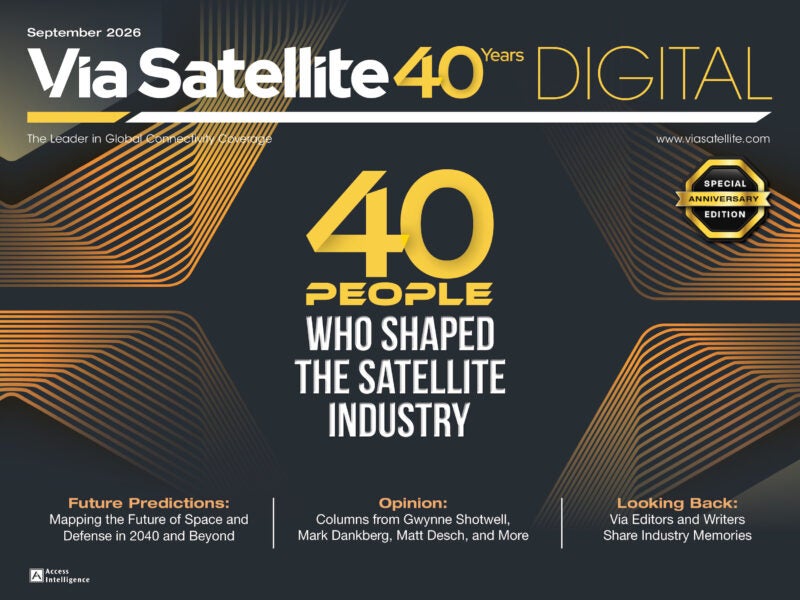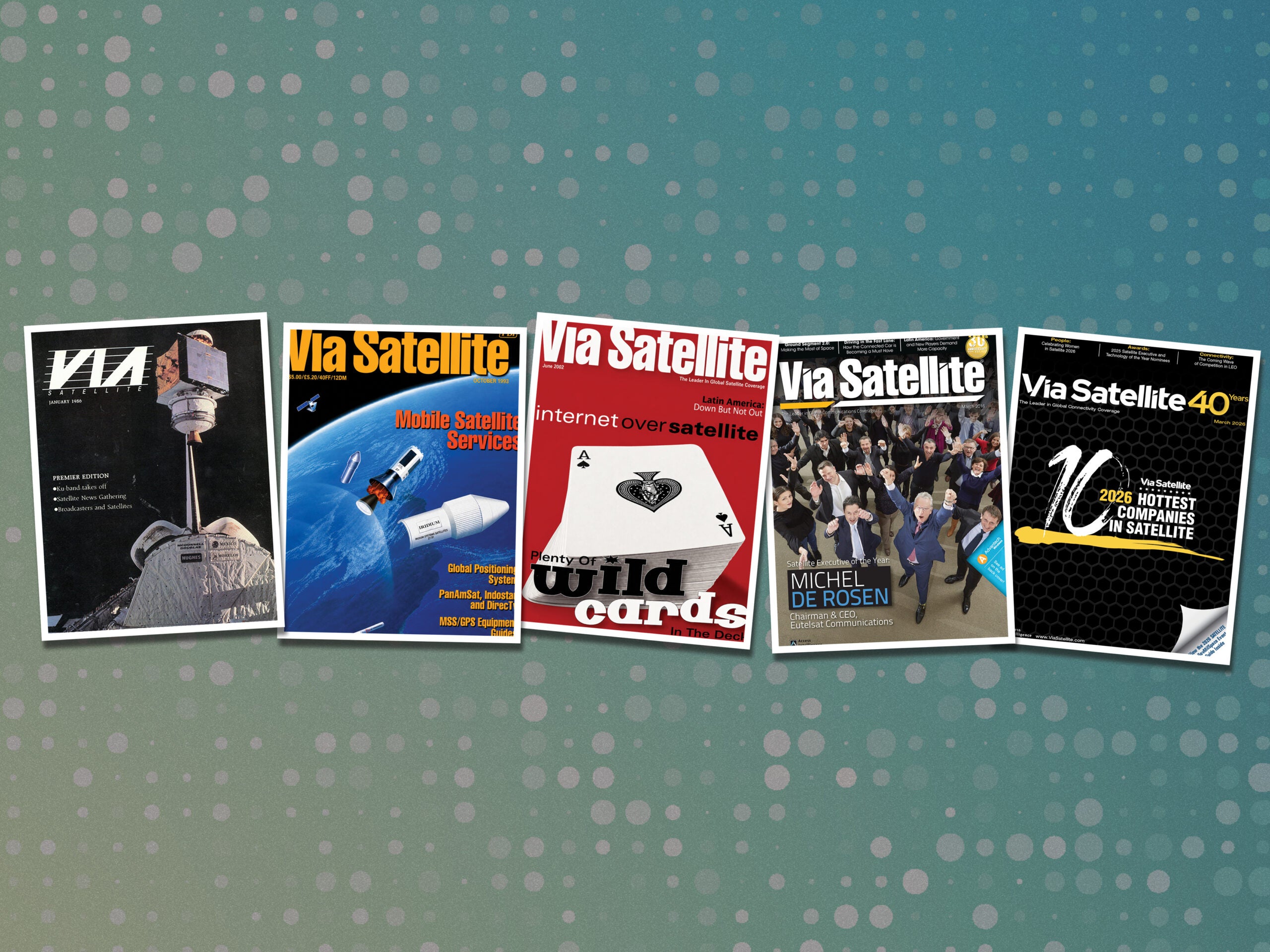

Over a 40-year history, Via Satellite has told countless stories of the space and satellite industry. From its first edition in 1986 to today, the magazine’s writers and editors and are the heart of the publication. We caught up with editors and writers — both past and present — to hear some about some of their favorite stories they wrote, favorite memories of Via Satellite, and what we might be talking about at Via’s 50th anniversary 10 years from now.
Scott Chase
Longtime editor and publisher
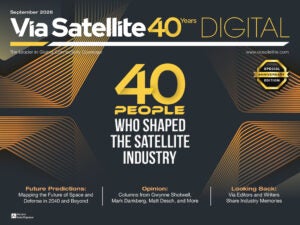
Explore the September 2026 Issue
Check out more from this issue and find your next story to read.
Tell us about your early days with Via Satellite.
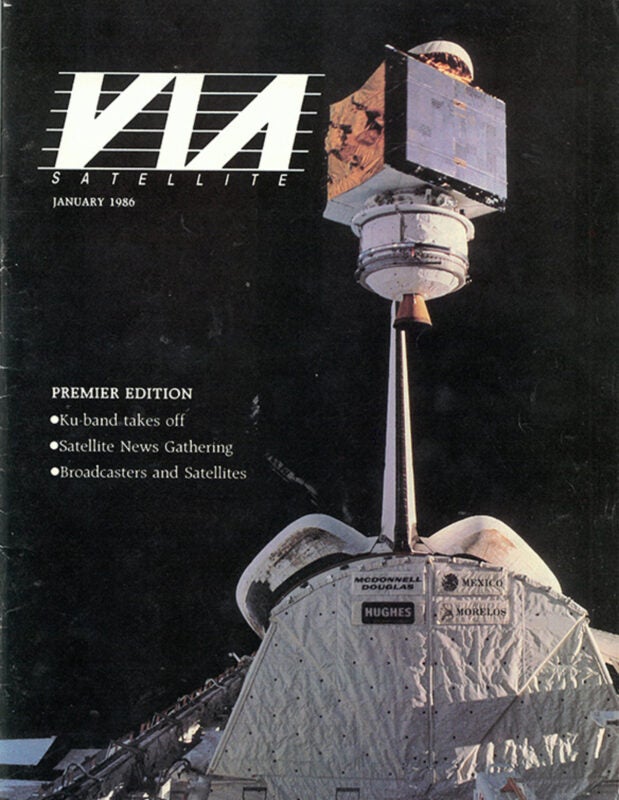
Chase: Forty years ago, Tom Phillips, founder of the company that eventually became Access Intelligence, decided he wanted to add print magazines to his evolving media empire. We already had a strong presence in the global communications satellite arena with must-read newsletters covering the commercial arena as well as evolving technology plays such as direct broadcast satellite. To create a monthly magazine was a logical step and, almost by divine intervention, we had just then a solid proposal and issue mock-up from industry journalist Irl “Bucky” Marshall. So, I was there from the very first issue and continued to have an active role with the magazine as editor and then as publisher for another 15 years. After that, I mentored our journalists, my successors, and contributed to the publication in one form or another until March 2020 when I retired from the satellite marketplace as chairman emeritus of the annual SATELLITE show in Washington, D.C.
What was your favorite story you wrote or edited and why?
Chase: My favorite story actually was a sequence of articles for the Satellite Executive of the Year award, which I created in 1988. Our first honoree was PanAmSat visionary Rene Anselmo, an easy nomination to get the tradition started. Over the years, we had very gracious and appreciative winners such as Radiation Systems Inc. founder Dick Thomas (for advances in earth station technology) and Jean-Claude Husson of Alcatel Space, controversial choices such as Iridium chairman Bob Kinzie (for changing mindsets regarding optimized assembly line satellite manufacturing and launch vehicle procurement), global luminaries such as Eutelsat’s Michel de Rosen and Romain Bausch of SES, and true pioneers such as David Thompson of Orbital Sciences Corporation and Thomas Choi of Asia Broadcast Satellite. Writing about these bold and charismatic innovators was electrifying, and the process of nomination, selection, and announcement let me and the satellite team get to know these folks on a more personal and effective level.
What is a favorite memory or anecdote from your time at Via Satellite?
Chase: I had the opportunity to participate twice as a “mentor journalist” in NASA’s Reduced Gravity Student Flight Opportunities Program. In 2001 I joined a small team of students from Purdue University, the “Cradle of Astronauts,” to test the team’s experiment in reducing gas bubbles in satellite station-keeping propulsion tanks, fluid dynamics in microgravity. My gang and teams from other universities met at NASA’s Johnson Space Center for three days of preflight training, tweaking the experiments, learning in-flight emergency procedures, undergoing hypoxia training, and more before boarding NASA’s KC-135 “Vomit Comet” aircraft for a day of zero-g over the Gulf of Mexico. Up we went, giddy with excitement! The flight profile included 30 zero-g parabolas, one Martian gravity (about a third of Earth’s gravity), and one lunar gravity (about one-sixth of the Earth’s pull). I’m delighted to report that my Purdue students validated their experimental projections in less than 15 loops, so we had another 15 or so to turn cartwheels and flip Nerf balls in zero-g. So much fun packed into an afternoon, plus a passing grade for the experiment. Likewise, my 2013 team from University of Texas, flying in Zero Gravity Corp.’s 727-200 G-FORCE ONE aircraft, experienced similar positive results and also had time for a little fun in weightlessness. We got two features out of the deal, and I would fly those missions again in a heartbeat!
What has surprised you the most about the satellite industry?
Chase: My vote goes for resilience, from 1965 to date! The global communications satellite industry has weathered many storms, from launch failures to the heartbreaking Challenger disaster, regulatory threats, the oft-touted fiber optics “Death Star,” industry consolidation, and more. But every time terrestrial technology took away a core satellite market, space-based technology created a new one. Fiber took international telephony; satellite retorted with direct-to-home television. Fiber took internet backbone traffic; satellite countered with remote broadband, maritime, and aviation connectivity, disaster recovery, and more. You don’t see fiber in war zones or earthquake epicenters. Satellite will always have a role, consumer, commercial, military, and scientific. The technologists and engineers working this marketplace today continue to lay the foundations for a robust global business for decades to come.
What do you think will be the big talking point at Via Satellite’s 50th anniversary?
Chase: My old friend Arthur C. Clarke told me – and everyone else – never to make predictions if you think you will outlive the considered timeframe. I sure hope to be here in 10 years. To hazard just one little guess, I’ll point to satellite-harvested and -delivered energy from space. And I’ll be thrilled to participate in Via Satellite half-century celebrations!
Jason Bates
Assistant editor 2005 to 2006, then editor from 2006 to 2011
What was your favorite story you wrote or edited and why?
Bates: Working with then-editor Nick Mitsis when Jean-Yves Le Gall of Arianespace was named Satellite Executive of the Year in 2005. Great story. Everyone at Arianespace was great. We had an amazing dinner at a French restaurant in Georgetown — the owner and staff treated us like rock stars once they found out that Jean-Yves was there.
What is a favorite memory or anecdote from your time at Via Satellite?
Bates: Attending global shows and seeing everyone in the industry face-to-face. From Las Vegas, Singapore, Amsterdam, to Dubai with Mark and Joe and everything associated with that. It was just a series of long, intense, informative days and coming back from shows with a better understanding of what was going on around the industry and with so many ideas of what to do with the magazine and the SATELLITE show.
What has surprised you the most about the satellite industry?
Bates: The failure of the first Low-Earth Orbit (LEO) constellations and alternate launch vehicles in the late 1990s and early 2000s — versus where we are today as the technology and the economics around everything improved.
What do you think will be the big talking point at Via Satellite’s 50th anniversary?
Bates: Honestly, no idea. I don’t have any confidence in looking out 10 years, when things can change so drastically in a one- to two-year time frame now. But I think the long transformation of the satellite sector from a siloed, niche areas of communications into a critical part of the integrated global comms sector will continue gaining speed.
Anne Wainscott-Sargent
Via Satellite freelance writer since 2010
What was your favorite story you wrote or edited and why?
Wainscott-Sargent: That’s a hard question. Two closely aligned articles, Marking a New Era of Human Voyages to Space in May 2022 and The Coming of Space Tourism in July 2019, were meaningful because they captured our industry’s excitement and momentum about the potential of space for everyone, not just professional astronauts. The May story appeared just a month after the successful launch of Axiom-1, the first all-private astronaut mission to the ISS. In the story, space entrepreneur and Orbite Space Co-founder and CEO Jason Andrews compared modern space tourism to 1920s aviation, noting that the wealthy will be the first to fly before it becomes widely accessible to the general public.
I have provided significant defense coverage for Via Satellite during my tenure. In that arena, my favorite stories were those that keyed off breaking news, like Russia’s KA-SAT attack on Viasat just before Putin invaded Ukraine in 2022 – a key focus of my story, Satellite Operators Respond to Cyber Threats in a Rapidly Changing Environment, and more recently, my cover story on the Arctic space race in January/February 2026, which coincided with rising geopolitical tensions in the region.
What is a favorite memory or anecdote from your time at Via Satellite?
Wainscott-Sargent: It’s a rare treat to meet up in person with the Via Satellite editorial team, and rarer still to attend the SATELLITE awards luncheon for the announcement of Satellite Executive of the Year and Satellite Technology of the Year. The stars unexpectedly aligned in March 2023, and I got to join Senior Managing Editor Rachel Jewett at the luncheon. Via has provided me opportunities to report on the evolution of space during a period of unprecedented change. For me, interviewing the brightest minds in our industry was better than getting an MBA in space, and I’m grateful for the opportunity to cover an industry so vital to the world and humanity.
What has surprised you the most about the satellite industry?
Wainscott-Sargent: The commercial space industry’s disruptive role in driving the satellite industry’s future. Lower launch costs and reusable rockets have reduced barriers and enabled universities, startups, and even nations once too small to play in space to be part of the space economy. This monumental shift was just getting underway in the 2010s when I began writing for Via – a dramatic change from the industry I entered in 1999, when space was purely government-led and government-driven.
What do you think will be the big talking point at Via Satellite’s 50th anniversary?
Wainscott-Sargent: By 2036, Via Satellite’s 50th anniversary coverage will focus on established cislunar operations powered by a nuclear power plant on the Moon and dramatic growth of orbital data centers. Space medicine will come into its own, with new therapies and commercial- scale manufacturing. Advances in propulsion will make Very Low Earth Orbit (VLEO) more utilized to ease congestion in higher LEO orbits.
Greg Berlocher
Contributor from 2007 to 2017
What was your favorite story you wrote or edited and why?
Berlocher: My most memorable story was How the Satellite Industry Responds to the Haiti Disaster in April 2010. On January 12, 2010, a magnitude 7.0 earthquake struck 16 miles west of Port-Au-Prince. It was the deadliest natural disaster of the 21st century for a single country with 100,000 to 160,000 estimated deaths, and 250,000 residences and 30,000 commercial buildings destroyed. All subsea fiber connections were lost, and satellite technology was at the center of the global response. I spoke to NGOs, the Global VSAT Forum, government officials, satellite operators, and hardware manufacturers to gain context.
What made this article so memorable were the tears: mine, emergency responders who I spoke with that had spent time in Haiti, and Via Satellite readers that sent emails letting me know how much the article had touched them. One of the emergency responders I spoke with recounted how television journalist who were seasoned war correspondents broke down after witnessing the death and destruction firsthand. The enormity of the devastation was emotionally difficult to deal with.
Another memorable aspect of the story was the creative merger of wireless technologies. Just days after the earthquake, Wi-Fi hotspots started popping up all over Haiti. Wi-Fi routers connected to satellite terminals were a game-changing combination. The satellite link allowed the boots on the ground to connect to social media sites and individuals with laptops and smart phones, which were still relatively new, could now communicate asynchronously. The wireless connections allowed hundreds of people at a time to send and receive messages. Organizations quickly learned to coordinate and direct activities through social media posts. In addition, volunteers could send comforting notes back home to worried parents and coworkers of their whereabouts and well-being.
What is a favorite memory or anecdote from your time at Via Satellite?
Berlocher: I had the pleasure of supporting the Via Satellite staff at the SATELLITE show for five years, writing short articles about panel discussions for the show daily. My favorite activity was putting together the panels for Engineering Pre-Day.
What do you think will be the big talking point at Via Satellite’s 50th anniversary?
Berlocher: I predict that we will be discussing a “Big Three” satellite service providers that operate constellations of LEO satellites. The Pentagon will dramatically expand their use of LEO satellites, and to create healthy competition in the LEO market, the Pentagon will entice Starlink competitors with hefty contracts to expand their constellations.
Veronica Magan
Managing Editor from 2012 to 2018
What was your favorite story you wrote or edited and why?
Magan: One of my favorite stories was covering SpaceX’s first commercial satellite launch for SES from Cape Canaveral. The launch was scrubbed on the first attempt, and I was allowed to extend my trip to stay for the next attempt … which was also scrubbed! The third attempt finally worked after I had unfortunately already returned home. I still remember Nita Wright from SES messaging me afterward saying, “IT SHOOK THE CAR!” I’m paraphrasing, but I can still hear her in my head saying it. I remember standing out on the causeway with her, with the wind tossing our hair in all directions. I was definitely not prepared for the cold November Florida breeze, but it was an unforgettable experience. I also really appreciated that Mark encouraged me and gave me the freedom to write the story in a more personal way — capturing not just the significance of the launch for the industry, but also what it felt like to be there.
What is a favorite memory or anecdote from your time at Via Satellite?
Magan: Working at the SATELLITE Conference and Exhibition was the highlight of the year for me. Producing the Show Daily was challenging, but it was also incredibly fun. I would set up with Vince, our designer, in our Show Daily office on Sunday and work together to get the publication printed each day. I loved building the schedule for all the writers and editing day in and day out. I remember one particular day where Vince and I we were among the very last few people to leave the convention center after 9 p.m. — they even shut down the lights while we were still working and we had to find an open door to leave. I also remember how fun it was working on the 30th anniversary issue.
What has surprised you the most about the satellite industry?
Magan: What surprised me the most was how much I got into the industry. When I first started, I knew almost nothing about satellites — I remember being surprised that there was even a magazine dedicated to the field. Over the years, I loved learning about everything from Ka-band to LEO constellations and watching the industry evolve, especially with the emergence of companies like SpaceX and OneWeb back in the day.
What do you think will be the big talking point for Via Satellite’s 50th anniversary?
Magan: I think the biggest question will be what the next 50 years will bring. Technology is moving faster than ever, forcing every industry to constantly transform in ways that would have been difficult to imagine even a few years ago. I’m sure Via Satellite will continue to play an important role in covering that evolution, pushing boundaries, and serving as a trusted voice for the industry.
Caleb Henry
Reporter from 2013 to 2016
What was your favorite story you wrote or edited and why?
Henry: In 2015, I wrote a story about the revitalization of Goonhilly Earth Station, an iconic satellite teleport previously on the verge of shutting down. Located in Cornwall, U.K., Goonhilly got its start in the 1960s at the beginning of the space age, and carried the first transatlantic broadcasts from Telstar-1, the world’s first active communications satellite. By the early 2010s, Goonhilly’s owner, BT, was preparing to close the site, before a determined satellite engineer argued for saving it. That engineer became CEO Ian Jones, who recounted this story to me.
I have many favorite stories from my time at Via – covering the RD-180 debacle, rising startups like Rocket Lab and Leaf Space, etc. – but for some reason, this Goonhilly piece is my favorite. I really enjoyed the history lesson, and getting into the weeds of a story that would be a hard sell at a generalist publication but mattered to trade press readers.
Also, you don’t know if startups you talk to will make it or not. Plenty of ventures I covered (Dauria, GeoMetwatch, Virgin Orbit) are now gone. Goonhilly grew into an important gateway for commercial satellite operators like Planet Labs and Starlink. The company helped track NASA’s first two Artemis missions, and collaborated with ESA to become the agency’s first commercial deep-space tracking service provider. Earlier this year, Intuitive Machines acquired Goonhilly. I’ve enjoyed watching this small company go from near death, to prominence, to successful exit.
What is a favorite memory or anecdote from your time at Via Satellite?
Henry: We came up with some great T-shirts one year for the SATELLITE show. One had a word cloud in the shape of a satellite with all the buzzy phrases and acronyms that were popular on the Via Satellite website at the time (WRC-15, 3D TV, HTS). Another was themed like the music video game Rock Band, with shoutouts to popular spectrum bands (C-band, Ku-band, Ka-band). They were super nerdy and I wish I kept more of them.
What has surprised you the most about the satellite industry?
Henry: Thinking about this question in the context of my time at Via, I was surprised by many things. I didn’t initially know how international the satellite industry was, or how impactful its work was to the world. Through my reporting, I learned that nearly every part of modern life – from checking the weather to swiping a credit card – involved a satellite somewhere in orbit. The more I learned about the magnitude of the satellite industry’s impact, the more I wanted to share all those amazing stories, which I did.
What do you think will be the big talking point for Via Satellite’s 50th anniversary?
Henry: It’s hard to think about something as big as Via’s semicentennial! The roots of Via Satellite go back to its history as a broadcast publication, where the subject matter was television channels and media content distributed “via satellite.” The evolution of the satellite industry from a broadcast-centric field to one defined by broadband gave the publication a new locus in the 2010s and 2020s. Today we see emerging satellite technologies that could connect even more people – direct-to-cell, NB-IoT, even orbital data centers. In another 10 years, I expect satellites will play an even larger role in connecting a digital world.
Annamarie Nyirady
Managing editor and contributing editor from 2018 to 2021
What was your favorite story you wrote or edited and why?
Nyirady: I wrote a feature with a title that started with “Pretty Fly for a Wi-Fi” and Mark Holmes received emails the next day from people expressing how fun that was.
What is a favorite memory or anecdote from your time at Via Satellite?
Nyirady: The camaraderie from the team that worked the Show Dailies at the SATELLITE Show. We’d be diligently working in a tucked away room at the conference center to hit the print deadline for the next day. It was always fun collecting the stories from the show, quickly writing them, and turning it all around to see the publication on the stands the next day.
What has surprised you the most about the satellite industry?
Nyirady: How intertwined the satellite communication and Earth Observation sides of the industry have become. They used to be more distinct conversations and I’m seeing increased partnership and combined capabilities emerge.
What do you think will be the big talking point for Via Satellite’s 50th anniversary?
Nyirady: A big talking point could be as simple as how far we’ve come as an industry in 50 years. We have evolved from big satellites in GEO reserved for a select few operators to all sorts of smallsats in LEO built, launched, and operated by a variety of government and commercial operators. The continued democratization of space has been fascinating.
Marisa Torrieri
Freelance writer since 2017
What was your favorite story you wrote or edited and why?
Torrieri:I’ve loved every single story but two stand out: My first story on flat panels and phased-array antennas. It’s a subject I knew absolutely nothing about and had to consult my satellite-engineer dad to understand the differences between antennas (which was super fun!). My sources truly outlined their big visions for this technology. Another story, The Gravity of Space Debris, stands out. I’m a huge fan of sci-fi narratives and dystopian fiction, but the threat of Kessler Syndrome is real. Constellations are getting built out at an insane pace in LEO. Talking to a mix of scientists, investors, startups, and legacy satcoms was fun.
What is a favorite memory or anecdote from your time at Via Satellite?
Torrieri: This one is tough, because I really want to say that the media dinners with Arianespace (and meeting reporters from Washington Post, Bloomberg, and CNBC) at the annual SATELLITE conference were so fun and lively. A few moments from the SATELLITE show stand out. The first has to be watching Mike Pence give a speech about U.S. space priorities and policies during Trump’s first term after going through an hour in line and a high-security pat-down. Or attending sessions and filing stories SATELLITE 2020 just one day before COVID-19 was declared a national emergency on birthday, March 10th. I still recall the huge vats of hand sanitizer in the bathroom, and the little covers put on microphones. I felt like a hero because the new editor Rachel was still cutting her teeth and knew little about space and I was available to support her in the midst of the pandemic.
What has surprised you the most about the satellite industry? I’m surprised that we don’t have more launch activities given that the cost of going into space has dropped so significantly. I’m also surprised we don’t have limits on constellation growth. VS