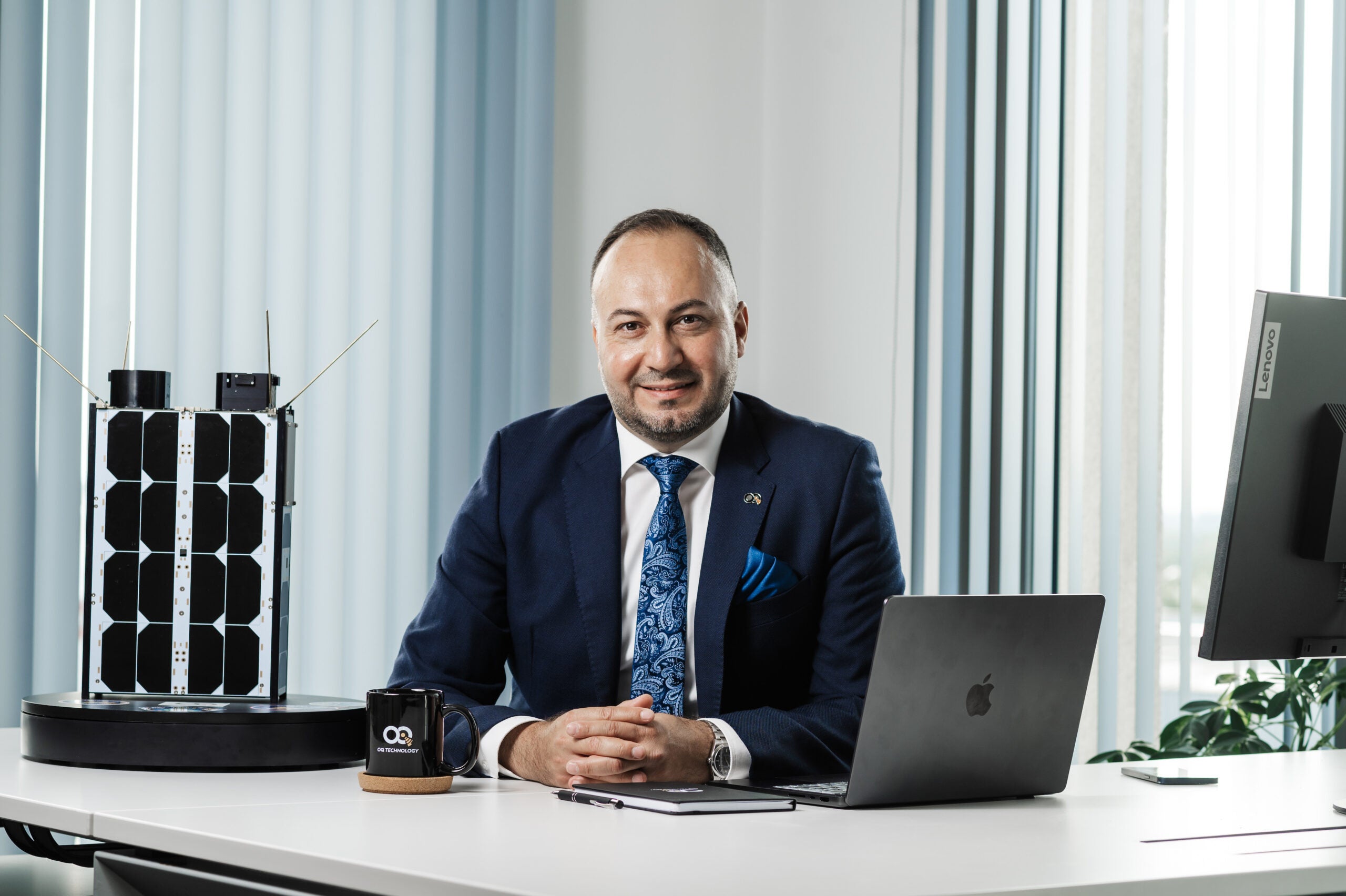
As the direct-to-device (D2D) market heats up, OQ Technology CEO and founder Omar Qaise wants the company to be a trusted, sovereign partner in D2D for European governments.
OQ Technology is expanding on its existing IoT business to offer 5G D2D connectivity from space. The company has launched 12 satellite missions so far and is preparing to launch two more satellites this year, including the first ever C-band D2D mission.
In this interview, Qaise details the company’s niche as a homegrown European player in the D2D market. He talks about recent deals with Telefónica Germany and the Luxembourg government, and the company’s outlook for the defense market, including drone connectivity. Qaise also shares an update on the second generation constellation, and why OQ is considering further verticalization.
VIA SATELLITE: OQ Technology recently announced an agreement with Telefónica Germany to demonstrate direct-to-device in Europe. Can you talk about the significance of this partnership and how you will work with Telefonica?
Qaise: This is very significant for us, for Europe, and for mobile users. We are partnering with a large mobile operator in order to demonstrate direct-to-device connectivity in Europe from a European satellite operator using the IMT [international mobile telecommunications] band, terrestrial spectrum that belongs to Telefónica. This will be done in Germany, similar to the model of SpaceX with T-Mobile in the U.S.
By using terrestrial spectrum bands already supported by smartphones (iPhones, Google Pixel, Samsung devices), we can demonstrate connectivity in areas with no cellular coverage by reaching standard smartphones directly through a LEO satellite network. This validates our technology, payloads, service capability, and ability to manage interference with terrestrial networks, while positioning OQ as a leader in Europe. Many D2D companies working with mobile operators are focused on the U.S., and Europe has lacked a comparable initiative, with OQ helping to change that.
The live demonstration will include two-way text messaging and voice calling directly between standard smartphones and OQ’s satellites. We also plan to demonstrate live drone video-feed connectivity using 5G new radio (NR) technology. This is not narrowband IoT, but rather 5G NR with our next mission.
VIA SATELLITE: Will this be the first time that OQ will be operating in telco spectrum?
Qaise: Yes. We’ve always operated in MSS [mobile satellite services] S-band, which is the standardized NTN [non-terrestrial network] band that’s highly contested now in Europe. We also have a mission for C-band, which the FCC is trying to auction and mobile operators are hoping to use as it’s compatible with current smartphones. OQ and other satellite operators are also interested in using C-band for D2D, especially in the U.S. This will be our second spectrum that we will demonstrate.
VIA SATELLITE: OQ is targeting D2D but you also have an IoT business with an existing constellation. What are some of the top use cases and markets for the IoT service that you’re providing today?
Qaise: Our current first-generation satellites provide narrowband IoT connectivity. They are also capable of delivering broadcast emergency messaging directly to smartphones, a capability we demonstrated for the first time last year. These services are designed primarily for IoT roaming in partnership with mobile operators, connecting standard non-terrestrial network (NTN) devices such as Nordic chipset modules and other existing hardware. Through these mobile operator relationships, we enable NTN IoT roaming across a range of applications.
Today, we serve customers in the oil and gas and broader energy sector, including Aramco, as well as the logistics and maritime industries. Our active markets span Australia, the Middle East, Africa, and international waters, and we are actively exploring expansion into South America.
Our core applications include pipeline monitoring, wellhead monitoring, predictive maintenance tracking, asset tracking, and environmental monitoring. These represent the dominant use cases we serve today. Our emergency broadcast offering is a newer capability. Here, we partner with government agencies, community organizations, first responders, and NGOs to deliver emergency broadcast messaging during disasters, catastrophes, or cyber attacks, when terrestrial networks are unavailable. We are also exploring the use of IoT links to connect unmanned aerial vehicles (UAVs).
VIA SATELLITE: Can you share more about the possibility to connect drones or UAVs with IoT?
Qaise: Last year we ran a successful drone connectivity test with Airbus, connecting a drone over a narrowband satellite link. While this approach does not provide continuous coverage, we are focused on use cases where continuous coverage is not required.
More recently, we succeeded in sending compressed video from a drone camera directly to the satellite over a narrowband IoT link, leveraging edge computing. This is well suited to applications that do not require live streaming, such as infrastructure or pipeline inspection and asset tracking, where you can capture a short video, compress it, and transmit it over a narrowband link.
The key advantage is the hardware. We use a very small, low-cost narrowband IoT modem that fits on an inexpensive commercial drone. This is not the broadband-class or costly phased array terminal approach; it is a narrowband, low-cost terminal designed for commercial low-cost drones. This is a genuinely new capability, and we are proud to have achieved it.
The upcoming D2D satellites starting in the third quarter of this year will use 5G NR technology and will be able to provide high-resolution, live video streaming directly from drones.
VIA SATELLITE: OQ also recently secured the company’s first defense project with the Luxembourg government. How do you see the defense market for OQ?
Qaise: Under the Luxembourg contract, 30 projects were submitted and nine companies were selected. Ours is one of them. Our project focuses on drone-to-satellite connectivity and interference mitigation using 5G and NTN. Project Sentinel is a new initiative for us, but we see significant potential in defense and dual-use applications. We have made it a top priority, working closely with the government and the broader ecosystem to understand the opportunity and deliver against it.
VIA SATELLITE: Are there other markets you think D2D connectivity will break into?
Qaise: Mobility with smart cars is another high-growth, high-potential market for us. Private industrial networks are also a key opportunity, where customers need a secure, private, wide-area NTN network. Rather than relying on satellite phones, users can connect with standard smartphones linked to a private, secure industrial network. That is another compelling application.
VIA SATELLITE: What is the plan for OQ’s second generation constellation?
Qaise: We are targeting a constellation of 48 satellites within the next 18 to 24 months. In Gen2, these satellites will be capable of supporting both 5G NR and IoT, allowing us to address both the direct-to-device (D2D) and NTN IoT markets. This will be a different class of satellite, enabling us to cover a wider range of applications.
VIA SATELLITE: Where are you in the process of determining a manufacturer for the satellites?
Qaise: We are pursuing verticalization and bringing satellite manufacturing in-house. We manufactured the last two satellites we launched through our Greek subsidiary, and we already build both the payloads and the satellites ourselves. OQ assembles satellites by integrating the various subsystems through the assembly, integration, and test (AIT) process.
This approach keeps us in control of the quality we deliver and of our value chain. It also reduces our dependence on third-party timelines and supply chains that could be disrupted. We are seeing this shift broadly across the industry, where even large satellite operators are becoming manufacturers. It is an unusual transition, but for critical applications such as D2D connectivity combined with sovereignty requirements, controlling your own infrastructure is essential.
VIA SATELLITE: There is steep competition in direct-to-device. How do you see OQ Technologies’ niche in this market?
Qaise: It is a very good question. While there are large players in this arena, it remains a very new market. It is still in its infancy, but it is highly attractive with significant potential. I believe we can capitalize on our position as a European satellite operator and leverage sovereignty as a differentiator.
We work very closely with mobile operators to extend their coverage and enable them to offer competitive service around the world. We began developing this technology early, and we are now working with a range of partners across different bands. We are already licensed in many countries, and with access to C-band, MSS band, and IMT bands, we can deliver strong global coverage alongside our partners.
When it comes to sovereignty, the conversation extends beyond infrastructure. It also covers the cloud, spectrum use, and where the data resides. With our satellites manufactured in Europe, our payloads operated here, and our cloud based here, we can leverage that value as an operator across both NTN and D2D.
VIA SATELLITE: Do you see OQ as going up against the big well-financed players like SpaceX and Amazon?
Qaise: I don’t see us as going against them. I see us as complementary, and there is enough room for everyone. These companies are the leaders and pioneers in this field, and we want to be the European pioneer. Offering the end customer multiple options is genuinely valuable. Ultimately, this is about reliability and availability, and having multiple options strengthens the overall value proposition. That is how I look at it.
If you consider the other players and what they offer today, none of them has a fully available service yet, because this is still a very new market. Starlink is very advanced, but others still need a larger number of satellites to deliver continuous or semi-continuous service. I see us on par with many of these players, particularly when you factor in the European angle. We own our infrastructure, rather than relying on GEO infrastructure from a third party.
VIA SATELLITE: You mentioned the MSS band in Europe — is OQ technology planning to apply for one of the licenses in the 2 GHz MSS proceeding?
Qaise: Yes, absolutely. We participated in the consultation, and we view the decision as very positive in terms of enabling European players to access this band. The details of how it will be allocated and distributed have not yet been finalized. Today, the number of players able to offer a D2D and IoT NTN service is limited, and within Europe that pool is even smaller, with OQ being a leader. We believe we are well positioned to fill this gap, and access to European spectrum will be important to delivering the service across Europe.
VIA SATELLITE: OQ Technology was very early in talking about using standardized cellular protocols, and now that’s become much more common. Do you feel like OQ was ahead of the curve? What led you down that path early on?
Qaise: We were. We have been granted 12 patents covering the use of cellular over NTN, which we filed in 2018 and which were granted with that priority date. The standard was published in 2022, and we see substantial overlap between our claims and the standard.
Our original idea was how to use low-cost LEO satellites to provide connectivity for IoT and low-power wide-area network (LPWAN) devices. At the time, the available technologies, such as Sigfox and LoRa, were proprietary. We asked a simple question: why does every satellite company that offers a telecom service rely on technology proprietary to itself? The same was true even in the GEO world. You do not see this in the cellular world or in standards like Wi-Fi, where there is one global standard that everyone uses, from chip makers and device makers to operators and vendors.
From there came the idea of flying a cell tower in the sky to tap into an existing ecosystem of billions of IoT devices. That was the thesis. Around the same time, 3GPP began standardizing 5G over satellite and non-terrestrial networks. D2D followed naturally, because if you can connect a cellular IoT device with a SIM card, you can also connect a smartphone with a SIM card to the same tower. As companies like Starlink entered the field, it reinforced the case for using D2D and cellular technology to connect through satellite, which did not exist before. The whole industry is now looking at it this way, and I firmly believe there is significant potential in D2D.
VIA SATELLITE: What are your top priorities for the rest of 2026, is this a critical year for OQ Technology?
Qaise: Our focus is on securing the resources needed to put our next generation of satellites into space, obtaining additional landing rights across more countries to expand our footprint, and building further partnerships with mobile operators around D2D and IoT.