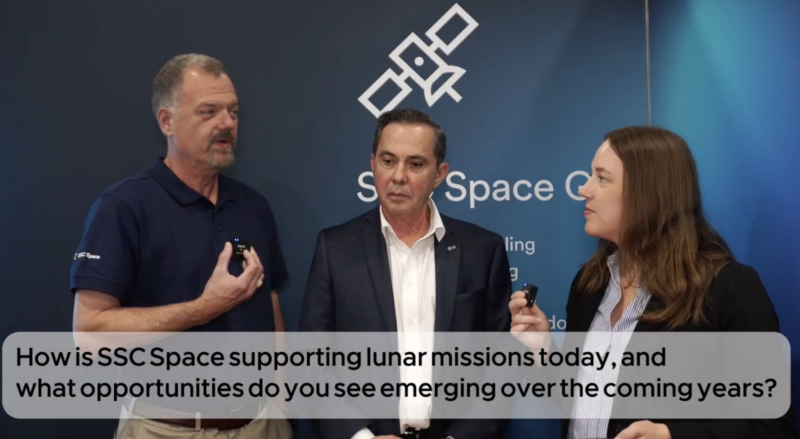
In this conversation at Modern Day Marine, Lite Coms U.S. Government Sales Director George Cerasani discusses how Lite Coms designs its products to provide tactical, multi-orbit connectivity in order to give U.S. government customers like the Marines the ability to operate across multiple satcom networks.
Via Satellite Executive Editor Jeffrey Hill interviews Cerasani about some of the company’s products, including its CART terminal architecture.
“You need to have resiliency in your network,” Cerasani says. “We need some LEO, some GEO, some LTE. We need a little bit of everything in case you’re going against a near-peer threat and things happen on certain networks and you have to switch over.”
This conversation was sponsored by Lite Coms
Interview transcript
Hill: Hello everybody. This is Jeffrey Hill from Via Satellite Magazine and I’m here at Modern Day Marine in Lite Com’s booth with George Cerasani from Lite Coms. George, good to see you.
Cerasani: Good to see you.
Hill: Welcome. How’s the show been going for you so far?
Cerasani: It’s been great this year. It’s been very busy. A lot of foot traffic, a lot of people stopping by asking about our equipment.
Hill: Yeah. Lots of excitement here. I can already tell. I can see even on the last day there’s a lot of people taking a look at all the products here.
But we are here in front of your multi-orbit 1.3A terminal. And we also have some of your CART minis, your infrastructure – we’re going to talk about in a bit.
I wanted to ask you uh with Lite Com’s 1.3 terminal, what kind of operational advantages do you—does the terminal provide? This is a multi-orbit terminal, so what advantages would that provide to war fighter in operations?
Cerasani: Yeah, so the Lite Sat 1.3 is is very unique. It’s multi-orbit. It does MEO, GEO and HEO, so the highly elliptical orbit. It’s certified on multiple different constellations, and the pack out is extremely small. Three cases, it can be airline checkable, which makes it awesome for a logistic standpoint. So that’s our huge advantage of it right now.
Hill: Yeah. I heard people earlier talking to you, asking if it was compatible with different constellations, and you said like it was it was compatible with a lot of different.
Cerasani: Yep.
Hill: Yeah. Yeah. There’s been a lot of talk here about the sort of, you know, Marines on the move on, comm’s on the move, which is no surprise for a military show. But can you tell us from your perspective how you expect those requirements for true comms on the move for the Marines to evolve over the next few years?
Cerasani: Yeah, so from my perspective, you know, the NATAM program specifically, the network on the move, has had a small parabolic antenna inside their vehicle. And I think a lot of things are switching to a flat panel system. So electronically steer to raid, and they’re looking for multi-orbit and then frequency, you know, the spectrum. They want to operate on different bands, and that’s really what we offer. We have a KU and a KA terminal that are certified on different networks. Multiple LEO platforms, which is awesome, because no one else really does that. And I think that’s where it’s all going to, right? Because we need to stay connected, you know, as you maneuver the battle space.
Hill: And do you still have people— I’m just curious if you still have people asking like why multi-orbit or why single orbit? Like, do you still have people and how do you answer that question?
Cerasani: You know, I think it used to be a common question, but now it’s just kind of a standard practice, right? That’s great to hear.
Hill: That’s great to hear.
Cerasani: Yeah, Like you need to have resiliency in your network, right? So, we need some LEO, some GEO, some LTE. We need a little bit of everything just in case you’re going against a near-peer threat, and you know things happen on certain networks, and you have to switch over. And that’s what kind of makes us unique, right? Like you can generate a pace plan inside of our terminal, so your primary alternate, you know, networks and it’ll switch between them as you know something becomes compromised or it’s no longer connected, and it’ll just switch automatically. Awesome for the war fighter.
Hill: That’s great to hear. You’ve got this really cool Polaris vehicle on display, and on top of that, we have a CART mini. Can you talk about your new CART infrastructure and how that works with your network?
Cerasani: Yeah. So the CART mini KU we’re, you know, we can do multiple LEO networks, right? So, we can do one web or SpaceX network. Then GEO, it’ll do GEO and LTE, and it has an option for a modem hookup on the back, right? So, you can hook up an external third modem, which is awesome. Then we have our KA cart, which is our newest product. So that’ll be GEO and LEO and MEO as well for the Empower network, which makes it awesome. An automatic filler between the three. So, makes it really unique.
Hill: Yeah, that’s great. That’s great. And you know what are some of the next big steps here for Lite Coms in the next year? Are you just —what do your customers have to look forward to?
Cerasani: Yeah, so they’re looking forward to our CART combined or KUK cart combined, and really that’s what we’re focused on, right? So, give them the advantage of KUKA in one single platform is our next step.
Hill: That’s awesome. Well, George, thank you so much for explaining all this to me. It looks really cool. The booth looks great and we’re glad that you’re having a great show here.