Latest News
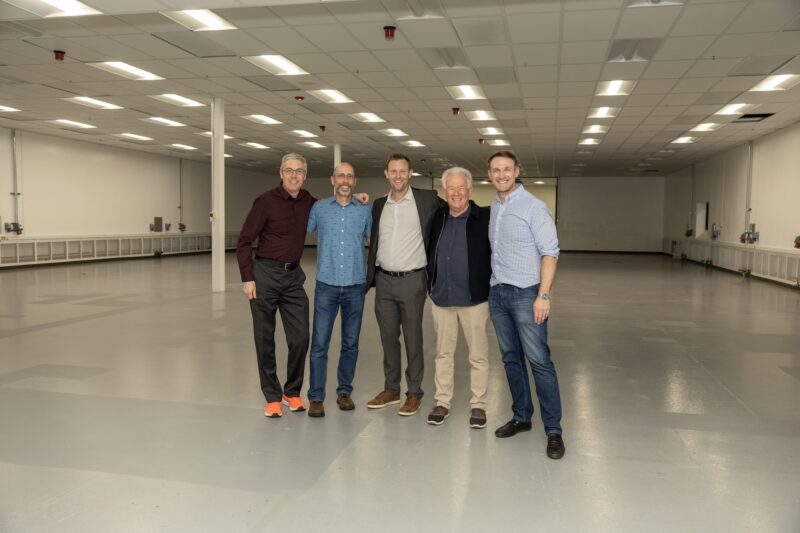
Muon Space founders in the company’s new San Jose, California facility. From left: Pascal Stang, Reuben Rohrschneider, Jonny Dyer, Dan McCleese, and Paul Day. Photo: Muon Space
Muon Space has expanded its Series B funding round by $89.5 million and acquired propulsion startup Starlight Engines in a bid to expand and vertically integrate satellite production.
Muon Space is scaling up its capabilities as an end-to-end space systems provider, company President Greg Smirin tells Via Satellite.
The company also moved into a 130,000-square-foot facility in San Jose, California, that will serve as its production center, housing manufacturing and test operations. The facility was already equipped with certified clean rooms. The company said this is a 10 times expansion in cleanroom space from its first facility, and the facility can support up to 500 satellites annually in the 100 kg to 500 kg+ class.
Muon Space designs, builds, and operates satellite constellations, including designing sensors. Its customers include Hydrosat and the FireSat constellation for the Earth Fire Alliance. Smirin said the company is targeting five satellites to launch this year — the FireSat Protoflight, which launched in March, a Hydrosat satellite awaiting launch, and three more later this year.
Smirin said the scale-up comes as its customers, both announced and unannounced, are planning constellation expansions of 10 to 20 to 50 spacecraft and in some cases more than 100 spacecraft.
“There are a good number of companies, especially in the startup phases, that are doing different types of EO. But we’re also seeing signals tracking in the communications phase, also IoT,” Smirin said. “We’re seeing more private corporations who have been working out business models and validating customer interests of their own, where they see that they need to have a dedicated constellation in order to get the revisit rates and frequency updates for various tracking efforts.”
As part of the scale-up, Muon Space has grown its team by 50% since December, with Smirin said hires have come from traditional aerospace backgrounds, New Space backgrounds, different sciences for phenomenology, and software tech talent as well. “It’s one of the more exciting things to see because the space community is quite small. There’s a lot of word of mouth,” he said.
The company is also investing in its automated constellation operations platform and expanding its ground station network.
Acquiring propulsion startup Starlight Engines will shift its spacecraft propulsion from noble gases to a solid propellant Hall-effect thruster that uses zinc.
Smirin said propulsion is one of the biggest supply chain challenges with increases in demand and complexity of noble gas systems that have multiple dimensions that can fail. Zinc as a solid propulsion fuel is a simpler mechanism, he said.
“We’re excited that they chose to join the company and we could merge their R&D efforts into production, so we’re scaling that up,” he said. “It makes it quicker, cheaper, and more reliable — which is sort of unusual to get all three of those with a technology shift.”
Congruent Ventures led the B1 round announced Thursday, which also included existing investors Activate Capital, Acme Capital, Costanoa Ventures, and Radical Ventures. New investor ArcTern Ventures also joined the round.
The new capital includes $44.5 million in equity and $45 million in credit facilities, and follows the company’s initial Series B close in August of 2024, bringing total Series B funding to $146 million.
Stay connected and get ahead with the leading source of industry intel!
Subscribe Now