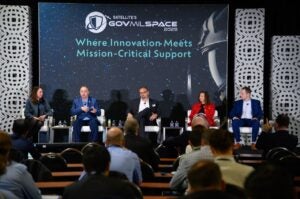

Satellite operators took aim at the narrative that Starlink is dominating the satellite communications industry, pointing to growth and strong demand in their connectivity businesses.
“There is a narrative in the market that every time Starlink wins a deal, it’s amplified. Yet if you look at the performance of every company here — we’re all winning our fair share of big deals,” SES CEO Adel Al-Saleh said, setting the stage for the Tuesday Opening General Session at SATELLITE 2025 on March 11.

Explore the Show Daily 2025 Day 3 Issue
Check out more from this issue and find your next story to read.
“The narrative is just wrong,” he added. “It’s not Starlink’s fault — they’re doing a great job. I think it’s the market — whether it’s the capital markets or the media. We’re all winning our fair share of big deals. There is incredible demand in the market. It’s growing.”
Al-Saleh pointed to the cruise market where Starlink gets a lot of attention, but SES has also seen continued success. SES connectivity solutions coexist with Starlink on every large cruise line. “We share that market share between the two of us, we’re both growing,” he said.
Intelsat CEO David Wajsgras echoed the confidence in the connectivity market, previewing that Intelsat has secured in-flight connectivity (IFC) contracts with two international airlines expected to be announced in the coming days.
He also pointed to Intelsat’s momentum in agriculture working with CNH Industrial to equip tractors with satellite connectivity and greater opportunity in the land mobility market. Intelsat is in the final phases of testing with CNH in Brazil and the United States, he said.
Wajsgras also said Intelsat is set to announce a border security-related contract with the sheriff’s office in Cochise County, Arizona. “We see that as a very good first step into border security more broadly, both in the United States on the southern border and northern border, and also around the world. I have some experience of border security in different parts of the world. I know the size of the market, what the opportunity looks like. I think that’s going to be a very big deal for the company.”
Wajsgras said Intelsat’s multi-orbit approach is resonating with customers and he reported that more new RFPs across a few different verticals have a requirement for multi-orbit capabilities.
Hughes Network Systems, an EchoStar company, is seeing success in blending different types of transport through its Fusion technology, said Hughes COO Paul Gaske. Hughes recently announced a follow-on deal with Delta Air Lines for its Fusion technology for IFC. The service blends Geostationary Orbit (GEO) and Low-Earth Orbit (LEO) capacity to optimize the user experience for passengers onboard.
Instead of multi-orbit, Hughes sees it as multi-transport, Gaske said. “When you talk about having terrestrial networks, that’s part of Fusion. 5G [is in] Fusion. It’s a blending of these technologies to give the best user experience that we can get. That, to us, is where the future is — building that technology to do better and better for the user.”
Telesat is working to bring another alternative to Starlink to market in Low-Earth Orbit (LEO) with the Lightspeed constellation, which CEO Dan Goldberg addressed in a fireside chat just before the OGS. After finalizing its financing agreements last year to move forward, the constellation is moving forward with manufacturer MDA Space. Goldberg said Telesat is targeting the first launch in the second half of 2026.
“There’s massive surging demand for high quality, affordable, resilient, secure, low latency, broadband connectivity. We see a massive market opportunity. The technology is ready and customers are ready,” Goldberg said. “It is a joy to be here with a project that’s fully underway. My colleagues and I are very bullish about what we’re bringing to the market at this point of time,” he added.
Goldberg wouldn’t commit to a Telesat Lightspeed terminal at a less than $1,000 price point, but said the “advancements being made in terms of the user terminal technology [are] moving in the right direction.”
Eutelsat Group CEO Eva Berneke put out a challenge to satellite manufacturers and antenna technology developers, saying that the supply chain has pushed the barriers of what technology can do, but hasn’t pushed forward enough on industrialization to bring down the cost.
“It’s a bit of a crime and I think that’s because we have so many fantastic engineers that know exactly how to tweak and do just a little bit better. But they’ve been spending a lot more time expanding the scope and the capabilities rather than bringing down the cost,” Berneke said. “We need to get into an industrialized setting of producing multiple satellites. In constellations, that’s the name of the game. We’re going to need to bring down the cost of capacity through focusing on continuous improvement and bringing down overall costs in the supply chain.”
Viasat CEO Mark Dankberg said one of the issues is that aerospace companies have had a difficult time delivering apertures and satellite buses on a schedule that allows for a reasonable return on capital. Viasat has been focused on simplifying the bus and the apertures to combat this.
Dankberg sees an opportunity in a proliferated GEO architecture because of how GEO satellites can concentrate capacity over areas where there is high demand. Viasat wants to create GEO platforms to make available to countries to support civil, commercial, and security issues.
“The objective — and I don’t think we’re very far away from it — is a single GEO satellite that is agnostic to the network. You can build it over and over again, put in any orbital spot to respond to the traffic demand,” Dankberg said. “That’s our next thing. The idea is to do that — instead of with multi-hundred millions of dollars [in] capital bites, with tens of millions of dollars [in] capital.” VS