
Direct-to-cell (D2C) connectivity will be available soon to many different military and commercial users, but the issue of who uses it and how it will be used is still being explored.
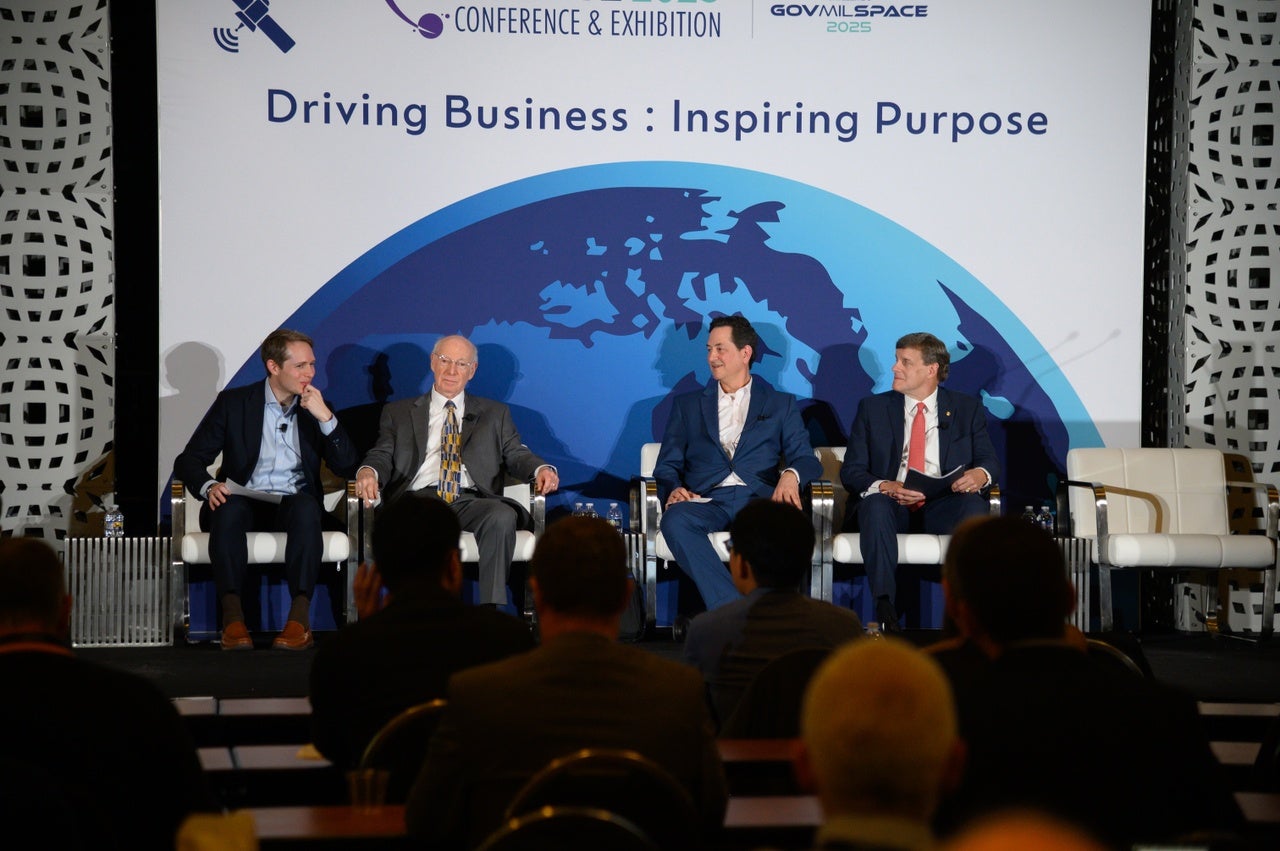
Leaders from Omnispace, Lynk Global, and Capgemini America, Inc discussed the outlook for D2C communications for military use on Monday at SATELLITE 2025.

Explore the Show Daily 2025 Day 3 Issue
Check out more from this issue and find your next story to read.
“Our direct-to-device proposition is not just the cell phones, but it’s for messaging, voice, and enough data throughput to do apps, email, and the like,” said David Radi, vice president of Government Solutions for Omnispace. “The quality of that service is going to be directly proportional to the amount of spectrum available.”
There is no denying that the race for development is about who has the best technology and application, according to Dr. Joseph Bravman, chief engineer of Lynk Global. Bravman does not believe there will be one single winner. “I think that both from the standpoint of interoperability and hybrid architectures, the Department of Defense will be the beneficiary just as a commercial will be the beneficiary,” he said. “The amount of leverage that will take place between those two sectors can be very profound, especially if the apps and the capabilities overlap as much as I think they are going to.”
On Monday, Lynk Global secured an investment and go-to-market partnership with satellite operator SES for direct-to-device services. The partnership will support a range of commercial applications, but also first responder and secure government communications.
Radi agreed that space is going to be a contested environment. “We talk about the need for government-owned communications, for a central command and control of the nuclear function and other things,” he said. “But there is no reason why direct-to-device/direct-to-cell cannot supplement forces. Think about how we will go about it if we have to take on the Chinese. Think back to island-hopping and disadvantage of comms there.”
Direct-to-device also impacts quality of life issues, Radi said. “From the challenges of recruiting and retention in this era, when the security environment enables our sailors and marines to communicate back home — that makes quality of life an inextricable part of the equation here. Men and women are away from home for a hell of a long time, and we want them to stay in the service and we want new generations to serve,” he said.
Other applications include humanitarian and disaster relief, emergency first responder, and border patrol. “These are things that are in national security,” said Dan Freyer, director of Satellite Industry Engineering R&D for Capgemini America, Inc.
He added that D2D would be a better source of communication during hurricanes or large fires, such as the recent fires in Los Angeles, or other places where there is no infrastructure.
“It can be a lifesaver for personnel and added resiliency to connect to things, like vehicles, or for asset tracking,” he said. “Having better resiliency and more bandwidth, lets people perform rescue missions.”
Radi said that he anticipates that with direct-to-device for military use, command forces will want to put a client on it — someone to monitor the conversation. “I’m a very proud sailor and did time on a carrier with 6,000 of my closest friends,” he said. “I wouldn’t trust all of them to follow the rules. That’s why I think there should be a client base controlled by the government or military.”
Uses and applications will evolve over time, Freyer said, as more is learned.
Radi agreed with the evolutionary nature of D2D. “People that have grown up with these handheld direct-to-device capabilities,” he said. “I’m actually upbeat that the government and the military are going to be quick adapters.”
When will those services be ready? Randi looks to Apple and other progress and sees potential in the near-term. “There are half a dozen or more [companies] trying to do this. Are all going to make it? No. But there are a lot of birds going up. I won’t hazard a date, but I think even in my old age, we’re going to see it in my lifetime,” he said.
Bravman pointed to the conversation about space tourism as a comparison for D2C adoption.
“The question was posed, when will real space tourism happen? And the answer was two years after people stop laughing. I’m going to give you that kind of an answer here,” Bravman said. “I’d say two to three years after there is a gapless constellation up, it will be deployed for certain applications.” VS