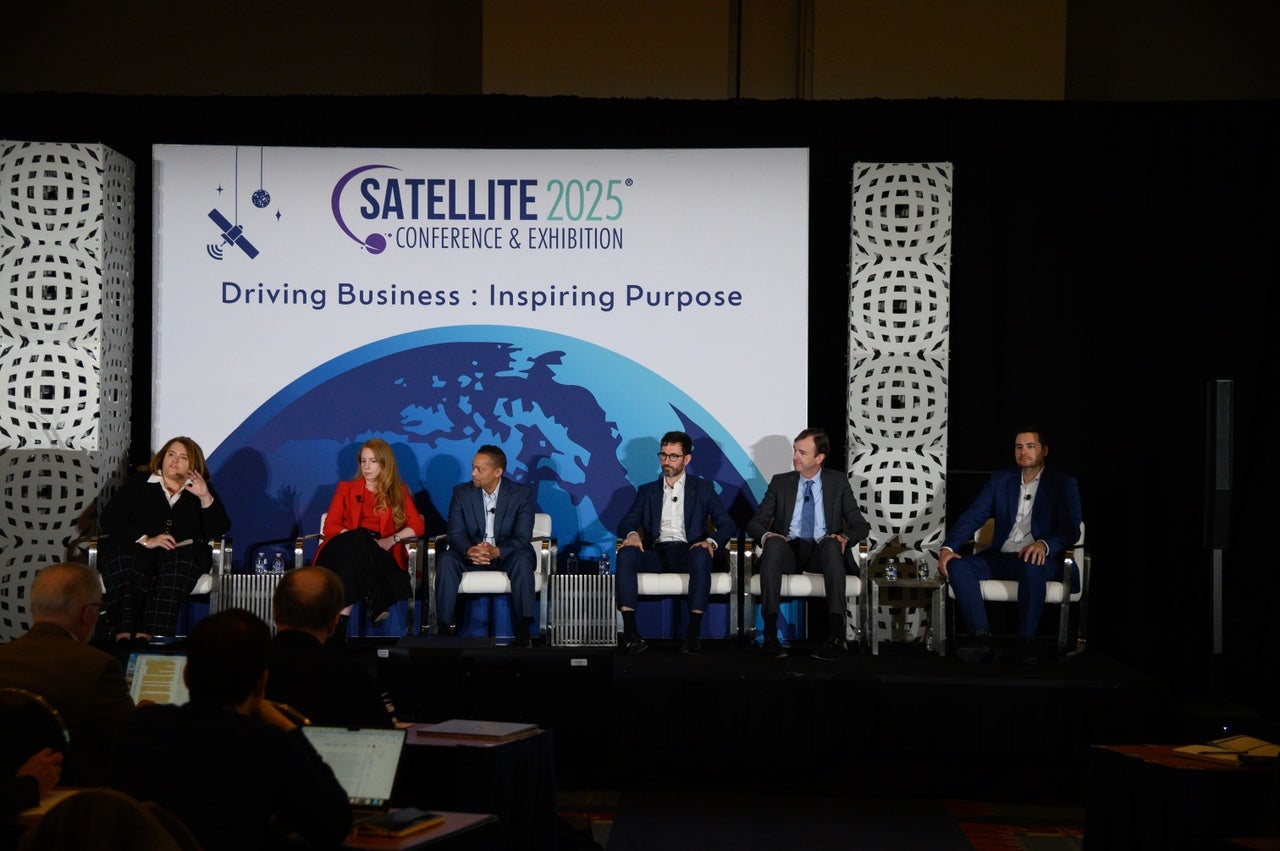

After years of waiting in the wings, three new rockets finally made their debuts over the last 15 months as the industry saw the first launches of the Vulcan, Ariane 6, and New Glenn rockets. This year’s launch panel at SATELLITE took place at a critical time as launch providers prepare for a pivotal year ramping up capacity to ease the scarcity of providers in the market dominated by the Falcon 9.
Arianespace’s new CEO David Cavailloles said the company plans on five launches of Ariane 6 this year, with the goal of reaching 10 Ariane 6 launches a year going forward. Cavailloles spoke after last week Arianespace launched the first commercial Ariane 6 mission.

Explore the Show Daily 2025 Day 3 Issue
Check out more from this issue and find your next story to read.
Jarrett Jones, senior vice president of New Glenn Heavy-Lift Orbital Launch Vehicle for Blue Origin believes with the onset of more constellations, Blue Origin is in a good position to capitalize on the growing demand.
“We looked at where the market is going and we counted on the fact we would see more constellations. This is something that we are counting on. If someone is interested in a launch, we are up and going now. We know this is a sweet spot for us. We need to demonstrate our usability, rate, and then focus on doubling the rate,” Jones said.
Blue Origin recently celebrated the success of the first New Glenn launch in January.
One of the key topics was about disruption in the launch market. Stephanie Bednarek, vice president of Commercial Launch and Crew Sales for SpaceX, talked about the potential impact of Starship. She said, “I think it is difficult to understate how Starship will change the launch market. I think this will be a significant disruptor. I am going to be excited about where this goes. I think the way customers buy launch services will also change.”
SpaceX suffered a setback with Starship’s development as the upper stage broke apart during the eighth test flight last week, the second unsuccessful test flight in a row.
Bednarek highlighted SpaceX’s cadence of 134 launches in 2024, and said the company is targeting 170 launches this year.
Jones spoke about Blue Origin’s vision of millions of people living and working in space, and that the step to realize this dream is to reduce the cost of going to space. “The disruptor is gaining that low cost access to space. We want to open the minds of people so they can think differently. In my mind, that is what we are here for. We want to open up that gate,” he said. “I feel so bullish right now. We are living in a really good time for space exploration. We believe the technology has caught up with demand.”
Cavailloles admitted that the industry needs to prepare for stronger disruption. “We want to develop missions end-to-end. Our clients are asking for more and more tailored missions. This ability to do end-to-end services including in-orbit services is something we should be looking at. We hope to work with other players. We want to design and execute complex space missions.”
Cavailloles said around one third of Arianespace’s backlog is institutional and two thirds is commercial. The company wants to stay in the commercial market, even though it sees “huge growth” in the institutional market.
Mark Peller, vice president of Vulcan Development for ULA, said he believes the disruptive element of the market comes from the amount of demand launch players could be seeing. He said, “The way we see the disruption is the unprecedented level of demand. The demand is huge. There are order books behind that demand. That is a disruptor. We see growth among commercial, civil, and national security.”
Peller made some interesting comments about reusability, adding, “At ULA, we are pursuing some elements of reusability. We are making a step towards reusability. We view it as important and we have a roadmap to get there.”
He added that ULA has been through the peaks and valleys of this market. “I don’t think the valleys are going to be as deep as they were in the past. You need flexibility to cater for the different demands of the market.”
Brian Rogers, vice president of Global Launch Services for Rocket Lab, talked of how ‘verticalization’ in the launch market could be a disruptor. He believes Rocket Lab is well placed to pick up business from emerging constellations. “In terms of deploying constellations, we think our Neutron vehicle is the right size, and that is where we are headed.”
In terms of what excites Bednarek about the launch market, she said, “I am so excited about all the new rockets. I think you will see a ton of excitement coming from the generation in school right now. The demand from government and commercial will grow. Everybody wants to launch the second their satellite comes out of the factory.”
The executives had consensus that launch pricing will continue to come down due to increased competition and innovation in the market. VS