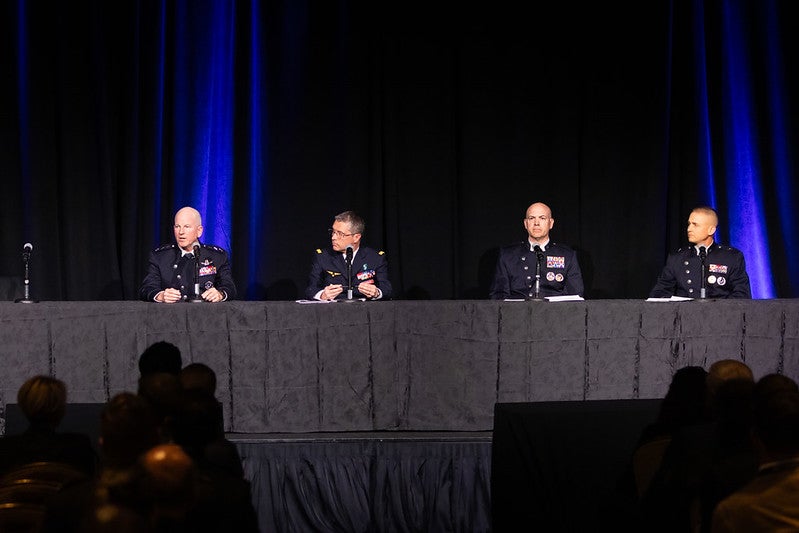
COLORADO SPRINGS, Colo. — New space capability is being actively identified by the U.S. Space Force, which is monitoring and managing threats from adversaries while creating missions to defend assets in this country and around the world. Three generals from the U.S. Space Force and a head NATO commander discussed the current and future state of new and specific space defense domains during Space Symposium in Colorado Springs on Wednesday.
Lt. Gen. Dennis Bythewood, commander of U.S. Space Forces – Space (S4S), gave his view of how broad the Space Force’s specific area of interest (AOR) is — from 100 kilometers “out to infinity.”
S4S is a Space Force component field command established in late 2023, responsible for commanding combat-ready space forces in support of U.S. Space Command’s AOR.
Bythewood, who assumed his position in November 2025, looks at the threats within that environment that have grown and have become the driver for why the U.S. has established space defense operations.
“That threat regime has continued to grow for the last decades, whether it’s jammers coming from a base on the planet, anti-satellite weapons that would take out our capabilities on orbit, orbital satellites that are holding our assets at risks, and all of the cyber domain things that would hit our terrestrial based infrastructure.” The U.S. Space Force enables the country to be able to prosecute offensive operations against adversary space capability, Bythewood said.
Lt. Gen. Guillaume Thomas, the deputy commander of NATO Allied Air Command, emphasized that NATO is a defensive alliance, not an offensive alliance.
“We share our borders with some neighbors that are not so friendly, that are nuclear capable, that engage in active combat with some of our partnership. We also have a neighbor, Iran, where recently we faced a ballistic missile attack. So space is contested in our huge AOR, which goes from the Arctic Circle to the Mediterranean Sea and to the south border of Turkey,” Thomas said.
The newest command in the Space Force is Spacefor-North. Its AOR includes the high north of Alaska, northern Canada and Greenland, down to the territorial integrity of the United States, according to Brig. Gen. Robert Schreiner, commander, Spacefor-North.
“It’s really a diverse mission set where we’re trying to integrate space and space effects to support everything from high north operations down to the territorial integrity of the United States,” he said. “And also working when civil authorities require support,” Schreiner said.
He explained the challenge for the service is to continue to modernize and provide newer capabilities and track and defense against threats if necessary. “The ability to support the high north with space support also remains absolutely vital and will continue to be vital into the future,” Schreiner said.
Brig. Gen. Brian Denaro, commander at U.S. Space Forces Indo-Pacific, described his AOR is “all the way from Hollywood to Bollywood and penguins to polar bears.”
He said that the Space Force is the game changer for the joint forces. “Space Force is what enables the joint force freedom of maneuver. It’s what denies adversaries the use of space to close kill chains, and it’s what protects the joint force from space enabled attack.”
Space and space capabilities in the Space Force that are being built now with allies and partners, “bring a decisive advantage to the joint force when you talk about missile warning and missile tracking. These are the things that our joint forces come to appreciate. And we’re taking it to another level,” Denaro said.
The component field commands that the Space Force has decided to field across the globe that are reporting to the combatant commanders are the solution to joint integration, Denaro said.
“We’re in the process now of normalizing the presentation of forces to the combatant commanders,” Denaro said. “By doing that, we’re improving the integration with just our presence in the Indo Pacific theater. My team is learning things every single day, and our presence alone is what’s bringing that joint force integration to light.”
Partnerships are crucial to the success of the Space Force. “America is not in a position to go it alone,” Bythewood said.
“When we look at how to surveil all of the activity that’s going on in space, and making sure that we can execute [our] missions, that would need partner nations from around the globe to allow us to do 24/7 operations and really share an unclassified space domain awareness picture to understand space domain awareness across the globe,” he said. “It’s fundamental to how we do business and understand what’s going on inside the space environment.”