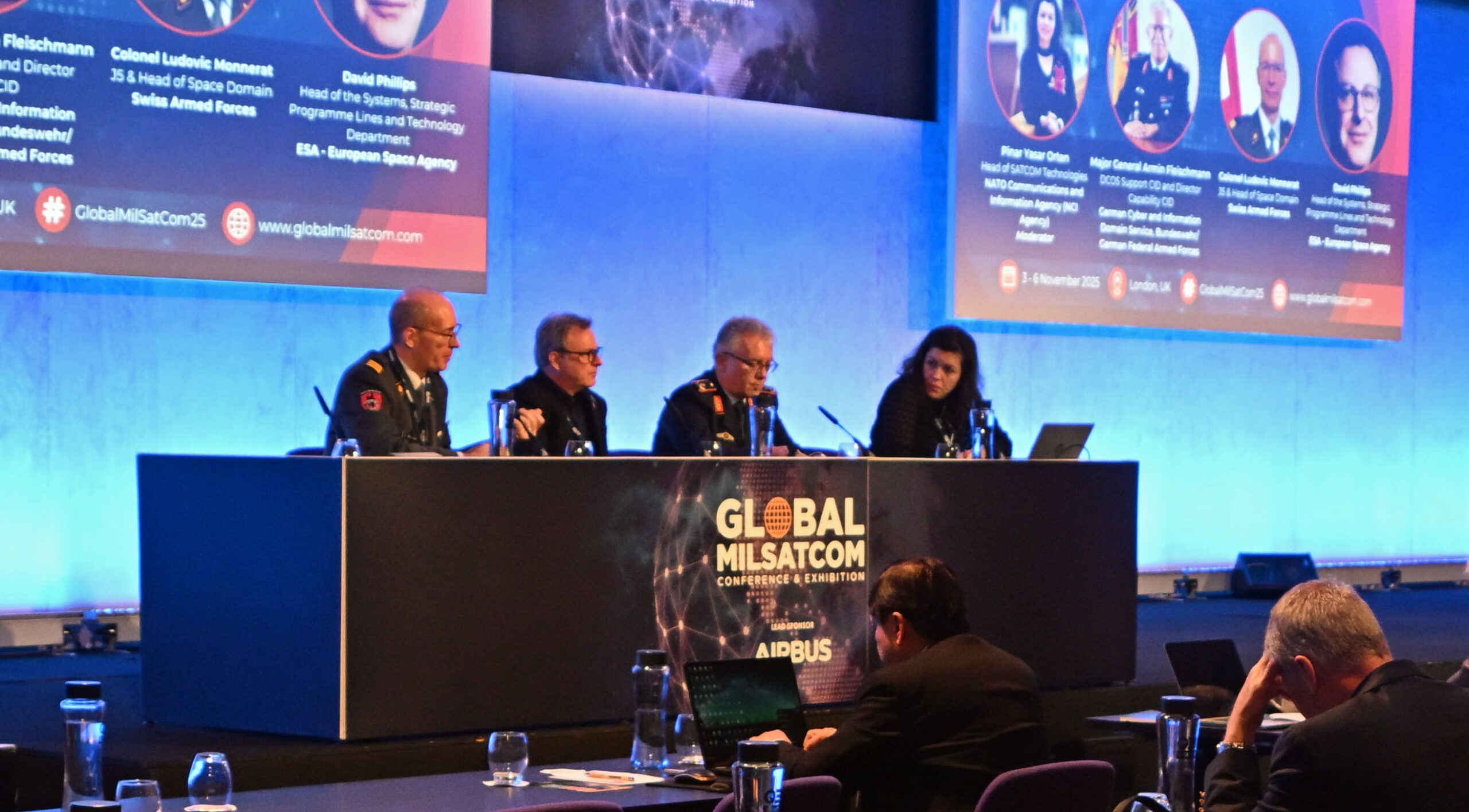
The growing role of satellites in defense was one of the key themes of Global MilSatCom, with leaders from the German Federal Armed Forces, Swiss Armed Forces and the European Space Agency (ESA) sharing insight into the state of play in Europe and what needs to be done next.
Maj. Gen. Armin Fleischmann, DCOS Support CID and Director Capability CID, German Cyber and Information Domain Service, German Federal Armed Forces, spoke of the importance of Europe having a more coherent and unified approach to satcom. Fleischmann spent nearly 30 years in planning and procurement and his two tours in Afghanistan have shaped his learnings in this area.
“You need one project, a unified, sustained European investment framework. You need to speak with one voice, one budget, and have shared objectives. You need common standards for safety and security. Every nation procures its own systems. We need to build one great project and have a common understanding. This is a very big issue for us,” he said.
Germany is looking to invest more in satcom capabilities, with the nation’s Defense Minister recently announcing a plan to invest millions of euro in space defense capabilities by 2030.
Increasing German satcom capabilities in the Eastern part of Germany is a huge focus right now. “From a German perspective, it is very important to look at the Eastern flank; it is a priority. We have to invest in systems that cover the Eastern flank. Germany is nearer than other countries to this particular hotspot,” Fleischmann said.
Fleischmann said that Germany sees satellite communications as a core capability of the German Armed Forces. He also highlighted the importance of standards. “We should standardize inter-satellite links and satellite terminals. We need to get companies to use the same standards to enable interoperability and more resilience. This is the way we have to go forward,” he said.
David Philips, head of Systems, Strategic Programme Lines and Technology Department, European Space Agency (ESA), said that while he believes Europe has had a good track record of deploying milsatcom capabilities, the world is “changing quickly.”
He made some interesting comments related to Europe’s capability to build Low-Earth Orbit (LEO) assets.
“There is a big ambition to accelerate what comes next. It is all about LEO. What is missing is the industrial capacity in Europe, to manufacture LEO on a large scale. There needs to be an improvement in European frameworks and have an urgency to put this together,” Philips said.
Philips echoed Fleischmann’s comments around standards and Europe having a more unified approach here. “There is a need to have better agility in our industry. We need to have this overarching European resilience framework. We need to work to one goal to have this integrated architecture so that it can provide national capability within this framework.”
On the subject of standards, he added, “The key is the development of standards. We need to work with the European government and agencies around standards. There is a mechanism for putting standards together. Another element to standardization is doing at the right time. We try to anticipate on what is coming. It has to be done quite early. We are doing a lot around optical, 5G/6G. We want standards to support the most relevant technologies.”
However, is Europe moving fast enough? While nations such as Germany are ramping up defense spending, it seems more needs to be done. Ludovic Monnerat, head of Space Domain for the Swiss Armed Forces, said there was a danger that Europe could “miss the train” when considering how many satellites SpaceX produces for Starlink each day.
Monnerat added, “Satellites need to be considered dependable pieces of a global architecture. We need to use space-based systems. You may have sovereign assets, but you can share those assets with partners. We are now seeing the developments for dual use capabilities in federated networks. Everybody has to bring something to the table.”
Monnerat said for a small country like Switzerland, these partnerships are important to its success. He said Switzerland wants to be able to invest in new services and capability. However, it wants to have partners with a base in Switzerland. He added, “Our partners have to be on our soil in Switzerland. We are not part of NATO or the EU. We have to be sure the people are working with us and are on our soil. This is a key element of the solution.”
He warned that consolidation among European players is not necessarily going to lead to better products and services for countries like Switzerland.
“When you look at the evolution of the big enterprises, you see some going up, some going down. Consolidation to keep the margin and captive part of the market won’t lead us very far. We have to support the winners and give the money to the best [providers].”