Latest News
Top Space Industry Organizations Petition Congress Over Planned Cuts to Space Traffic Management System
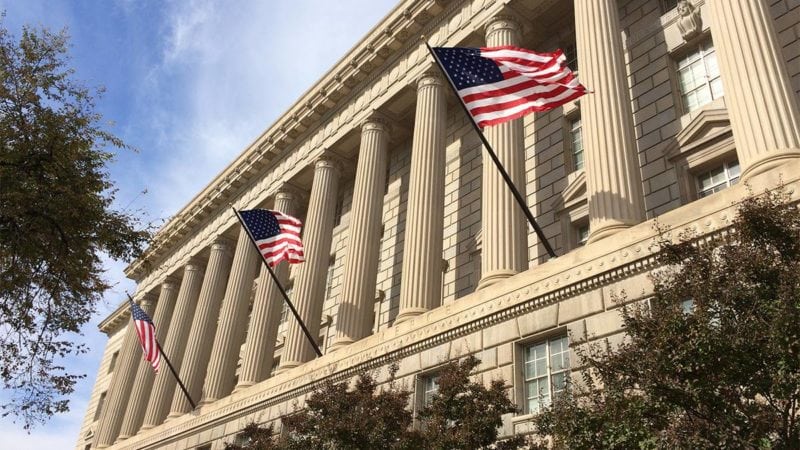
The Herbert C. Hoover Building is the Washington, D.C. headquarters of the United States Department of Commerce. Photo: U.S. Department of Commerce
Top space industry organizations are urging Congress to fund the Office of Space Commerce (OSC) and its space traffic coordination system after NOAA’s budget proposal for fiscal year 2026 details steep cuts to its funding.
A group of space industry organizations representing more than 450 space, satellite, and defense companies sent a letter to House and Senate leaders on Tuesday arguing that these cuts would put commercial and government satellite operators at risk.
“Without funding for space traffic coordination, U.S. commercial and government satellite operators would face greater risks – putting critical missions in harm’s way, raising the cost of doing business, and potentially driving U.S. industry to relocate overseas,” the letter says.
The Aerospace Industries Association (AIA), American Institute of Aeronautics and Astronautics (AIAA), Commercial Space Federation, Commercial SSA Coalition, National Security Space Association, the Satellite Industry Association, and Space Data Association all signed the letter.
OSC is under the National Oceanic and Atmospheric Administration (NOAA) and is the principal unit for space commerce policy activities within the Department of Commerce. NOAA’s budget request released last week would cut OSC’s budget by 85% and 18 positions and eliminate federal funding for the Traffic Coordination System for Space, known as TraCSS.
The cuts would undo the work that the previous Trump Administration began in 2018 with Space Policy Directive-3, which directed the Department of Commerce (DOC) to provide basic space situational awareness (SSA) and space traffic coordination services to commercial and civil space operators, instead of the Department of Defense.
OSC has been developing TraCSS for years in collaboration with industry. The system currently produces conjunction data messages for a set of beta users.
According to the budget justification, the Administration believes the support to private industry SSA services has met the intention of of SPD-3, and private industry has the “capability and the business model to provide civil operators with SSA data and STM [space traffic management] services.”
Space industry organizations argue in the letter that space traffic coordination is best managed by a civilian agency, which also preserves military resources for defense missions. “Keeping space traffic coordination within the Department of Commerce preserves military resources for core defense missions and prevents the conflation of space safety with military control – critical to U.S. leadership in setting international standards and norms for space activities,” the letter says.
“This funding change would effectively undo over a decade of policy consensus on this topic,” Audrey Schaffer, vice president of Strategy and Policy at Slingshot Aerospace, told Via Satellite.
Slingshot Aerospace is one of the commercial providers involved with TraCSS. Schaffer also represents the Commercial SSA Coalition, a group of commercial space situational awareness (SSA) providers that includes Slingshot Aerospace, ExoAnalytic Solutions, COMSPOC, and Kayhan Space.
Schaffer says that a U.S. government system that leverages private innovation, like TraCSS, is the best outcome for space traffic coordination and U.S. leadership in space.
“The U.S. government needs to be able to go toe-to-toe internationally with other countries who are also creating space traffic coordination or space traffic management systems, to be able to negotiate the rules and formats and standards for global space traffic management,” she said. “While industry certainly has the technical expertise to support those discussions, there are governments that are not necessarily interested in negotiating with a private company on those standards. That’s really a role for the U.S. government.”
She says U.S. leadership is important in shaping the future of space traffic management — much like the fact that the official language of air traffic control is English because the U.S. had such a strong role in shaping the international system for air traffic control.
“If we don’t have a U.S. system to bring to these negotiations to shape those rules and standards, we will lose our opportunity for leadership in the air traffic control of the future, essentially,” she added.
Tom Stroup, president of the Satellite Industry Association, echoed those concerns about the U.S. losing ground in international leadership in space traffic management if TraCSS is canceled.
“This is an international issue, and this is a great opportunity for U.S. leadership because we are far and away the leader in space,” Stroup told Via Satellite. “My fear is that if the U.S. isn’t going to take on this role, that it could be China or Europe — I don’t think in any of those circumstances we want to rely on data from other countries to determine the safety of U.S. assets.”
Satellite services like defense applications, weather monitoring, broadband, and mobile communications, and direct-to-device services could all be put at risk in a satellite collision or if an orbit becomes unusable from a lack of space traffic management, Stroup said. He was surprised to see the proposed TraCSS funding cuts because it was an issue the previous Trump Administration prioritized, and one that has broad consensus in the commercial space industry.
“This is an issue behind which space industry is absolutely united,” he said. “It’s not just the commercial satellite industry — but all operators in space. This had been a carefully thought through process over a number of years. I think we’re all questioning what’s next if the TraCSS program is canceled.”
Stay connected and get ahead with the leading source of industry intel!
Subscribe Now