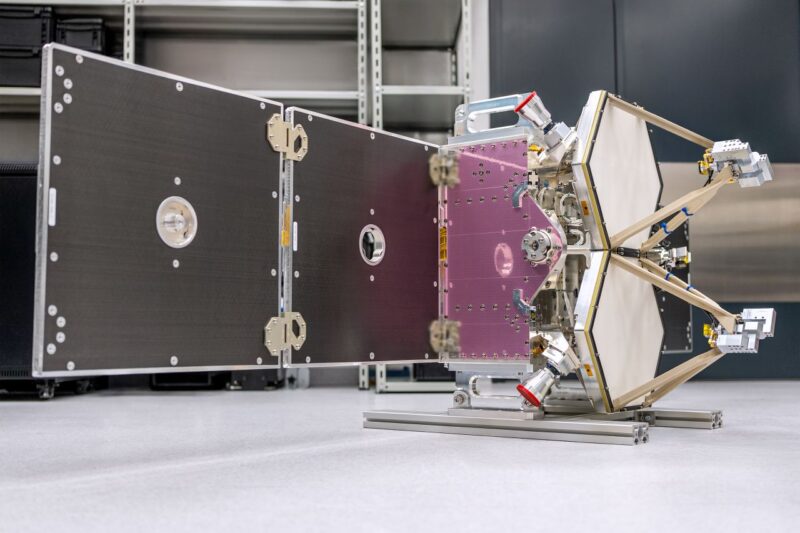
[Satellite News 12-12-08] President-elect Barack Obama’s transition team is considering what it calls, “not-yet-refined technology,” which includes solar energy-collecting satellites, as part of its energy plan, according to the administration’s transition website.
While Obama has yet to publicly detail or endorse the idea of using solar satellites, industry analyst Tim Farrar agrees that solar energy could become a whole new sector of the industry. “There will definitely be benefits for manufacturers driven by research and development grants,” Farrar told Satellite News. “One of the first groups to benefit from this would be defense contractors looking to supply power and electricity to the battlefield.”
Farrar also speculated that satellite start-up companies could use the administration’s push for new technology to establish business and get a jump on the space solar energy market. “Larger commercial companies would need proof that this idea is economically viable,” he said. “It will be at least five to ten years before we see benefits for the general commercial satellite industry.”
A spokesman for the Obama transition team told Satellite News that more details of Obama’s energy plan would be announced once the transition happens and a new secretary of energy is established.
This is not the first time satellites have been mentioned in an energy and environment agenda from the Obama administration. At the November 2008 National Conference of Governors meeting in Los Angeles, Obama mentioned Earth observation satellites in a list of methods to deal with global climate change. Reacting to the remarks, Northrop Grumman CEO Ronald Sugar, in a speech to the Center for Strategic and International Studies in Washington, D.C. on Dec. 5, called on the Obama administration for a national initiative to analyze vast amounts of global climate data being collected by various earth observation satellite systems to address the challenges of global climate change.
“Our president-elect has made clear his intentions to act,” said Sugar. “It may well be time to take the next step to create a higher-level structural mechanism, under government leadership, which builds on our scientific successes to date.”
For satellite executives, the most important issues for the new administration are the economy and subsidizing broadband infrastructure, according to Farrar. “If the new administration makes it a priority to subsidize satellite infrastructure in the same manner as terrestrial as a way to provide universal coverage of broadband, it would have tremendous benefits to the commercial industry,” he said.
But Farrar added said that universal broadband legislation could also be problematic for the satellite industry depending on the terms of how it is initialized. “It all depends on the required speed to the end user,” said Farrar.
Another issue that has the attention of the satellite broadcast sector executives is the changes that Obama will make to the U.S. Federal Communications Commission (FCC). “I think everyone will ask whether or not the FCC will become interventionists,” said Farrar. “The FCC has been relatively hands off for a long time. It is not known whether a new FCC chair would make consolidations more difficult for the media industry.”
At the ISCe Satellite Investment Symposium in Oct. 2008, Owen Kurtin, principal and founder of The Vinland Group, warned satellite companies that the U.S. government was headed into a new era of regulation. “With the political party shift in Congress and the White House, we have to understand that mergers and acquisitions will be much more difficult under the magnifying glass. There will be much more regulation and the spirit of creating competition in the air," he said.
Kurtin joined several analysts at the symposium in the opinion that some satellite companies would survive through acquisitions of smaller companies.
The Obama transition team has made no announcements on potential changes to the FCC at this time.
While Obama has yet to publicly detail or endorse the idea of using solar satellites, industry analyst Tim Farrar agrees that solar energy could become a whole new sector of the industry. “There will definitely be benefits for manufacturers driven by research and development grants,” Farrar told Satellite News. “One of the first groups to benefit from this would be defense contractors looking to supply power and electricity to the battlefield.”
Farrar also speculated that satellite start-up companies could use the administration’s push for new technology to establish business and get a jump on the space solar energy market. “Larger commercial companies would need proof that this idea is economically viable,” he said. “It will be at least five to ten years before we see benefits for the general commercial satellite industry.”
A spokesman for the Obama transition team told Satellite News that more details of Obama’s energy plan would be announced once the transition happens and a new secretary of energy is established.
This is not the first time satellites have been mentioned in an energy and environment agenda from the Obama administration. At the November 2008 National Conference of Governors meeting in Los Angeles, Obama mentioned Earth observation satellites in a list of methods to deal with global climate change. Reacting to the remarks, Northrop Grumman CEO Ronald Sugar, in a speech to the Center for Strategic and International Studies in Washington, D.C. on Dec. 5, called on the Obama administration for a national initiative to analyze vast amounts of global climate data being collected by various earth observation satellite systems to address the challenges of global climate change.
“Our president-elect has made clear his intentions to act,” said Sugar. “It may well be time to take the next step to create a higher-level structural mechanism, under government leadership, which builds on our scientific successes to date.”
For satellite executives, the most important issues for the new administration are the economy and subsidizing broadband infrastructure, according to Farrar. “If the new administration makes it a priority to subsidize satellite infrastructure in the same manner as terrestrial as a way to provide universal coverage of broadband, it would have tremendous benefits to the commercial industry,” he said.
But Farrar added said that universal broadband legislation could also be problematic for the satellite industry depending on the terms of how it is initialized. “It all depends on the required speed to the end user,” said Farrar.
Another issue that has the attention of the satellite broadcast sector executives is the changes that Obama will make to the U.S. Federal Communications Commission (FCC). “I think everyone will ask whether or not the FCC will become interventionists,” said Farrar. “The FCC has been relatively hands off for a long time. It is not known whether a new FCC chair would make consolidations more difficult for the media industry.”
At the ISCe Satellite Investment Symposium in Oct. 2008, Owen Kurtin, principal and founder of The Vinland Group, warned satellite companies that the U.S. government was headed into a new era of regulation. “With the political party shift in Congress and the White House, we have to understand that mergers and acquisitions will be much more difficult under the magnifying glass. There will be much more regulation and the spirit of creating competition in the air," he said.
Kurtin joined several analysts at the symposium in the opinion that some satellite companies would survive through acquisitions of smaller companies.
The Obama transition team has made no announcements on potential changes to the FCC at this time.