Growth in aviation and defense pushed SES’s Networks segment 6% revenue growth in the third quarter on a like-for-like (LFL) basis, as overall revenue grew by a modest 4.2% year-over-year.
CEO Adel Al-Saleh called it an “outstanding quarter” for the Government & Defense segment with 216 million euro ($242 million) in revenue and growth in both global and U.S. government. Revenue was up 4.2% LFL.
Strategic space mission prime awards lead the growth, with Al-Saleh mentioning the Protected Tactical Satellite-Global (PTS-G) award, IRIS², and demand for managed services.
“Our Government & Defense business remains healthy with MEO [Medium-Earth Orbit] renewals on track and GEO [Geostationary Orbit] capacity sales continuing to stabilize,” Al-Saleh said. “We’re seeing a steady improvement in business fundamentals since 2025. The rate of decline we saw between 2023 and 2025 continues to moderate.”
Mobility also had stand-out growth during the quarter, up 19% year-over-year (LFL) to 234 million euro ($263 million), led by the aviation business.
Al-Saleh reported that installations picked up for electronically steered antennas (ESAs) during the quarter. Year-to-date, SES has installed and activated more than 230 ESA-equipped aircraft. Its installed base for ESAs is roughly 650 aircraft.
SES has won deals for more than 250 planes this year with fleet expansions from existing customers and new awards, including recent awards from Finnair and Air Astana. Commitments to the ESA program stand at more than 1,330 aircraft, Al-Saleh said.
The aviation business negotiated favorable contract restructurings during both the first and third quarter of this year. CFO Lisa Pataki mentioned a 54 million euro ($61 million) contract restructuring with an unnamed customer. She said it was a higher than normal restructuring, but it will free up capacity for new customers.
Al-Saleh told investors that SES is confident in the uptick it is seeing with customers. “We’re also seeing customers in aviation begin to tell us that they want options,” he said. “They are not looking for just one solution and that plays well into the capabilities that we have.”
Growth in aviation and Government & Defense pushed Networks’ backlog to 7 billion euro ($8 billion), up from 3.5 billion euro ($4 billion) at the end of the previous quarter.
SES continues to face “significant headwinds” in Fixed Data, which declined more than 12% LFL year-over-year during the quarter, to 105 million euro ($118 million)30 in revenue.
However, the Media business was essentially stable in revenue like-for-like, year-over-year at 304 million euro ($341 million), which one analyst pointed out hasn’t been seen in many years at SES or other broadcast operators.
Al-Saleh said the Media business is performing exactly as planned, and the stable quarter was driven by contract renewals.
“We had a bunch of very large contract renewals where certain accounting treatments helped Media to perform in Q3, but that was all planned,” Al-Saleh said. “We will see Media stabilize in kind of the mid-single digits — 6% to 8% kind of numbers — versus the double-digit decline we’ve seen over the last four quarters. Those renewals give us very good visibility going forward.”
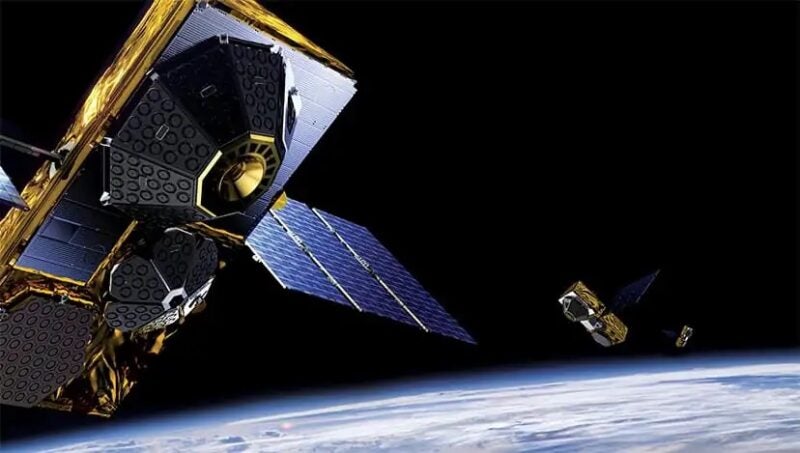
SES also highlighted the award to OHB to build the platforms for 18 MEO satellites for IRIS² during the quarter. SES will design and build the payloads and perform assembly, integration and test (AIT) itself.
“Owning payload development, manufacturing and final AIT provides SES with ownership, overall intellectual property and greater control over the value chain, enabling more effective cost management and driving a significant double-digit percentage reduction in the overall constellation cost,” Al-Saleh commented.
As IRIS² is a public-private partnership, Al-Saleh stated that SES will be able to commercialize 90% of MEO capacity, which is equivalent to a range of 830 gigabits to 1.2 terabits of sellable commercial capacity. This will support revenue generation until the end of life of the satellites around roughly 2040.
“IRIS² and meoSphere are highly complementary networks. The two networks will create a unique MEO dense network with seven inclined orbits, pole to pole coverage and 5G NTN capabilities,” Al-Saleh said.