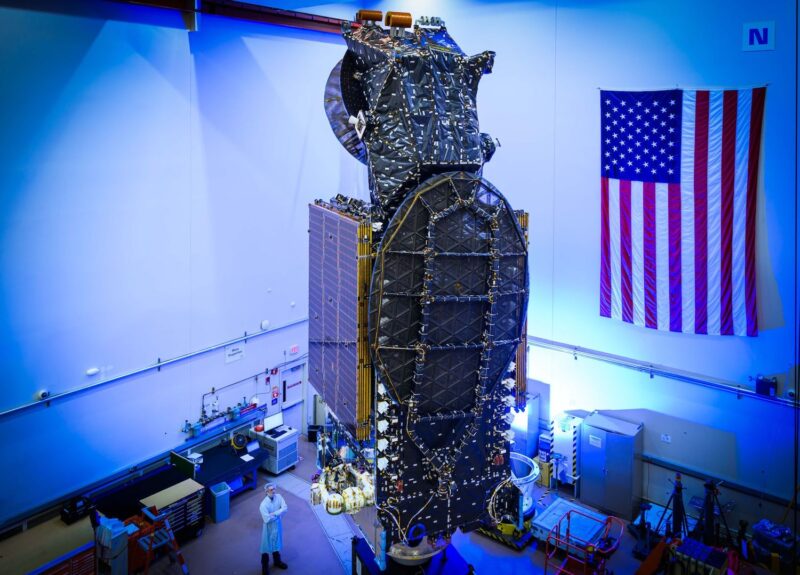

Surges in throughput along with changing business needs in an environment of scarce spectrum are driving the move toward what many consider the holy grail of satellite design — flexible payloads.
A whole new generation of satellites, including Inmarsat-5 and Intelsat’s Epic (NG) constellations, are embracing flexible payloads that give operators the ability to dynamically move power and even frequency bands to better serve customer needs.
Clearly, there is a need for agile payloads. With global IP traffic expected to grow at more than 20 percent annually in the next few years, the amount of information the world will want to transport globally will double in the next five years. All this change makes it extremely difficult to predict what services will be needed where.
“You end up having a geography of demand that is extremely dynamic over time whether in quantity or in nature of services,” observes Thierry Guillemin, senior VP and chief technical officer of Intelsat. “Because demand is changing so fast and the way it’s spreading over regions, operators will expect to have in the future the flexibility to change most payload characteristics in orbit as business needs require.”
Many industry watchers believe flexible payloads will enable satellite operators to match terrestrial providers, the amount of capacity they can offer customers.
“From an operational point of view, flexible payloads move the satellite market much closer to the way general telecom markets are provisioned,” says Jay Gullish, director of Space & Telecommunications for Futron Corp.
He sees flexibility as the wave of the future for a growing segment of operators of high-throughput satellites. With a flexible payload on board, operators can respond to changes in demand as they occur, rather than having to pinpoint where they expect demand to be a decade or more in the future.
“It’s a big deal because you don’t have to pre-set your supply-demand requirements or lock in your supply-demand assumptions early,” Gullish says.
Coverage Options
The two most common ways to achieve flexibility are one, using a bent-pipe architecture to direct satellites to provide a specific service to a specific area of the globe, and two, to re-point antennas on the spacecraft using steerable spot beams. For the past decade or more, operators such as Intelsat and Inmarsat have been able to re-point the coverage to regions as satellite missions have evolved.
According to Hampton Chan, VP and chief architect of Space Systems/Loral (SS/L), customers are driving for more flexible payloads “to give them the maximum opportunity to utilize satellite capability throughout their satellite’s lifetime.”
This push requires operators to balance the degree of flexibility customers seek with the costs of attaining it.
Providing a flexible system for customers, whose businesses are also changing very fast, was a central requirement driving the design of Intelsat’s Epic (NG) spacecraft. With its C-, Ku- and Ka-band capabilities, EpicNG was built on an open space architecture that can support both star configuration and mesh-configured networks. The former is common in all high-throughput systems, while the mesh topology is unique because it allows users to connect spot beams to spot beams. EpicNG uses wide beams, spot beams and frequency reuse technology to provide a complementary overlay to the operator’s fixed satellite network, including Intelsat’s existing satellite fleet. “That means that a customer can continue to use their existing infrastructure,” says Guillemin.
Military Innovation
Flexibility in payload design is nothing new for Boeing Space and Intelligence Systems, which is building Intelsat’s Epic (NG) payload as well as flexible satellite systems for Thuraya, SkyTerra and Spaceway. The global satellite builder has applied significant innovation from its experience designing DoD’s WGS system.
“WGS is really the prototype for a lot of these flexible satellites,” notes Jim Simpson, VP, business development for Boeing Space and Intelligence Systems.
As the Pentagon’s high capacity, next-generation satellite constellation, WGS can switch between X- and Ka-band frequencies. An X-band phased array allows users to shape beams to best fit their needs, while steerable Ka-band spot beams give government the ability to move coverage areas to the appropriate spot for warfighters. WGS uses an active phased array.
Simpson believes the initial “sweet spot” for flexible payloads is the communications arena for government programs of record that need a surge capability.
“I think the first emergence of flexible payloads will be in the communications area and right behind it, in the sensor area for applications such as earth observation, crop development, oil, weather and mapping applications.”
He adds that increasingly both government and commercial customers want the ability to tailor their frequencies to the appropriate market demand.
“The major satellite service providers are all starting to recognize the potential to open up new market areas by being able to look at different frequencies,” he adds.
Key Markets
Operators agree that flexible payloads are most attractive in four major segments: mobility; network services for backhaul in emerging markets; satellite broadcast TV and other media services; and the government sector.
Many customers want to leverage a payload to enter emerging markets because the satellite capacity can quickly be redeployed elsewhere as market needs change.
The European satellite operator Avanti is currently using a highly innovative flexible payload on its Hylas-1 satellite contracted to Astrium and launched at the end of 2010. This satellite is primarily dedicated to bringing high-speed broadband services to remote rural areas across Europe. Its “highly adaptable” payload was designed to allocate varying amounts of power and bandwidth to the different regions within its footprint, reacting to the highs and lows of traffic demand.
VSAT network operators in emerging markets are an important target customer for Intelsat’s EpicNG satellite. That’s because VSAT services use backhaul – where mesh connectivity is extremely important. “These customers have their own gateways and don’t want to give up the control they have over their network topology and their network applications,” says Guillemin.
For MSS providers like Inmarsat, having an agile, flexible spectrum management and power reallocation capability on board remains critical to their ability to serve customers.
“We have had to cope with varying levels of traffic across the globe, we’ve always had to have the flexibility to move power and bandwidth around,” says Marcus Vilaca, chief scientist for Inmarsat.
Inmarsat-4 is notably one of the most flexible constellations in orbit today. The first two Inmarsat-4s launched seven years ago, and feature digital processors that enable the operator to channelize its spectrum to more than 190 beams covering the globe and provide up to 25 channels per spot beam.
“Our systems cover the whole globe but our traffic varies immensely according to where you are on the globe,” Vilaca says.
Because L-band spectrum is scarce, Inmarsat needed a way to optimize the use of the frequency. This was accomplished with transparent digital processors, “which enable you to connect any point to any other point with a fine degree of granularity and a wide degree of re-configurability,” notes Laurent Thomasson, head of Telecom Marketing and R&D for Astrium’s satellite business, which was the lead contractor for Inmarsat-4.
Cost Remains a Concern
Some global operators are taking a more cautious approach to flexible payloads in their fleets. Martin Halliwell, CTO, SES, says that when it comes to flexible payloads, he’s most interested in knowing two things: how late can he introduce changes when the satellite is being constructed, and once it’s in orbit, can he configure that satellite to do precisely what he wants it to do?
“That’s where we’d like to be. To carry that kind of flexibility and that kind of processing today is extremely expensive. It’s heavy; it needs a lot of power; and it has a lot of complexity. And with that complexity, there is often an associated reduction in reliability.”
For now, Halliwell says his fleet investments in the near term will remain committed to current satellite payloads that are “relatively simple and reliable” and will take a more “evolutionary” approach to embracing flexible payloads.
“We’re still several years away before we start looking towards a true, full flexibility in our payloads,” says Halliwell, who adds he would like to see more flexibility on the telemetry and control side first. Today, when SES moves a satellite from one orbital position to another, coordination of the telemetry frequencies becomes challenging due to the fact that the telemetry system operates on fixed frequencies.
Simpson agrees that there is definitely cost associated with creating this type of flexible space-based capability. Especially since the payload has to fit on a planned satellite, last 15 years in orbit and accommodate the harshness of a space environment.
“All of that costs money, and the key is: does the business case warrant the additional cost associated with these payloads that enable processing? What we are finding is that the business cases are compelling and you are able to extract more gold out of the mine by utilizing these capabilities.”
Simpson notes that affordability is getting better since the burden of the non-recurring investment doesn’t fall exclusively on either the commercial or government segment.
SS/L, which provides close to half the Intelsat in-orbit fleet and a large number of Direct Broadcast satellites in the United States, has successfully implemented highly cost-effective versions of payload flexibility by working with customers to pre-define a finite number of possible coverage patterns, rather than having “infinitely flexible coverage.”
“Many customers are very receptive to having a few coverage options,” says Chan, because the cost savings are dramatic on the order of “one-tenth the cost” of offering an infinite number of antenna patterns from an active phased array.
Relying on ground-based technology for greater satellite flexibility is another strategy that SS/L has employed successfully. SS/L’s patented Ground Based Beam Forming (GBBF) enables MSS satellites to be reconfigured to provide disaster recovery services. Spot beams can be added, removed or reconfigured to enable a satellite to operate from different orbital locations and to adapt to changes in traffic patterns. With beam forming performed on the ground, the cost and time to deliver a highly flexible satellite are significantly reduced. The benefits of GBBF were demonstrated when S-band satellite ICO G1 was reconfigured to provide emergency communications services to Haiti after the earthquake, and when TerreStar-1 was reconfigured to expand service over the Eastern coast of the United States after Hurricane Irene threatened.
Guillemin believes the holy grail of flexibility would be generic platforms that can be customized and configured to current market needs. He contends this would solve the cost equation and actually make it cheaper to go fully flexible solutions because one, it eliminates a lengthy, costly engineering process on every program, and two, a generic payload design opens up the possibility for satellite manufacturers to produce their satellites in batches independent of orders from operators. An inventory of satellites would be available on short notice, meaning operators would realize much faster return on investment.
“These are the conversations we have with manufacturers. A number of building blocks exist. What you really need is to pull them all together and get to a system design that is compelling for a broad base of customers.”
Bright Future
Most agree that flexible payloads are the future for certain segments of the satellite market. Chan hopes that as operators think to increase the percentage of their satellite procurements with payload flexibility in mind, they consider having a dialogue earlier with manufacturers to explore ways to jointly define flexibility requirements so that manufacturers can develop and insert the proper features into the satellite design.
Thomasson sees the benefit of the new flexible technologies as a way to better integrate satellite nodes within the global telecommunications networks in the short and medium-term future.
“The point is for the network operator to find the best combination of all this infrastructure to maximize penetration,” he says.
To be competitive in this evolving environment, the satellite industry needs to adapt and perhaps rethink its mission to offer the “right connectivity and right amount of capacity from one source to another. You have to adapt over time.”