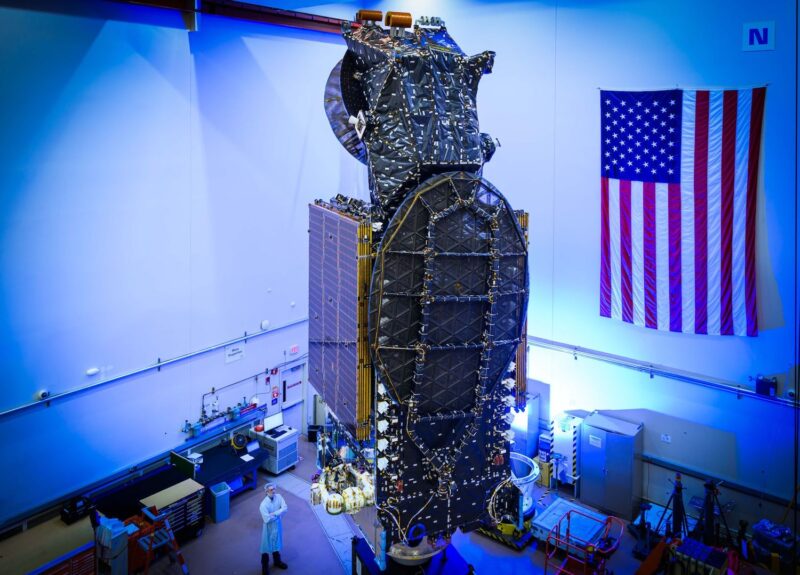
[Satellite TODAY Insider 09-09-11] After a series of frustrating setbacks and delays beyond its control, ViaSat confirmed Sept. 8 that the launch of its highly anticipated ViaSat-1 high-capacity satellite is now scheduled for mid-October.
ViaSat said the final clearance to launch ViaSat-1 would be issued next week, following a review of the investigation conclusions by a Failure Review Oversight Board (FROB) to be conducted Sept. 8-9 in coordination with its launch provider International Launch Services (ILS). ViaSat-1’s manufacturer Space Systems/Loral has completed construction and testing of the satellite and is preparing the spacecraft for a Sept. 13 shipment to the ILS launch base at the Baikonur Cosmodrome in Kazakhstan.
The launch was originally scheduled for Spring 2011, but was pushed back to the end of summer. The mission was delayed a second time when a solar array onboard the Telstar 14R satellite failed to fully deploy following its launch in May. Telstar 14R, like ViaSat-1, was built by SS/L using many of the same solar array elements. In January 2011, ViaSat-1 was damaged while being moved for testing by its manufacturer Space Systems/Loral, causing management to push out the expected launch date from spring 2011 to summer 2011.
The latest delay, which pushed the mission back from the end of September, was due to the Russian Space Agency’s (Roskosmos) Proton-M rocket launch failure last month that placed the Express AM-4 communication satellite into a bad orbit and caused the satellite to lose connection with its ground station. Immediately after the failure, the Russian Inter-Agency Commission conducted a formal investigation into the cause of the failure, which temporarily grounded the Proton-M. Roscosmos recently lifted the ban on Proton/Breeze M launch processing during the last week of August following the completion of that investigation.
The setback took a toll on the ViaSat’s 2011 first quarter net income, which dropped $3.26 million from the same period last year to $1.76 million. In a statement, ViaSat CEO Mark Dankberg said the results were anticipated as “revenues and earnings reflected new contract delays in prior periods and costs associated with the ViaSat-1 launch schedule.”
ViaSat-1 aims to provide satellite broadband capacity to allow Internet access during the next decade and enable satellites to compete with terrestrial alternatives. The high-capacity Ka-band spot beam satellite has planned coverage over North America and Hawaii, to support high-speed broadband services for WildBlue in the United States and Xplornet in Canada.