By John Quale, Brian Weimer, and John Beahn
On November 20, 2003, the Federal Communications Commission (FCC) released a notice seeking comment on the feasibility of implementing a so-called "interference temperature" model for quantifying and managing interference. The new approach to interference management would fundamentally alter the FCC’s policies by focusing on the actual radio frequency interference environment confronted by receivers rather than focusing on transmitter operations. Interference temperature is of particular importance to the satellite industry because the FCC has proposed to introduce the concept first in frequencies where Fixed Satellite Service (FSS) uplinks are the predominant use, namely, portions of the C- and Ku- band. If the proposal moves forward, a large number of unlicensed devices would be permitted to operate in the target bands with EIRP emission levels "possibly as high as 30 dBm to 36 dBm (1-watt to 4-watts)." While only a proposal at this point, satellite industry observers are understandably concerned about the implications interference temperature concepts have for satellite operations in the C- and Ku- uplink bands.
Background. The FCC’s Spectrum Policy Task Force first raised the possibility of an interference temperature model as one of several potential spectrum policy reforms it released last summer. The interference temperature model is intended to provide a more accurate measure of interference by taking into account the cumulative effects of all unreserved RF energy in a given environment. The FCC believes that an interference temperature approach could be superior to its traditional focus on transmitter operations because it may facilitate increased use of licensed spectrum by unlicensed devices and also provide greater protection and certainty for incumbent licensees by more accurately measuring actual interference in a given RF environment. The concept of interference temperature, however, is controversial with some industry observers who argue that the system is unworkable and infringes substantially on existing licensee’s operations.
The Need for Flexibility. The FCC’s current spectrum regulations manage interference by strictly regulating the power and emissions from transmitters, and by specifying the operational parameters of services operating within a specific spectrum band. In their present form, however, the FCC’s regulations do not measure the actual interference in a given RF environment. According to the FCC, the cumulative effect of the dramatic increase in the overall use of spectrum (especially unlicensed spectrum) has strained the effectiveness of the current policies. To remedy this situation, the FCC proposes an interference temperature regime to measure more accurately the actual interference in a given environment.
Under the FCC’s proposal, the interference limit (or interference temperature) in a specific spectrum band would represent a cap on the total RF energy that could exist in the band. Measurement devices would calculate in real time the actual interference in their location and transmitters would ensure that their operations are within the applicable limits. Most importantly, if the permissible interference temperature in a certain band is not exceeded, existing devices could operate at higher powers or other devices (either licensed or unlicensed) could be introduced into the band. The FCC believes that this system would be a more flexible and market-oriented approach to spectrum management and would stimulate the development of unlicensed technologies.
Structure and Operation of an Interference Temperature System. The FCC seeks comment on how an interference temperature system would operate. In this regard, the Commission asks for input on whether an interference measurement scheme should operate on a single site or multi-site basis. Under the single site approach, the entire process would occur within a single device, which would measure the interference temperature at its location in real time and make a transmit/no transmit decision based on its measurements. In the multi-site approach, monitoring devices would measure the interference temperature at various locations and forward this information to a central location that would aggregate the measurements to create the interference temperature for a given area. This information would be broadcast throughout the entire area to compliant devices, which would then restrict their level of operation as necessary.
The FCC also requests further comment on the actions that devices subject to the interference temperature limits should take if the applicable limit is exceeded. The FCC theorizes that in the single site approach, a device could select a different transmitting frequency, cease transmitting altogether, reduce transmitting power, or change the direction or shape of the transmit antenna pattern. In the more complex multi-site system, the FCC suggests that devices could cease all undesired transmissions, limit the number of devices that could transmit at a specific power level, or restrict the operations of undesired transmissions to certain areas.
FSS Uplink Spectrum Targeted. The FCC proposes to introduce the concept of interference temperature in frequency bands where the predominant use is FSS satellite uplinks. In particular, the FCC identifies the 6525-6700 MHz band and the 12.75-13.25 GHz (excluding 13.15-13.2125 GHz) band as a potential "test bed" for interference temperature concepts. The 6525-6700 band is allocated on a primary basis to FS and FSS (uplink) international and domestic operations for non-federal governmental uses. The 12.75-13.25 GHz band is allocated internationally and domestically to FS, FSS, and mobile services for non-federal governmental services on a primary basis and for federal and non-federal governmental space research on a secondary basis.
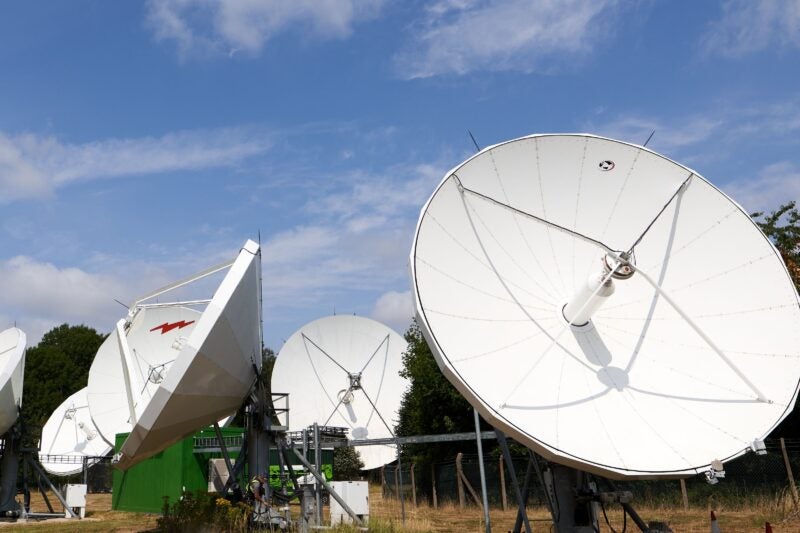
The FCC notes that for satellite uplink frequencies the licensed receiver being protected is located on the satellite in space. Accordingly, the receiver is not in close proximity to any potentially interfering unlicensed device. Given that satellites are located a great distance from the surface of the earth, the satellite receiver would essentially "see" the cumulative effects over CONUS of all unlicensed operations in the band at issue. Thus, the FCC concludes, it is possible to develop a simplified interference temperature approach without the need for adaptive, real-time monitoring that would be used in a more robust interference temperature model such as the multi-site approach described above.
More specifically, the FCC notes that the typical satellite receiver noise temperature is a known parameter that can be used to determine an interference temperature threshold. In this regard, the FCC looks to the [Delta]T/T criterion used by the International Telecommunications Union (ITU) to determine whether satellite coordination is required. The [Delta]T/T threshold that triggers the need for co-primary satellite services to coordinate is set at 6 percent. The FCC characterizes its proposed use of a 5 percent [Delta]T/T limit for the interference temperature as "conservative" (i.e., more protective). From this 5 percent limit, the FCC tentatively concludes that "a reasonable interference temperature limit in [FSS uplink bands] might support unlicensed operations with maximum transmit powers possibly in the range of 24 dBm to 30 dBm and EIRPs in the range 30 dBm to 36 dBm." The FCC sets forth the details of its analysis in a satellite link budget analysis appended to the notice.
Comments on the FCC’s notice will be due 75 days from its publication in the Federal Register, which has yet to occur. Given the potential impact the FCC’s proposal could have on core satellite operations, the proceeding will be closely watched by satellite industry observers.
John Quale, Brian Weimer, and John Beahn are attorneys in the Washington, D.C. office of Skadden, Arps, Slate, Meagher & Flom LLP. Mr. Quale’s email address is jquale@skadden.com; Mr. Weimer’s email address is bweimer@skadden.com; and Mr. Beahn’s email address is jbeahn@skadden.com.