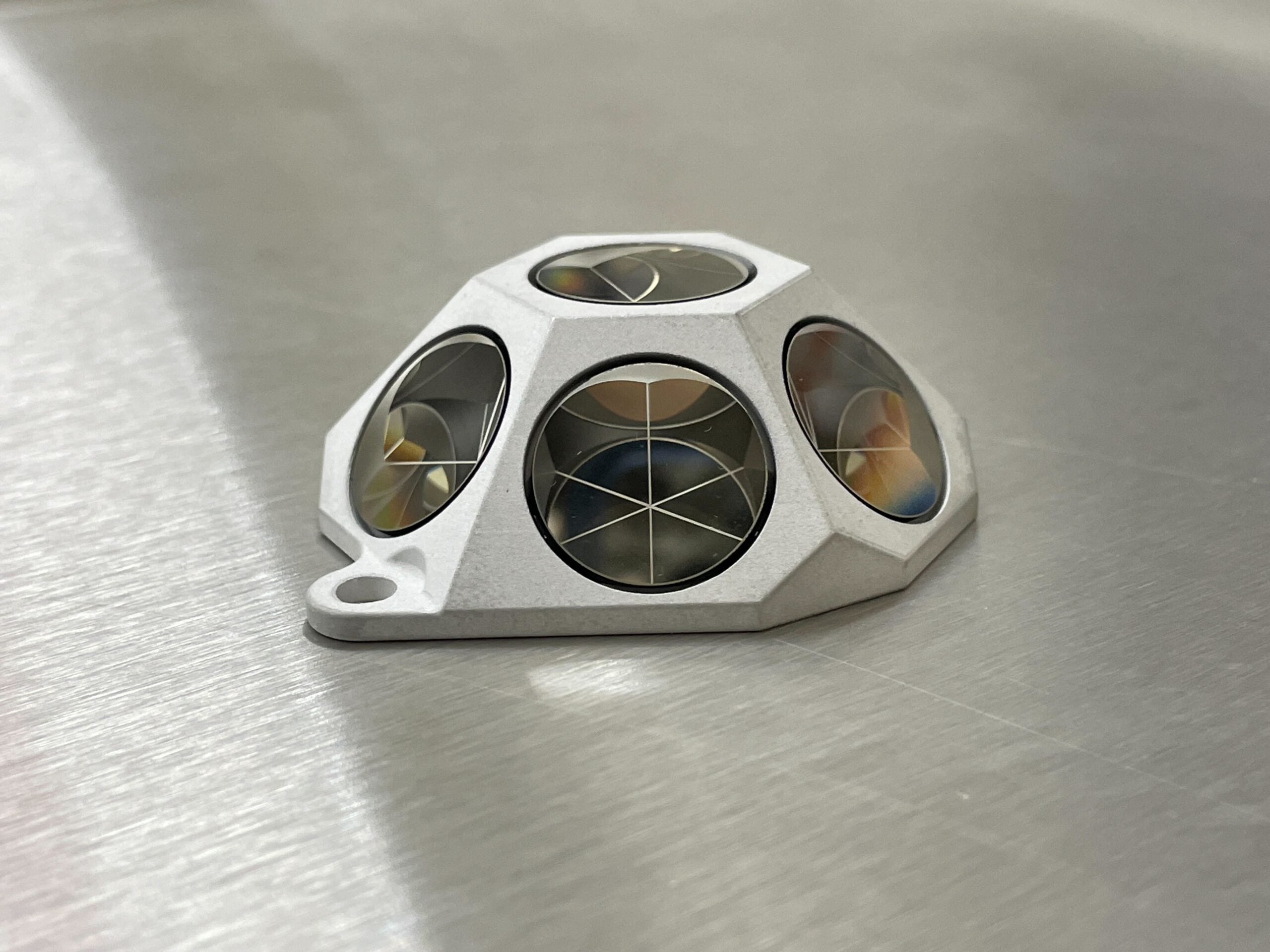
BREMEN, Germany –Foundational.Space has developed an in-orbit optical satellite tracking technology, the Retro-2 laser retroreflector, reporting the tech recently demonstrated laser ranging signals in space.
London startup Foundational.Space emerged from stealth in early October with 8.2 million pounds ($10.8 million) in pre-seed funding, and announced the laser retroflector on Tuesday during Space Tech Expo Europe.
“Laser ranging is the gold standard of measurement in the space situational awareness realm,” Arthur Cunningham, principal space systems engineer at Foundational told Via Satellite. “It is inherently more accurate than radar or optical due to the physics involved. Precise tools such as the Retro-2 can be used to calibrate other measurements and improve the data that we are seeing.”
Retro-2 does not require electronics, power, or command from its host spacecraft. The device weights just 50 grams (1.76 ounces) with a 160-degree acceptance angle meaning ground stations can connect to them and track data from near the horizon to overhead without it needing to point at the planet.
In the demonstration mission, Foundational recorded 6,111 laser returns from Retro-2 across five passes at distances of 609 kilometers to 866 km, establishing a single-shot ranging precision of 4 millimeters, measuring across 5-second intervals. That means ground control was able to achieve an average uncertainty of just 0.6 mm.
Cunningham sees the technology as complimentary to those that are already being put to work.
“In-orbit space domain awareness (SDA) is an augmentation rather than a replacement,” he said. “Satellites travel at 7 kilometers per second each, so trying to image something that’s flying by you at that speed or accurately detect, or understand its trajectory, is a very tall order even for state-of-the-art sensors. Those space-based platforms also need precise domain awareness on their location to even have a stab at determining where other objects are, so it’s a combination of systems.”