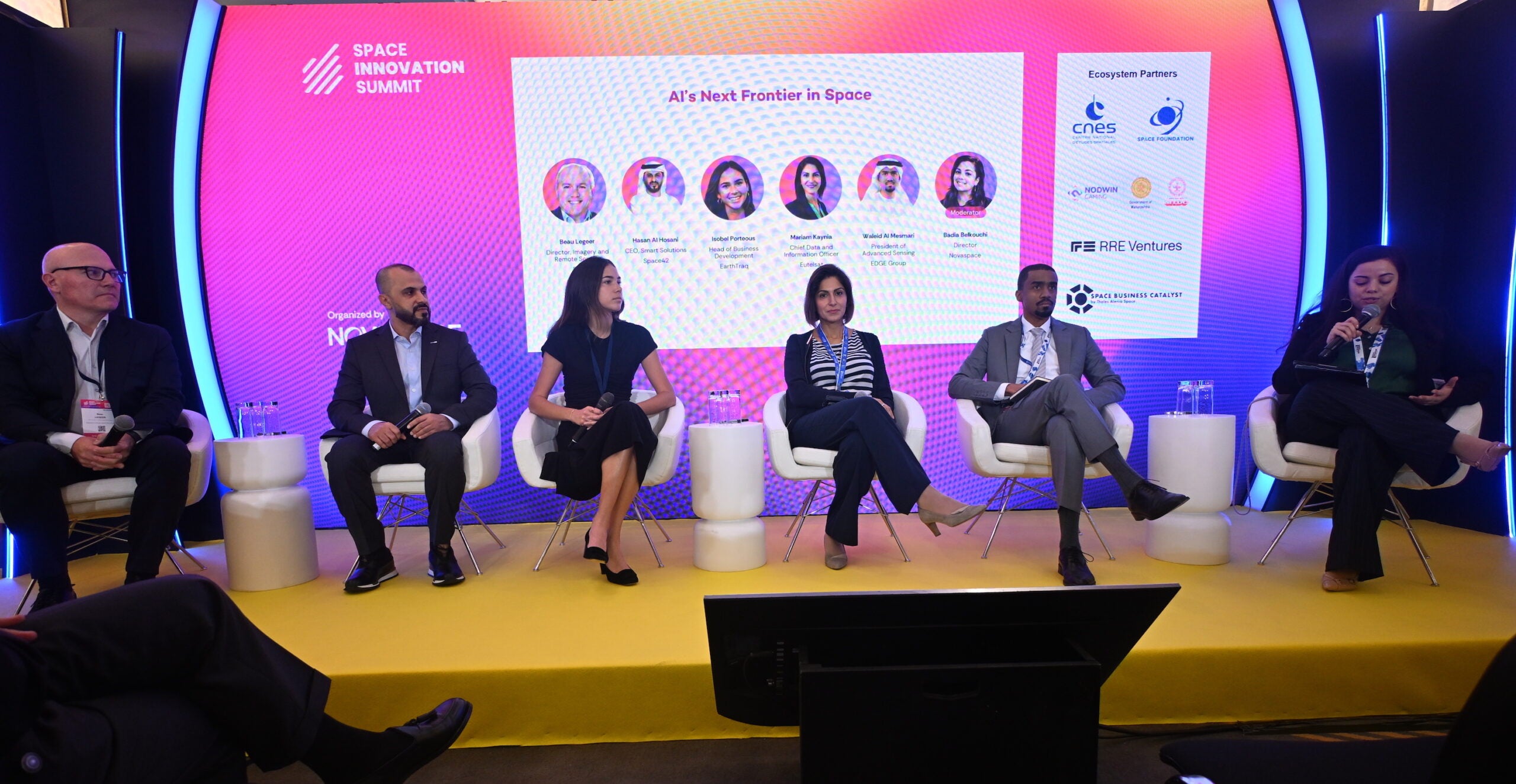
PARIS – New AI tools are opening the opportunity for more people to get involved when it comes to AI and space. Over the past year, AI has moved from a specialized analytical tool in the hands of the few to an embedded tool in the hands of many, Eutelsat Chief Data and Information Officer Mariam Kaynia said in a discussion Wednesday at World Space Business Week.
“It allows more end-to-end work rather than just specific optimizations,” she said. “The foundation models are changing. You can operate with more data, get better insights. You can easily communicate and ask questions. The agentic aspect also allows for more autonomous work. It has really moved over to autonomy where the human is more of a supervisor. AI can define the actions on a satellite.”
Beau Legeer, director of Imagery and Remote Sensing for Esri, agreed and said the industry is lowering the barrier of entry and expanding market reach. Legeer added that whatever you do downstream is where you can get a competitive advantage. “AI is definitely going to penetrate space and operations first. Downstream is really more important and we need to drive an alignment of the models. There has to be an alignment function. We need to have somebody there to see that the AI intent is the human intent.”
Isobel Porteous, head of Business Development for EarthTraq, an exciting newcomer in this arena, spoke of a couple of different impacts of AI. “We are putting AI co-processors on the spacecraft and doing much more dense computing in orbit. They are making much better use of the sensor suite on board. As a result, we are able to build a more efficient pipeline. Data is the most important currency. Customers are seeing a new kind of need for space data. For the first time, the insights of our data are accessible to a larger community, and we are opening up to larger customer sets outside of the space industry.”
Waleid Al Mesmari, president of Advanced Sensing for The Edge Group, said there is a vast amount of data to be analyzed and harvested into actionable intelligence. “AI helps in turning it into an action. On-board AI processing is the place where the technologies are being hosted on the satellite,” he said.
Taking the Lead
Kaynia believes AI is starting to go more into the lead. She said she sees humans becoming the supervisor, but importantly that you will still need humans behind the scenes. She said, “You still need to do context engineering, training of the models, adaptations etc. There is a lot of need for humans in the loop. AI is now starting to take the decisions and the actions. But you need someone to validate it.”
Space42 has been a pioneer in the AI arena. Hasan Al Hosani, CEO of Smart Solutions, Space42 talked about the latest developments at the company and how it is using AI. He said the company’s focus is now more on the downstream side, and that with AI, it can infuse data in a very fast way. Hosani spoke about how the process from acquisition to report is much faster. “When you have a large pool of data on the ground, we are leveraging AI to have predictive analysis,” he said.
When asked for specific examples he spoke about how AI in space can help in areas where there are natural disasters. “Here, when we leverage all of this data, we can link the data and have predictive analysis on the situation, as well as courses of action. When you look at post-analysis, the impact of an earthquake, for example, the analysis comes much faster with the use of AI,” he said. “We want something that adds value, going beyond the common ML processes in understanding the data. Can I derive more information from the scene? How I can understand the whole scene? AI then becomes much more part of operations.”
Sovereignty Concerns
One of the big questions on the panel was looking at sovereignty in space and the impact of AI here. Legeer said, “I think it is important to own and control your assets. It used to be a sense of national pride. Now it is a national strategy.”
Kaynia thinks the definition of sovereignty is changing and evolving. “It was a lot about owning the satellite and the infrastructure. Now, it is about the trust. We have different sovereign countries. It is more about how you embed their requirements into your services. It is not an easy job. Every single country is looking to do this,” she said.
Hosani added when talking about sovereignty that he believes it is more about business continuity, and that this consistency of dataflow improves the competence and assets. “We have launched our first SAR constellation. Here, we talk about that data consistency coming in. It is more about preserving continuity, so we can evolve with AI. We want to build our capabilities on the downstream side, moving from information to knowledge to conviction,” he said.
Porteous added that she thinks many new actors are going to be able to work in the domain with AI tools, when it comes to sovereignty. “So many people can learn how to build spacecraft,” she said.